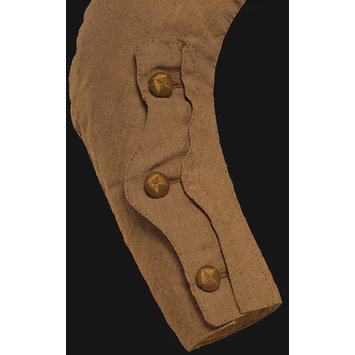
The follow-up to my earlier post about 18th century riding habits! Here are images from post-1770. Nearly all are riding habits, but a few redingotes slipped in.


Fashion Historian & Historical Costume Maker
The follow-up to my earlier post about 18th century riding habits! Here are images from post-1770. Nearly all are riding habits, but a few redingotes slipped in.
*Yes, “habitses” like “Hobbitses.”
As I’ve had 18th century riding habits on the brain for a while now, with my upcoming trip to Colonial Williamsburg (or, as I termed it to Cynthia the other day, “18th Century Disneyland!”), I thought I’d share some images and research! I do like a good image/source hunt, after all.
The best source that I’ve found thus far is: Blackman, Callie. “Walking Amazons: The Development of the Riding Habit in England During the Eighteenth Century.” Costume, Vol 35, 2001.
Riding habits were long worn as functional dress, but in the second half of the 18th century, they became fashionable dress as well. In addition to riding and hunting, they were worn for travelling, walking, visiting, and at home wear — in other words, informal day wear.
Stylistically, they tended to follow men’s clothing, and you will see cuts/fabrics/trims that are popular in men’s clothing show up in women’s riding habits of the same era. One area that you’ll specifically see this in is the cut of the waistcoat, which has long “skirts” in the 1750s-60s, but a simple V front in the 1770s.
From what I can tell from looking at LOTS of images, it appears that they could be worn over hoops from about the 1730s-50s; by the 1760s, it appears that they were generally worn over just a petticoat (or perhaps small hip pads?). Waistcoats cut to fit over hoops had a seam at the waist, and opened into an inverted V (from waist to hem), to allow for hoops.
Habits were generally made by tailors (rather than mantua makers, who made women’s dresses), and thus were constructed like men’s wear. According to Blackman, they “invariably buttoned left over right.”
There were a variety of sleeve treatments, including cuffs, flared end, and the mariniere sleeve. Pockets could be functional or false. Early styles had simple or no collar, while later on deep revers and high collars were popular. Waistcoats could either be separate garments, or a false front sewn into the jacket. The petticoat was cut simply, with pleats concentrated at the sides (1730s-70s) or back (1780s-90s).
There were a wide range of colors possible. If it was intended primarily for riding or hunting, it was often red, navy, or green. Habits meant more for fashionable wear could also be in other colors; blue, brown, beige, yellow, and even white were popular. Fabrics were usually wool or a wool/silk blend, although there is a 1780s riding habit at LACMA that is in silk faille.
The wars of the 1770s made it fashionable to have a military look to one’s riding habit. Red was increasingly popular (I assume modeled on the British army uniform?). Habits were made to look like the uniforms of specific regiments.
By the 1780s-90s, women increasingly wore the redingote, which was styled on the Englishman’s greatcoat, although you still see riding habits pop up.
Habits were worn over “habit shirts” (see Nicole’s post for a great rundown of this style) and neckwear (cravats, stocks, or kerchiefs). Hats varied by era; tricorns were worn by English/American women only in the first half of the 18th century (but continued to be worn by Continental women — see the portrait of Marie Antoinette from 1771), followed by jockey caps in the 1760s, high crowned hats in the 1770s-80s, and tall, cyclindrical hats in the 1790s.
I recommend reading Nicole and Carolyn‘s riding habit project overviews for some nice details and construction info.
Today, part one of my giant vat o’ riding habit sources! Part II coming next week.




There’s nothing like knowing that a Really Good costuming book is coming out. Having FOUR to look forward to? I may need a chaise lounge and a fan!
[Full disclosure – I’m an Amazon Associate, so the links to the books below take you to Amazon and will give me like $.02 (and support this site) if you buy from them. If you’d prefer not to support this site, don’t buy from these links!]
First, there’s Fashioning Fashion: European Dress in Detail, 1700 – 1915
Then on Nov. 1, 2010, our friends the Victoria & Albert Museum will be releasing Underwear: Fashion in Detail and Toiles de Jouy: French Printed Cottons, 1760-1830
Finally, on April 1, 2011, the V&A will do it again with Seventeenth-Century Women’s Dress Patterns: Book 1 (thanks to Catherine for the heads up!). I’d heard a while ago that they were working on a book related to 17th century costumes — they’d taken down some pieces from exhibit for the book — but I’d forgotten about it until Catherine emailed me yesterday. According to the book description, “This breathtakingly detailed book presents dress patterns, construction details, embroidery and making instructions for fifteen garments and accessories from a seventeenth-century woman’s wardrobe. Full step-by-step drawings of the construction sequence are given for each garment alongside photographs of the objects and the groundbreaking use of x-ray photography revealing the hidden elements of the clothes, the precise number of layers and the stitches used inside.” I am SUPER excited about this, after making my Nell Gwyn dress (altho I’m also grumbly, because how helpful would this have been?). Oh well, I’ll just have to make another 17th century gown! I’m also excited about the “Book 1” in the title — does this mean we can anticipate MORE 17th century costume books from the V&A? Be still my beating heart!
Karen Larsdatter, creator of the amazing Medieval & Renaissance Material Culture directory, has applied herself to a new era with the 18th Century Clothing Notebook. It’s an amazingly extensive directory of links on all sorts of fiddly bits related to 18th century costume. As someone who up until recently tried to maintain something like this (the Real Women’s Clothing Directory), my hat is off to her — this is an AMAZING amount of work, and a hugely valuable resource!
So I have been to the UK many times — I studied abroad in Scotland in college, and I’ve probably spent a combined 3 months in London. Which means that while I’ve done most of the London museums multiple times, I haven’t spent much time in England beyond London… which means that there are many interesting costume museums I’ve never visited! Which is all to say that a large point of this trip was to hit some out of the way museums.
I did go to the V&A to meet up with Kate, Christina, and Leia. Leia had never been, so we did go through the costume wing, but we spent more time in the new Medieval & Renaissance galleries and in the Textile Study Room. There was lots that was interesting, but highlights for me included seeing this Florentine bust in person — it is great to see a 3D view of mid- to late-16th c. Italian fit. There’s a nice curve to the bustline, and the neckline comes up past the bust point… and check out the waistline wrinkles, consistent with a bodice that’s stiffened with heavy fabric but not boning!

In the Textile Study Rooms, I bypassed the embroidery to look at the printed cottons, but luckily Kate mentioned this pair of mid-18th century jumps. One whole front was there — I think it had never been sewn together? And the teeny tiny embroidery stitches were absolutely to die for — maybe like 20 stitches to the inch?

Blaise Castle House Museum had a couple of nice rooms full of period costume (altho heads up, they had some signs up that they’re working on a [late?] 20th century exhibition – sigh). Probably the best moment was looking at this Charles Worth gown, when some very small (ages 5-6?) children ran in. Boy #1: “Is this what they wore in the Victorian era?” Boy #2: “Yes.” Boy #1: “NASTY.” My husband and I ran around saying “nah-sty” for the rest of our trip.

I happened to check out the Royal Albert Memorial Museum website, and saw they were doing an exhibit at the Lawrence House Museum in Launceston… otherwise I wouldn’t have known to stop in! This gown, from their regular display, is signed as being from the 1880s, but I say it looks about 1908ish.

The special exhibit, “Curious Curves,” would have been very cool if I wanted to try on reproduction period undies (bustles, panniers, etc.), but turned out to only have one extant dress on display — this late Victorian beaded number.

Killerton had a lovely exhibit called, “Elegance,” which included a number of really fabulous items. These pair of leather 18th c. stays had me peering up close for a while…

…and this 1770s sacque, with teeny tiny ikat pattern, was just gorgeous in person.

I was super fortunate to have a study appointment with the curator of Killerton and the Royal Albert Memorial Museum. I was looking at late 18th century gowns, and was super excited to find one in the particular style I’m researching, plus to look at a lot of other pretties. Unfortunately I can’t post pictures of any of them due to copyright.
I did find out that they recently photographed all of their collection, which will eventually (in a few years?) make its way onto the National Trust website. I don’t know if this means that other National Trust collections are also being photographed?
Many small museums that I didn’t think of as “costume museums” had period costumes on display. The Sidmouth town museum had this lovely fan front taffeta 1850s dress.

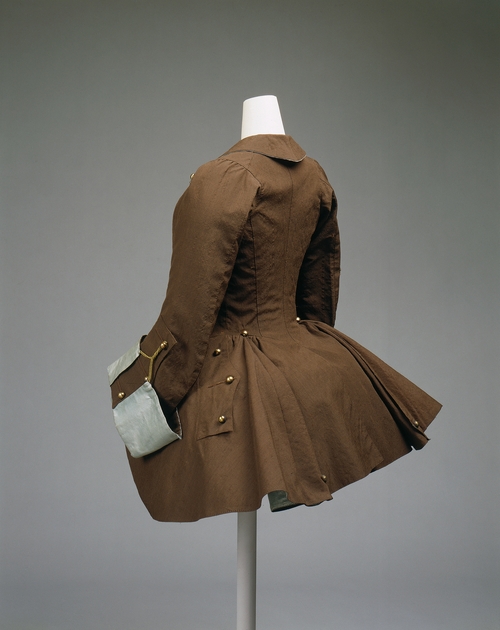
Chawton, Jane Austen’s home, was really really cool. REALLY! The jacket is from Mrs. Austen’s riding habit, which was recut by younger family members for fancy dress. And the quilt on the bed was made by Jane and Cassandra (and Mrs. Austen?) out of dress scraps.

Finally, the Winchester City Museum had a display of Tudor costumes recreated by Herbert Norris (author of Tudor Costume and Fashion) in 1908 for a town festival. I thought some of you 16th century costumers might like to see what he came up with!

All in all, it was a lovely trip, and I’m glad I got to cross so many small but interesting museums off my list. If you’re interested, you can see the full set of travel photos (including many from museums, but also just my general travel photos too) on Flickr.