New Research Article: 18th Century Hair & Makeup

So, I do tons of research.  All the time.  And I realized that I don’t tend to post too much of it anymore!  In an effort to rectify that, I’m going to take some of my teaching materials and put them together into articles & get them online.

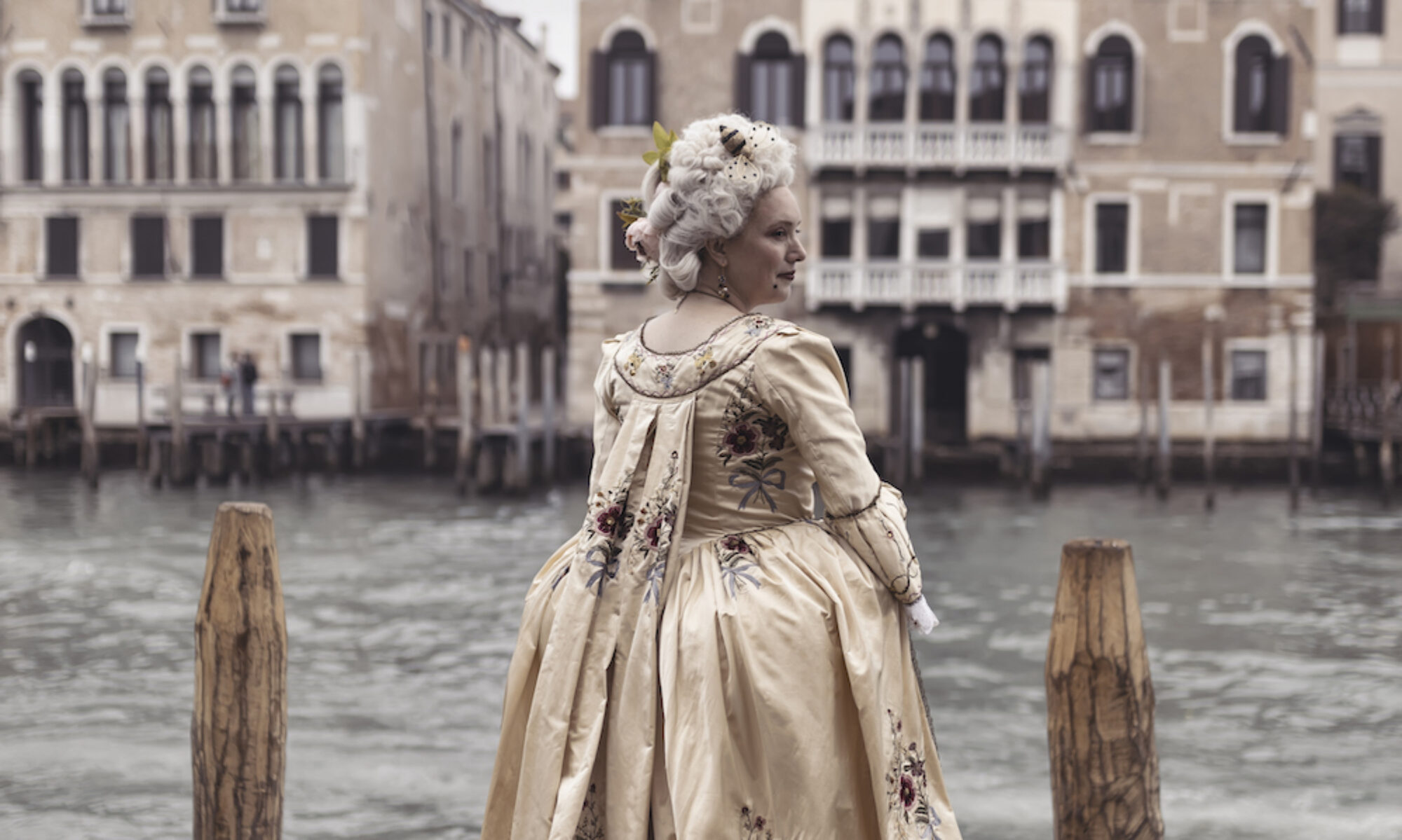
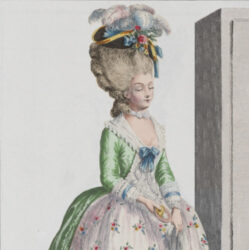
My first effort:  Women’s Hairstyles & Cosmetics of the 18th Century:  France & England, 1750-1790.  This discusses both what they did in the period, and the general looks of the era to aim for in reproduction.  I’m contemplating adding an image gallery with more examples of hair &  makeup looks from the period — let me know if anyone is interested.

Edited to add:  I found it particularly fascinating to find that women in the 18th century DIDN’T usually wear full wigs, as that’s what I’d always assumed, and in fact been told by Those Who Should Know.  Which explains why you don’t see obvious wig line in portraiture.  And will make me stop feeling non-period when I incorporate my own hair into my wigs!  I’m not giving up on the convenience of wigs, tho — they make getting ready for an event SO much easier.

If this seems useful, let me know and I’ll put up more!  Other things I could pull together easily are:  Venetian Renaissance (probably not needed, given the fabulous Realm of Venus site), and an overview of 1830s fashions.  I’d also like to do more research on 17th & 18th c. beauty patches and 18th c. court dress.  There’s lots more percolating in my brain/on my hard drive, but it’ll take a bit more time to pull those off!

Probably Covered Before

So apologies if this is old news…

In the age old “did Venetians fake the camicia underneath the CF/ladder laced bodices” debate — check out this painting by Montemezzano (done between 1560-1610).  It looks to me very much like she is wearing a faux-camicia, given the strong line at the top and how it looks like it’s folding over; with a real camicia underneath.

Of course, I don’t think this is at all evidence for corsetry, or even evidence of anything beyond, “Hey, this one painting suggestings a false front.”  But I do think it lends credence to the possibilty of an under-kirtle, bust band, or something (maybe even just the real camicia) that is being covered by a false camicia front.

I May Need to Move to Spain

Valencia, specifically.  So, I am forcing myself to Stay On Target and am starting the Maja dress!  What, you may be asking, is this?  Oh, only a costume that I’ve been saying I’m going to make for about three years.

To recap:  it’s a mid-1770s (c. 1773?  1775?  I’ve seen conflicting dates, gotta look into that more) portrait of the Marquese de Llano wearing a masquerade costume of a Maja.  Majas/Majos were working class people who lived in Madrid in the late 18th and 19th centuries.  They spoke “pure” Castilian, wore elaborate outfits, and had a general swagger and bravado that captured the imagination of Spain.  In time, their clothing became adopted as the national traditional dress of Spain.

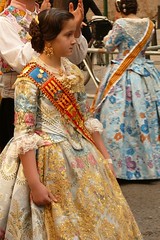
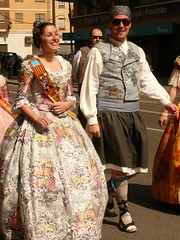
So in doing all this research on the style, I found a ton of cool resources, and then stumbled across Las Fallas, which is a big annual festival held in Valencia.  Why is this exciting?  Because they wear E-LAB-ORATE “traditional Spanish dress”… which is based on late 18th century Maja costumes.  Of course, it’s morphed over time, but it is totally gorgeous.  To wit:

Fallas Valencia 2010 (95)

Fallas Valencia 2010 (71)

Fallas Valencia 2010 (133)

Fallas Valencia 2010 (94)

I mean seriously, where do I sign up???  The hair!  The jewelry!  The fabrics!  The 18th c. silhouette!  Aiee!!!

There is, of course, a whole industry in Valencia around these costumes… but a whole lot of searching later, and it looks like not much of it is online.  Bah – I had gotten all excited about buying some shoes, like these (and I think Trystan needs these!).

New Digital Collections of Extant Costume

Some fabulous new resources for tracking down extant costume info/pictures online have been added to the Digital Collections of Extant Costume directory:

Europeana — cross-museum search; art from various European museums.  I recommend searching both in English and in other European languages.  So far, not too impressed by their “narrow by date” options — I recommend instead searching by century, and then again do it in various languages (example:  18th; 18e; settecento; XVIII; etc.).

Esbirky — Czech cross-museum search.  Click here to specifically to see the historical costume items in the database. Thanks so much to Hana Marmota for not only finding this, but figuring out how to use it!

Museo San Telmo Museoa in Spain — a few costumes in their collection highlights.

Texmedin — Spanish cross-museum textiles & apparel database.  New items still being added, so check back on this one periodically.

Indiana State Museum — thanks very much to The Dreamstress for finding this one!

Costume Accessories Exhibition

First, thanks to everyone for your kind words about my riding habit and Brunswick!  I really liked them, and I’m happy that you liked them too.  (I mean, what if I had horrible taste?)  I’m still irritated about the giant bust wrinkle on the habit, but oh well!

So, now I want to post about the Costume Accessories exhibition (next post, the symposium)!

The exhibition was really cool.  Not huge, but big enough.  What I really liked was that precisely BECAUSE it was focused on accessories, it made me notice tiny details that normally I would miss because I’d be looking at overall gowns/outfits.  A lot of people have been posting photos from the exhibition, so search around on Flickr if you’re interested; here are some of my highlights:

(Note for those reading on the LJ feed — LJ drops my image captions, so you may want to link to the post on my site if you’re interested in reading the notes that go w/ the photos!)

These photos and more from the exhibition can be found on Flickr.