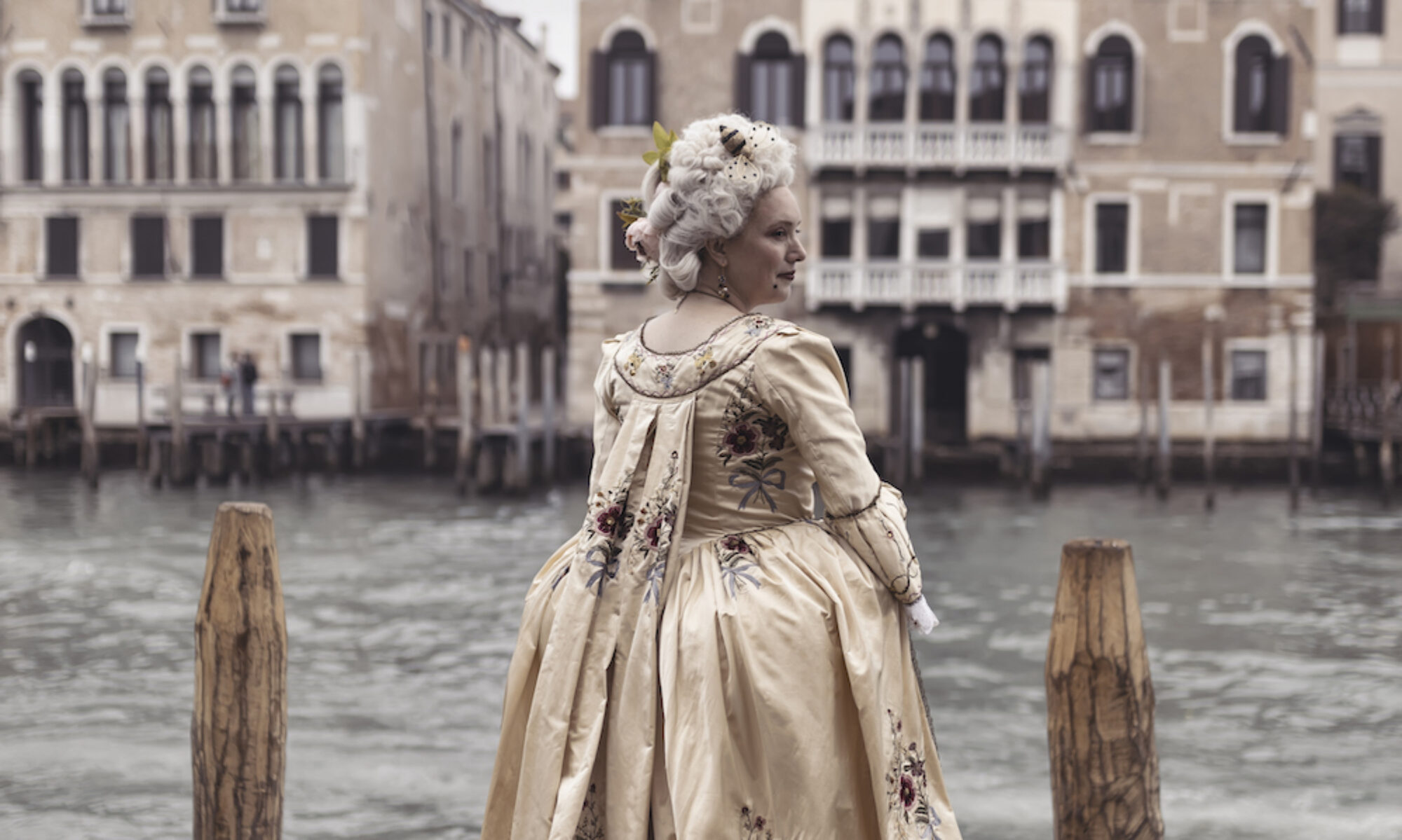
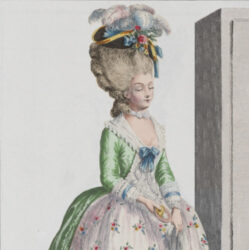
I decided to post the article on 1912 evening wear for men and women that I wrote for GBACG’s newsletter to my Fashion Trends for Winter/Spring 1912 page. I’m super excited about the upcoming Titanic Dinner that GBACG is putting on — can you tell?
Copyright for Costumers
Trystan has written an excellent primer on copyright for costume bloggers that’s worth checking out. It’s a good rundown on the essentials and can help us all determine what’s legal to post and what’s not.
And while we’re on the topic… I want to boost the signal on one particular portion: crediting others for their work. I can’t tell you how many times I’ve seen people post about something online that they’ve made or “researched” and I just KNOW exactly whose work they’ve used — without crediting the person who originally came up with the technique/did the research. It sucks, because it can make the original maker/researcher feel like not sharing their techniques/research if others are going to essentially appropriate it — take the credit for all that hard work.
Nobody’s perfect, and sometimes we just plain forget, but if you try out somebody else’s technique, drop a mention! Even if you improved on it; you can say “I started with Jane Costumer’s tutorial, and found that if I did X differently it worked better for me!” If you draw on somebody else’s research, just add a mention — “Jane Costumer’s article on Obscure Hat from Obscure Town got me thinking…” One way I like to do this is to have a “Useful Links” section on my project pages — I can just list the sites that I found useful, and I know I’m covering my bases.
Costuming is a small world. When you DON’T give a shout out to others for their work, we are all thinking, “Wait, hasn’t X done a lot on this?” or “Gee, it sure sounds a lot like Y’s research/method.” And it looks tacky, even if you didn’t MEAN to take credit for their work, we are probably thinking that you did… so to avoid looking tacky, drop a quick mention and/or link and then you know you’ve covered your bases!
Lucas de Heere 16th c. costume illustrations
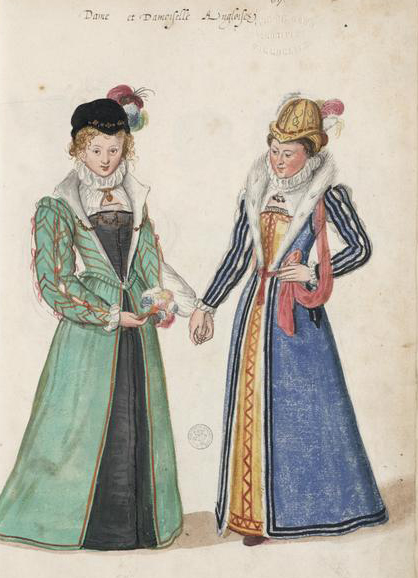
Researchers of 16th century English costume are probably familiar with Lucas de Heere’s sketch of middle and lower class London ladies (discussed here, higher resolution image here). It’s an important source, given that de Heere is documented as having actually BEEN in England when it was drawn, and it shows the common people. Most images depicting common people of this era are drawn/painted by people who may never have seen a commoner of whatever-country in their lives. There are a couple other famous-within-the-costuming-community images by de Heere: his images of Irish dress and his allegory of the Tudor succession.

About five years ago, I found some further images of Englishwomen by de Heere in a book on the Valois tapestries, but they weren’t the highest resolution and were only in black and white, which started me on a hunt to find more. It turns out that he published a costume book with a number of images I’d never seen. I found an online copy of a dissertation written somewhere in the Netherlands or Belgium which included all of the images, but the resolution was TINY. So, every year or so I’d do some poking around and hope to find an online or print source with usable images. And today I found it, digitized at the University of Ghent!
There’s a lot that’s in it that I think will be very interesting to 16th c. costume researchers. The book is a mix of representations of historical and contemporary dress. Some of the illustrations are probably pretty accurate, and some may be completely made up. However, there are enough images that are likely to be correct to make it a great source for costume research, and importantly costume books like this often served as models for future painters (ie an artist needed an image of some French peasants to fill out his/her landscape, so they’d copy those peasants out of a costume book).
Here is a link to the bibliographic data on the book, and here’s the scanned PDF of the book itself…. and here are some individual images from the book that I find most interesting!




For all those making Titanic-era dresses…
… for the upcoming anniversary! I just wrote an article on early 1910s evening attire for the GBACG newsletter, and as part of my research I went through all the issues of Vogue from January to March 1912 to see what trends would be up to the minute. Unfortunately, I ran out of room to include that information in my article, so I decided to post my notes in case they are useful to anyone. I also added a gallery of evening dresses featured in Vogue during the same period.
So if you’re interested, here you go: Fashion Trends for Winter/Spring 1912
JASNA NorCal Lecture by Me, Plus Champagne!
I’m vaguely organized enough to tell you that I’m giving a lecture on hairstyles of the Georgian & Regency eras on Dec. 10 in San Francisco, for the Northern California chapter of JASNA (Jane Austen Society of North America).
My talk will be:
“As Fashionable and Deceiving as Ever”: English Hairstyles in the Late Georgian and Regency Eras
The changes in fashion from the Georgian to the Regency will be traced, focusing on a changing hairstyles worn in England, and their social, cultural, and political context. From women’s gigantic “poufs” and men’s wigs of the late 18th century, through the “natural” and classical styles of the Regency, hairstyles underwent significant stylistic changes. These styles both represented the changes in politics and society and served as a locus for debate around issues of gender, class, and politics. This talk will trace the fashions in hairstyles from the late 18th century through the Regency Era, and analyze their perceived meaning and the debates around them.
There will also be other lectures, readings, brunch and high tea! If you’re interested in attending, the deadline to register is this Friday. Read more about it, and download the registration flyer.