New Project: 1770s Camisole à la Polonaise — and Forthcoming Research!

So if you’re an 18th century costume geek, you’ve probably noticed the discussions floating around about what is a “real” polonaise.  I’m excited to report that Brooke Welborn, the researcher who discovered that what many modern day historians were calling a polonaise was not the same thing as what eighteenth-century people defined as a polonaise, and I (who had been researching the very similar robe à la turque for a few years) decided to put our heads together and research and write an academic article on the topic.  It’s been accepted by Dress, the journal of the Costume Society of America, and will come out this May.  I plan to write a summary of our findings and post them here as we get closer to the publication date (as well as info on how to get the full article), but the in the meantime, here’s the two sentence summary — no news to those of you who’ve taken Brooke’s polonaise workshops through Burnley & Trowbridge, or been to my classes at Costume College, or read the various blogs mentioning our research:

In the eighteenth century, the “polonaise” was a term for a style of dress or jacket that was cut differently from the robe à l’anglaise:  it had a cutaway front, with the bodice closed at the neckline and sloping away into an inverted V shape (incorrectly called “zone”); the robe/jacket front and back were cut without a waist seam, with inverted pleats opening up from the seams, like a man’s coat.  The term “polonaise” was never applied to any dress worn with skirts looped up; these were called “retroussée” in French (e.g. robe à l’anglaise retroussée), with no specific equivalent term found in English (dresses were worn “back” or “up”).

So look for a longer summary in the next few months, as well as my research into that pesky term “zone,” which I would like to hereby banish from everyone’s vocabulary!

Of course, I’ve had to experiment with recreating this style — a few years back I made a proper robe à la polonaise, but didn’t blog it as the more information you put out there, the more likely you’re going to get scooped!  I will, however, post some more information about this dress as I get that research summary posted.

Now, I’d like to make a jacket version of this style, specifically this polonaise style jacket from the Musée Galliera in Paris, which I love for its froofy trim:

Caraco, entre 1770 et 1780. Musée Galliera, Musée de la Mode de la Ville de Paris. GAL1992.177.X.

I particularly love that if you look at the trim up close, you’ll see that it’s done in a windowpane cotton, while the jacket itself is in a solid:

Caraco, entre 1770 et 1780. Musée Galliera, Musée de la Mode de la Ville de Paris. GAL1992.177.X.

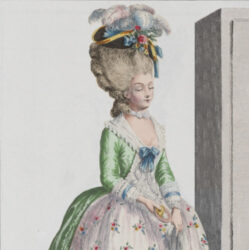
I’ve decided to fill out the ensemble based on this 1780 fashion plate from the Gallerie des Modes:

Camisole à la Polonaise, de Mousseline des Indes, doublée de Taffetas rose. Gallerie des Modes et Costumes Français, 31e. Cahier. 1780.

Specifically, the plan is a solid white cotton voile for the jacket and petticoat, with trim in a windowpane cotton.  The fashion plate’s dress is a sheer cotton lined in pink taffeta, an idea about which I started to get very excited, until I realized that I didn’t have any solid silk taffeta that I could use in my stash, I really shouldn’t go buying a bunch of silk taffeta given my current budget, and when I held up swatches under the sheer cotton the lining color didn’t show enough to make me love it as much as I did in the abstract.  So, I’m hoping I can maybe wear a colored petticoat from another outfit under the skirt, and of course a kick ass silly hat!

Next post:  draping and sewing the jacket!

Help Me Date Some Photos!

Late 19th/early 20th century is not my absolute forte, so I wonder if they are someone else’s!  I have some older family photos that I’d love help dating.  None of them have enough clues for me to figure them out on my own.

Mary Ridyard Daniels, born 1866, died after 1920. William Daniels, born 1850, died 1913.
Both were born and lived in England. They married in 1884.

Here’s where it gets tricky, because the rest are German/English circus performers

Simon Levy Blumenfeld, born 1828 in Germany, moved to England in the 1880s, died there in 1911. Wilhelmina Constance Blennow, born 1841 in Germany, moved to England in the 1880s, died there in 1915. The couple married about 1858. Performed throughout Western Europe.
Baptist Blumenfeld, born 1868 in Germany, died 1943 in New York. Performed throughout Western Europe and the United States.
Gertrude Daniels Blumenfeld, born 1884 in England, died 1944 in New York. Baptist's wife -- they married in 1910, she didn't start performing until after their marriage. Retired from performing in the 1920s.
Another shot of Gertrude.
The Six Salores: 1. Amy (aka Ruby) Simpson Blumenfeld (1886 England - 1963 US), wife of Paul Blumenfeld. 2. William Blumenfeld (1876 Germany - 1963 US). 3. Beatrice Daniels Blumenfeld (1889 England - 1983 US), wife of William. 4. Paul Blumenfeld (1874 Germany - 1963 US). 5. Gertrude Daniels Blumenfeld. 6. Baptist Blumenfeld. All three men were brothers; Beatrice and Gertrude were sisters. The act performed in England and the US from about 1910 through the 1920s.
Top row: Gertrude Daniels Blumenfeld, Beatrice Daniels Blumenfeld. In swing: Paul Blumenfeld. Laying across Paul: Baptist Blumenfeld. Hanging from Paul: William Blumenfeld. Again, must be between 1910 and the 1920s.

Can you spot any clues?

Guest Post: In Defense of the Use of Baleen in Hobbyist and Recreation Corsetry

Last May, I posted a review of Wissner boning (aka “German plastic boning”), and mentioned (okay, kind of ranted) that baleen wasn’t an option for boning as whales are an endangered species.  My friend and fellow costumer Sahrye emailed me privately with some very interesting information on whaling and conservation — she’s a marine biologist and so knows far more about this than I do.  I asked if, in the spirit of discussion, she’d be willing to share what she wrote with readers of my blog and she said she would.

So here you are, my first guest post ever, written by Sahrye — whose blog (It Came From the Stash!) is fabulous, by the way!

Continue reading “Guest Post: In Defense of the Use of Baleen in Hobbyist and Recreation Corsetry”

Powerhouse Museum Electronic Swatchbook

Thanks to Fran on the GBACGCostumers Yahoo group, I’ve discovered the Powerhouse Museum’s Electronic Swatchbook.  Swatchbooks were designed so that fabric manufacturers, agents and merchants could show samples of their fabrics.  The museum has scanned several from their collection from the 1830s through the 1920s.  What’s cool is you can not only browse by year but also by color.  The swatches themselves are scanned in high res and you can zoom in really closely.

A great resource for dating fabrics and identifying good reproductions!

18th Century Hairstyling Book?

So, a potentially crazy idea… A conversation at Costume College got me thinking about the possibility of writing a book on 18th century hairstyling (and makeup?) — using modern techniques to achieve a historically accurate look, working with your own hair, adding false hair, and wigs.  Now, this could be a lot of work, so it wouldn’t really be worth the time unless people would buy it.

Here’s what I picture:

  • Something along the line of Lauren Rennells’ fabulous book on vintage hairstyling
  • Start with some history, include lots of pictures and source material (if possible?  gotta look into that whole public domain images thing)
  • Go over some basic your-hair styling techniques, like ways to curl your hair, tease, etc.
  • Go over some semi-advanced wig/false hair styling techniques, like different ways to curl/straighten synthetic hair, ways to create volume, ways to create rolls, how to attach wigs/false hair to your head, how to match colors, how to not look like you’re wearing a Wig, how to adapt a wig for different hairlines, etc.
  • Step by step instructions that walk you through hairstyle for different eras — I picture 1-2 styles for each decade, with some info on variations
  • Hairstyles would be those worn in France and England (there’s some differences b/t the two, and lots of similarities) — the English stuff could be extrapolated to those doing American
  • Possibly 1-2 styles that are appropriate for lower/middle classes, but most would be upper class styles — I would talk about ways to tone things down if you’re doing middle class
  • Mostly I’m picturing this focusing on women, but it could also talk about men’s styles
  • Possibly including some brief info on creating an 18th c. makeup look using modern products
So, crazy idea or good one?  I’ve created a survey that I’d love if you would fill out so I can try to figure out 1) if there’s a market for such a thing, and 2) what specifics people would want.  Please feel free to share any thoughts in the survey or by commenting here — I wonder if people are concerned about geography, class, etc…. And my forte is NOT “here’s how this recipe from this 1764 beauty manual makes up,” so again, we’d be talking modern/theatrical techniques — would that work for you?
Please feel free to forward this survey around!  The more input I get, the clearer an idea I’ll have as to whether or not this is a viable idea.

Here’s the survey:  http://www.surveymonkey.com/s/KDVJZY7

And, in case you aren’t a regular reader of this blog, here’s some examples of hairstyles and wigs that I’ve done: