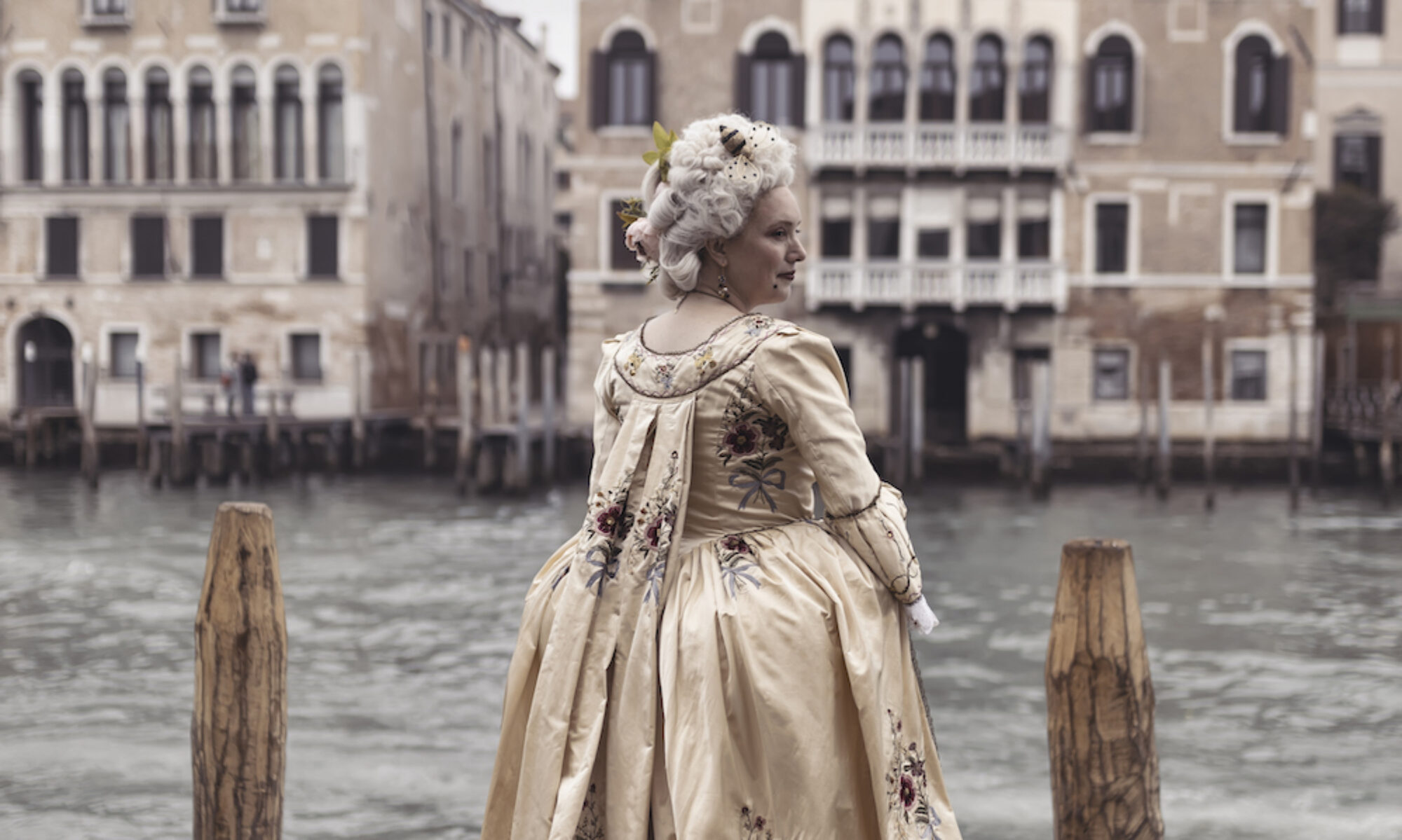
18th C Hair & Wig Styling book – new perks! Onward!

Pre-orders have been going great with the 18th C Hair & Wig Styling book — I’m just over 50% funded, with 19 days left!  BUT I still have a long way to go, and orders have really slowed to a trickle.  So to encourage more pre-orders, I’ve added some new perks to the Indiegogo campaign!  You can pre-order the book with one of these new perks, OR just buy one of the perks without the book (if, for example, if you’ve already pre-ordered the book):

DONATE WITHOUT BUYING THE BOOK:  A few people have requested this.  You can contribute any amount to the project by using the “Contribute Now” button, but to make it easier, I’ve set it up to easily donate either $10 or $20 to the book project without buying the book.  This gets you my eternal gratitude and your name listed in the book as a supporter.  Also, for those who can’t currently afford the book but would like to see it happen and maybe buy it down the line, if you the $10 or $20 now (or any amount), I will credit you that amount if you buy the book at any time in the future… AND I will sell you the book for $45 minus your credit (rather than $50, the post-pre-order price) at any time.

DETAILED ACCOUNTS OF WIG MAKING & HAIR STYLING FROM THE 18TH CENTURY:  Would you be interested in reading the actual text of 18th century sources?  Then you should consider ordering my English translations of the VERY long, multi-page French descriptions of both from Diderot’s Encyclopedie (1776) and its later edition, the Encyclopedie Methodique (1789).  The 1776 source has been translated into English, but it’s long out of print and if you search for it at online used book stores, it will cost you a minimum of $20.  The 1789 source has not been translated into English to my knowledge (and I’m a librarian, so if it existed, I should be able to find it).  You can support the book project by donating $27 and receive both translations in a PDF document without buying the book (for example, if you’ve already pre-ordered the book), or you can pre-order the book AND get the translations for $75 total.

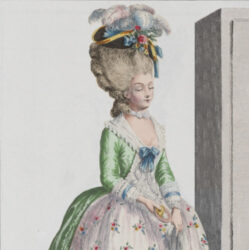
MARIE ANTOINETTE PENDANTWant to wear a bit of 18th century fabulousness every day?  I’ve designed a small silver pendant (.75″ diameter) with a reproduction of an 18th century fashion plate featuring Marie Antoinette.

Marie Antoinette pendant

You can donate $32 to support the book project and receive just the pendant without the book for $32 (for example, if you’ve already pre-ordered the book), or pre-order the book AND get the pendant for $80 total.


IMPORTANT NEWS ABOUT THE INDIEGOGO CAMPAIGN:  Like I said, I’m well on my way, but I still have a long way to go!  If the Indiegogo campaign doesn’t get fully funded, I’m going to be limited in the amount of money I have to print the book.  This may mean that I will need to limit the number of copies I am able to print, which means I may not have extra copies to sell later on.  In other words, if you want a copy of this book, you should pre-order it before January 31, because you may not be able to buy a copy later!
Stockholm!

I just got back from a week in beautiful, cold, dark Stockholm!  I was there doing research at the Nordiska Museet (Nordic Museum), looking at an 18th c. robe a la turque and some other garments related to my Big 18th-Century-Turkish-Influence project.  It was something of a whirlwind trip, given the flying time from San Francisco to Stockholm (THREE — count ’em — flights to get home, meaning about 24 hours of travel time), but it was lots of fun!

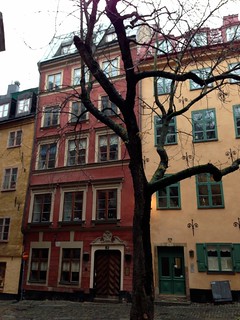
Stockholm is very pretty.  Lots of it is very Victorian looking, but mixed in (especially in the older parts) are beautiful, warm colored buildings:

Gamla Stan

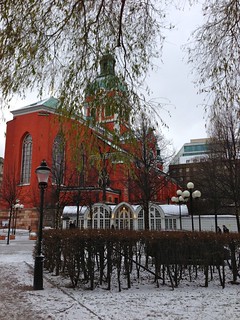
This was even prettier on the second day we were there, when it snowed!

Kungsträdgården

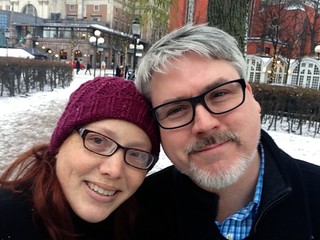
I was there with my husband, and we did a ton — museums, architecture, shopping for design-y items (Michael’s an illustrator, so he was all “Swedish design! Yay!”).

Kendra & Michael

I got to meet Elisa of Isis’ Wardrobe and Madame Isis’ Toilette.  She took me to Livrustkammaren, where they have the HUGE and fabulous royal dress collection.  I got to see TWO (count ’em!) Swedish 18th century court dresses, and Elisa was able to tell me lots of interesting things about the various pieces and the royals who wore them:

Coronation dress of Queen Lovisa Ulrika, 1751 | Livrustkammaren: http://emuseumplus.lsh.se/
Wedding dress of Queen Sofia Magdalena, 1766 | Livrustkammaren: http://emuseumplus.lsh.se/

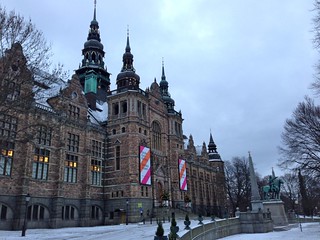
The Nordiska Museet is STUNNING:

Nordiska Museet

And they had a number of really fascinating exhibits, my favorite being the jewelry and costume exhibits (of course!):

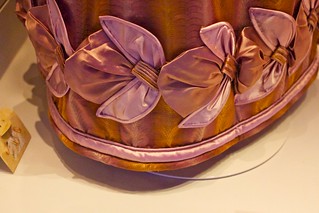
Modemakt/Power of Fashion

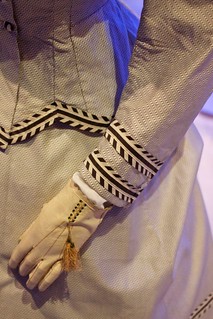
Modemakt/Power of Fashion

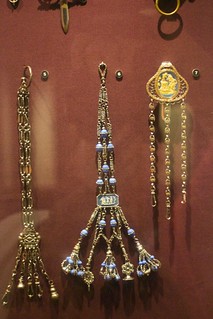
Modemakt/Power of Fashion

Modemakt/Power of Fashion

Equipages

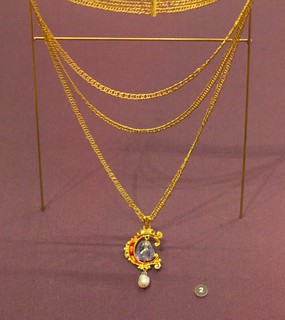
16th c. pendant

And best of all, I got to study a number of interesting 18th century costume pieces! The curators and conservators were really nice and great to work with, and they had some really interesting items in their collection.

You can see all of my pictures, including many more of the costume and jewelry exhibits, in this Flickr set.

Robe à la Polonaise Article Published!

I am thrilled to report that the research that I have been working on with Brooke Welborn for years is finally available!  Dress, the journal of the Costume Society of America, has just come out with our article on the robe à la polonaise.

I have written up a summary of our findings as promised:

The 18th Century Robe à la Polonaise: Research Summary


If you’d like to read a full copy of the article, you can get it one of two ways (if you’re not already a subscriber to Dress):

1. Find a local library with a print copy of, or electronic access to, the journal Dress.  WorldCat provides a list of libraries who subscribe to the journal.

2. Alternately, you can purchase a PDF of the article from Ingenta Connect.

I’m super proud, and hope you find the information useful!

Robe a la Polonaise, 1780-1; Kelvingrove Art Gallery and Museum, Glasgow; 1932.51.I: http://www.glasgowlife.org.uk/ museums/collections-research/online-collections-navigator/

Paris – I’ve been very busy!

Bonjour from Paris!  I’ve been here since Tuesday and already it’s been a whirlwind.  In addition to being on vacation (I leave tomorrow for the south for our two weeks of playing dress-up), I’m also here in France doing research!  See, the research I’ve been doing for years on the robes a la polonaise, turque, and circassienne have been growing and growing.  First they turned into an article that’s coming out this month in Dress (the journal of the Costume Society of America).  But it’s kept growing, and so… I’ve decided it’s a book!

What’s the book about?  Well, partially about what exactly these styles are, how they were cut and what was different/the same about them vs. other dresses of the period.  I’ve been doing tons of research, but I also really need to study more extant dresses and I especially want to take patterns.  So I applied for, and am incredibly excited to have received, some research grants!  I’ve received funding from the Design History Society’s Research Grant, and the Society of Antiquaries London’s Janet Arnold Award (hey, I won a grant in honor of Janet Arnold — how cool is that?).

So here in Paris I’ve just spent a day at a half at the Musee Toile de Jouy, a small museum about an hour outside Paris.  The museum focuses on printed cottons and the history of the Oberkampf fabric printing factory.  They have a dress that I’ve studied before, which belonged to Mme Oberkampf (the wife of the owner), which they’ve been calling a robe a la turque but that I have determined was a polonaise longue — a trained version of the robe a la polonaise.  Confusing, because the polonaise was looped up, right?  Well, one version featured the specific cut of the polonaise but had a long train, and that was the polonaise longue.  Here’s a not-great photo of the dress I patterned:

Robe a la turque de Mme Oberkampf (actually a polonaise longue), Musee Toile de Jouy: http://www.museedelatoiledejouy.fr/dynPopup000101b5.html

Then this afternoon, I went to Versailles to the chateau of Mme Elisabeth, the youngest sister of Louis XVI, to see the exhibition that is all about her.  Her chateau is very pretty, the gardens are stunning, and it’s waaaaay less crowded than the chateau de Versailles proper.  The exhibition is really nice, with some great paintings of Elisabeth, Marie Antoinette, Louis XVI, and more, plus personal objects of Elisabeth and related people.  And, best of all, there’s a room with about 8 costumes on display, including this tambour embroidered stunner that I think I’m going to have to make, now that I’m a tambour-ing demon (more on that shortly, I promise!):

Caraco et jupe, 1775-1785, Musee Galliera. Image courtesy of Madame Elisabeth, Une Princesse au Destin Tragique exhibition website: http://elisabeth.yvelines.fr/oeuvres-et-lieux/caraco-et-jupe/

Okay, I have more to write about but I’m exhausted (jet lag!) and I have to get up really early for my train to the south, so more soon!

New Research Article Posted: 18th c. rumps

About a year and a half ago, I wrote an article for Foundations Revealed: The Corset Maker’s Companion on late 18th century skirt supports (called “bums,” “rumps,”  and “culs” in the period).  I’ve been interested in this topic for a long time, as the shapes I had seen and used didn’t seem to create the same effect that I saw in paintings and fashion plates.

I did a lot of research and pulled together as many sources as I could find, and then set about making test mock-ups to see how the different shapes would work.  I ended up making a small version of each shape as well as a large, and then photographed each on an appropriately-sized model.

It’s long past the Foundations Revealed embargo period, but it’s still taken me forever to cross-post this article to my own site, as it’s so image intensive — but I finally have finished it.  So, if you’re interested in what they might have worn under their skirts in the 1770s-1790s, please check out the article.

And since you might be wondering… I have ditched my “bumroll” shape (shape #2 in the article) in favor of #3 for 1770s-85, and and #7 for 1785-95.  You can see more examples of me wearing these two shapes under my 1780 polonaise (shape #3), 1775 Maja costume (shape #3), and 1787ish roundgown (shape #7).

Happy rump-ing!

The Bum Shop, 1785. Lewis Walpole Library.