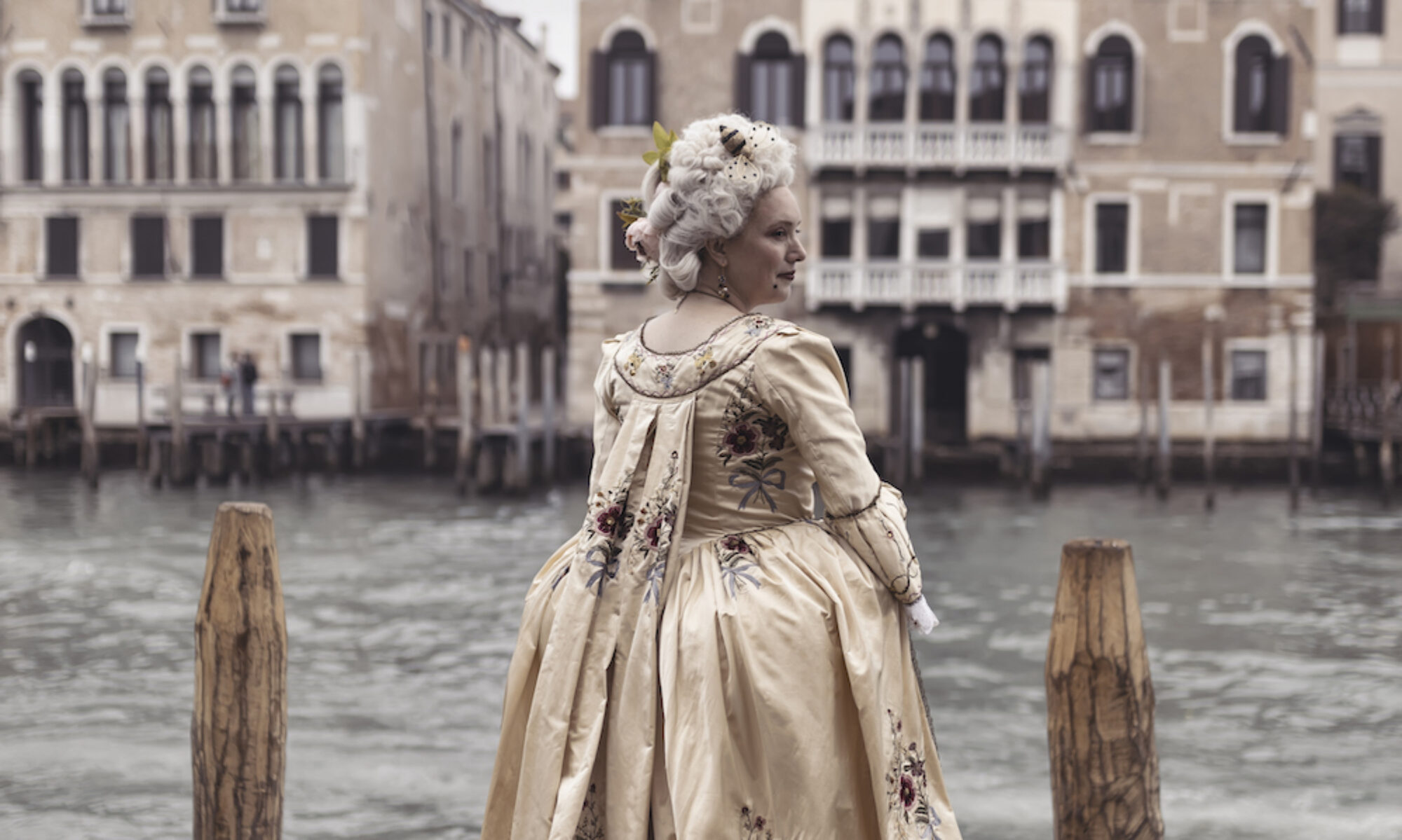
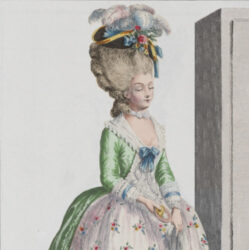
In doing research for my 18th century hair/wig-styling book, I’m coming across a lot of weird and/or hilarious bits of info that aren’t going to fit into the book. So this is just a random accumulation of bits and bobs that are making me laugh!
Did you know…
“Dildo” was a 17th century term for the sausage corkscrew curl of a man’s wig
In the 1860s there was an attempt to scare women off of wearing their hair in chignons by claiming there was a particular “chignon fungus” you could catch by wearing that hairstyle
There was a Russian hairdresser working in London in the 18th century named Ivan Peter Alexis Knoutscheffschlerwitz
There were dog wigs marketed in the 1960s
Mono-brows were fashionable in classical Roman times as well as in the Arab world (not sure exactly which periods, but I know it was fashionable in the Ottoman Empire in the 17th-18th century)
About a year and a half ago, I wrote an article for Foundations Revealed: The Corset Maker’s Companion on late 18th century skirt supports (called “bums,” “rumps,” and “culs” in the period). I’ve been interested in this topic for a long time, as the shapes I had seen and used didn’t seem to create the same effect that I saw in paintings and fashion plates.
I did a lot of research and pulled together as many sources as I could find, and then set about making test mock-ups to see how the different shapes would work. I ended up making a small version of each shape as well as a large, and then photographed each on an appropriately-sized model.
It’s long past the Foundations Revealed embargo period, but it’s still taken me forever to cross-post this article to my own site, as it’s so image intensive — but I finally have finished it. So, if you’re interested in what they might have worn under their skirts in the 1770s-1790s, please check out the article.
And since you might be wondering… I have ditched my “bumroll” shape (shape #2 in the article) in favor of #3 for 1770s-85, and and #7 for 1785-95. You can see more examples of me wearing these two shapes under my 1780 polonaise (shape #3), 1775 Maja costume (shape #3), and 1787ish roundgown (shape #7).
So if you’re an 18th century costume geek, you’ve probably noticed the discussions floating around about what is a “real” polonaise. I’m excited to report that Brooke Welborn, the researcher who discovered that what many modern day historians were calling a polonaise was not the same thing as what eighteenth-century people defined as a polonaise, and I (who had been researching the very similar robe à la turque for a few years) decided to put our heads together and research and write an academic article on the topic. It’s been accepted by Dress, the journal of the Costume Society of America, and will come out this May. I plan to write a summary of our findings and post them here as we get closer to the publication date (as well as info on how to get the full article), but the in the meantime, here’s the two sentence summary — no news to those of you who’ve taken Brooke’s polonaise workshops through Burnley & Trowbridge, or been to my classes at Costume College, or read the various blogs mentioning our research:
In the eighteenth century, the “polonaise” was a term for a style of dress or jacket that was cut differently from the robe à l’anglaise: it had a cutaway front, with the bodice closed at the neckline and sloping away into an inverted V shape (incorrectly called “zone”); the robe/jacket front and back were cut without a waist seam, with inverted pleats opening up from the seams, like a man’s coat. The term “polonaise” was never applied to any dress worn with skirts looped up; these were called “retroussée” in French (e.g. robe à l’anglaise retroussée), with no specific equivalent term found in English (dresses were worn “back” or “up”).
So look for a longer summary in the next few months, as well as my research into that pesky term “zone,” which I would like to hereby banish from everyone’s vocabulary!
Of course, I’ve had to experiment with recreating this style — a few years back I made a proper robe à la polonaise, but didn’t blog it as the more information you put out there, the more likely you’re going to get scooped! I will, however, post some more information about this dress as I get that research summary posted.
Now, I’d like to make a jacket version of this style, specifically this polonaise style jacket from the Musée Galliera in Paris, which I love for its froofy trim:
Caraco, entre 1770 et 1780. Musée Galliera, Musée de la Mode de la Ville de Paris. GAL1992.177.X.Caraco, entre 1770 et 1780. Musée Galliera, Musée de la Mode de la Ville de Paris. GAL1992.177.X.
I particularly love that if you look at the trim up close, you’ll see that it’s done in a windowpane cotton, while the jacket itself is in a solid:
Caraco, entre 1770 et 1780. Musée Galliera, Musée de la Mode de la Ville de Paris. GAL1992.177.X.
I’ve decided to fill out the ensemble based on this 1780 fashion plate from the Gallerie des Modes:
Camisole à la Polonaise, de Mousseline des Indes, doublée de Taffetas rose. Gallerie des Modes et Costumes Français, 31e. Cahier. 1780.
Specifically, the plan is a solid white cotton voile for the jacket and petticoat, with trim in a windowpane cotton. The fashion plate’s dress is a sheer cotton lined in pink taffeta, an idea about which I started to get very excited, until I realized that I didn’t have any solid silk taffeta that I could use in my stash, I really shouldn’t go buying a bunch of silk taffeta given my current budget, and when I held up swatches under the sheer cotton the lining color didn’t show enough to make me love it as much as I did in the abstract. So, I’m hoping I can maybe wear a colored petticoat from another outfit under the skirt, and of course a kick ass silly hat!
Thanks SO much to everyone who gave me your feedback on the idea of an 18th century hair/wig-styling book! I got a TON of positive, useful feedback and I really think it’s viable, so I am going to go for it!
I’m still crunching the data I gathered on the survey, and exploring options for images. I’ve ordered myself a practice mannequin so I can work out the specific styles I want to do.
And there are some things I want to do a bit more research on, like caps — how ubiquitous were they? Etc.
I even appreciate those who said they WOULDN’T buy the book, because that’s helpful to know! It seems like those few are more interested in a book on 18th century techniques, which I agree are interesting, but I just don’t see myself (or the bulk of costumers/theater people) wanting to make pomade out of beef tallow and setting curls by baking hair on clay curlers in ovens. It just doesn’t sound viable. I’ll certainly be researching how they did it, and including information about that in the book.
~~~
My goal is to have the book ready to go for Costume College 2013!
And — what I’m going to do is use Kickstarter, which is a site that allows people to fund a project. You can donate $1 or $500, depending on the various levels that I set it at. Obviously I will have the basic “donation” be a discounted price on the book, and you’ll get a copy of the book at this discounted rate for pre-funding the project. This way I can figure out the cost of the book and essentially pre-sell it… And the way Kickstarter works is that you figure out what your funding goal is, and if you don’t make that goal, nobody’s credit cards get charged — so basically you’d be buying the book, but if for any reason I can’t get enough people to buy a copy and the project falls through, you wouldn’t be out a cent.
So my plan is do more research and figure out hairstyles over the next couple of months, and hopefully do the real work with photography and writing over winter/spring. I won’t start the Kickstarter pre-sale until I have things pretty firmly lined up with a finish date — so when a lot of the writing is done and I’m starting to work with models, and have a firm end date in site. So, watch this space for lots more updates!
So, a potentially crazy idea… A conversation at Costume College got me thinking about the possibility of writing a book on 18th century hairstyling (and makeup?) — using modern techniques to achieve a historically accurate look, working with your own hair, adding false hair, and wigs. Now, this could be a lot of work, so it wouldn’t really be worth the time unless people would buy it.
Here’s what I picture:
Something along the line of Lauren Rennells’ fabulous book on vintage hairstyling
Start with some history, include lots of pictures and source material (if possible? gotta look into that whole public domain images thing)
Go over some basic your-hair styling techniques, like ways to curl your hair, tease, etc.
Go over some semi-advanced wig/false hair styling techniques, like different ways to curl/straighten synthetic hair, ways to create volume, ways to create rolls, how to attach wigs/false hair to your head, how to match colors, how to not look like you’re wearing a Wig, how to adapt a wig for different hairlines, etc.
Step by step instructions that walk you through hairstyle for different eras — I picture 1-2 styles for each decade, with some info on variations
Hairstyles would be those worn in France and England (there’s some differences b/t the two, and lots of similarities) — the English stuff could be extrapolated to those doing American
Possibly 1-2 styles that are appropriate for lower/middle classes, but most would be upper class styles — I would talk about ways to tone things down if you’re doing middle class
Mostly I’m picturing this focusing on women, but it could also talk about men’s styles
Possibly including some brief info on creating an 18th c. makeup look using modern products
So, crazy idea or good one? I’ve created a survey that I’d love if you would fill out so I can try to figure out 1) if there’s a market for such a thing, and 2) what specifics people would want. Please feel free to share any thoughts in the survey or by commenting here — I wonder if people are concerned about geography, class, etc…. And my forte is NOT “here’s how this recipe from this 1764 beauty manual makes up,” so again, we’d be talking modern/theatrical techniques — would that work for you?
Please feel free to forward this survey around! The more input I get, the clearer an idea I’ll have as to whether or not this is a viable idea.