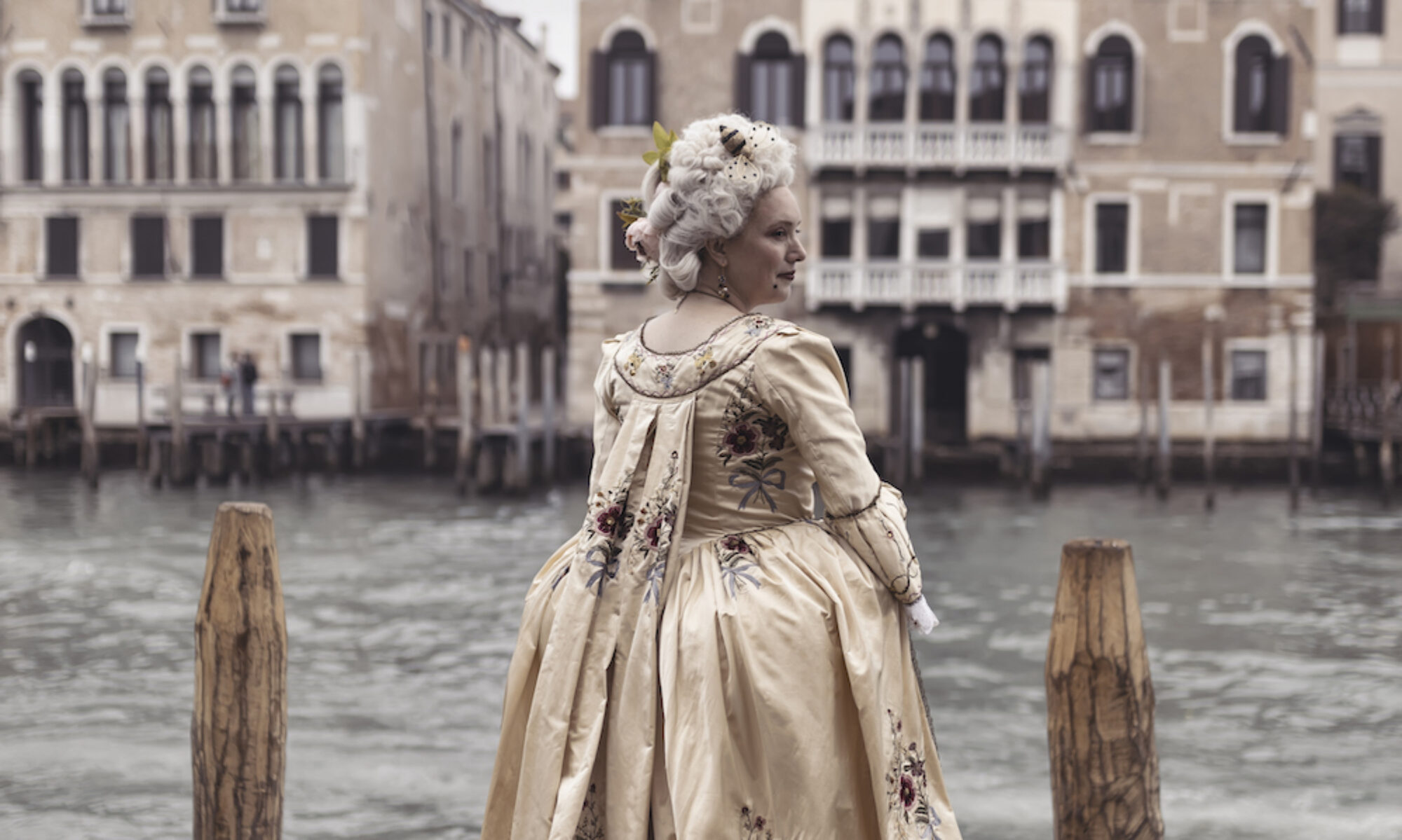
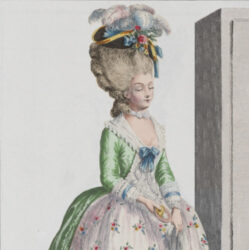
So I mentioned in my last post that I’ve been doing some sewing… Although work has been busy, I’ve also been enjoying the fact that I have no looming deadlines for any sewing projects, so free time plus limited energy means I’ve been working on some noodle-y stuff.
You might remember when last year, my fabulous friend Francis made me some handmade reproduction Elizabethan shoes. I’ve been wanting to gift him back, but of course he’s a costumer too, so have been trying to think of something I can make for him that he can’t make for himself. We figured out that he doesn’t do embroidery, so I am planning to make him an 18th c. hand embroidered waistcoat.
I have dabbled at embroidery and I know it’s one of those things I can do, it just takes a lot of time. I’ve been wanting to learn to do tambour embroidery for years, so decided that’s what I’d do on his waistcoat. But since the waistcoat is supposed to be a gift, that means I shouldn’t be experimenting on it! So I thought I’d better to a project for me as a learning experience.
To that end, I decided to make a hand-embroidered 18th c. fichu using tambour. I’ve had some REALLY fine white linen in my stash for a while, which I’ve been using in small pieces for special elements, as I have no faith in ever finding linen this fine again. I have Peri’s tambour frame on long-term loan, so all I needed was a tambour needle, the right thread, and some instructions. I got the needle and thread from Lacis, and then read through the books Tambour Work and 18th Century Embroidery Techniques to learn the technique.
I ended up using a pattern from the 18th C. Embroidery Techniques book, as it helpfully includes a pattern for a late 18th c. tamboured fichu from the (Bath) Museum of Fashion. I don’t love fichus that bunch up around the neck, so I decided to follow the cut of this fichu at the Met to hopefully avoid that.
So far, so good! It’s certainly taking time, especially now that I’m done with the long continuous line things and am on the 5 million individual flowers, each of which needs to be done separately from the others (as I’m trying to keep the back of the embroidery neat). The one thing that’s stymied me are the little dots, which on the original pattern are tiny spirals… there just isn’t enough embroidery to bring the tails through on the back, so I haven’t figured out whether/how I’m going to include those. I could of course NOT cut the thread off between dot/spirals, but then I’ll have all those extra bits of embroidery thread on the back of the work…
Over fall, I worked on a tambour embroidered fichu, which is nearly done (but not quite).
The rocket dress from Marie Antoinette (1938), designed by Adrian and conserved at LACMA.
I didn’t take very many pictures while I was making the dress, because I wasn’t blogging about it and I was focused on just getting it done! But I did take a few photos that show a bit of the process, plus I’ve finally gotten the official con photos of the outfit, and I gotta post those!
Here's a crappy early evening/outdoor photo of the pannier from the back.
I used Simplicity 3635 — I know! — for the pannier. I looked at the diagrams in Norah Waugh’s Corsets & Crinolines and Jean Hunnisett’s Period Costume for Stage & Screen, and found that they were really similar. The only real tweak I made to the Simplicity pattern is that I put boning in the bottom hoop. If you look at the pattern image, you’ll see the pattern breaks off around mid-calf, which I think would look really ugly underneath a skirt! Plus, I’m 5’11”, and I can use all the length I can get.
Because I am cheap and couldn’t stomach the thought of paying for all that hoop wire, I ended up using 3/8″ half-round caning from the Caning Shop, which was super cheap! I was, however, terrified that it would break, particularly when packing the giant hoop o’ doom into the car for the drive down to Costume College. So I ended up doubling the cane in each casing, which worked out great in terms of supports — no cracking, breaking, etc. One thing I did that you may want to avoid, however, is I initially thought that the half-round cane should go into the casing flat side to flat side, so that it would make one whole round — I thought a flat side against curved side might lay weird. Well, I found that the cane wants to go around with its natural bend, and when you put the second piece in flat to flat, you’ve got one piece of cane that is trying to bend against its natural curve — and things go wonky! It didn’t curve nicely and ended up sort of warped looking. So I pulled it out and put it back in, flat side to round side, both pieces curving along their natural curve, and it all laid fine and made a lovely shape.
A super crappy shot of the base skirt.
I wasn’t sure whether I’d need a petticoat to avoid the individual hoops sticking out, but I decided to make the skirt first and see if I needed one. I made a base skirt of grey cotton, because in looking at the original dress, I misread the top lace swags as a separate piece, not just applied swags like the lower pieces. I used Katherine/Koshka’s 18th c. court skirt tutorial to start, although I had to do a lot of futzing to get the end pleats to hang where I wanted them. It was REALLY hard to level the skirt given that my dress form was a floor model and so has a decided lean and rickety-ness to it! I ended up marking one side, and then matching the other side to those markings, and crossing my fingers.
The pannier/skirt was SO huge, I had to move it all into the living room while I was working on it. Luckily my husband was out of town for about 5 days, so I was able to take over! Unfortunately, the dogs discovered the joys of “I hide under the skirt and get you,” so I had to swat them away. A lot.
(C) Andrew Schmidt, http://photos.theshotwellcollection.com/
I attached the satin skirt to the cotton underskirt. The base of the satin goes up to about where the hoop starts to go down rather than out. The cotton underskirt and upper satin skirt are all sewn into the same waistband.
The lace around the overskirt is cut from that same yardage and hemmed. I made the flowers from the same satin, after trying to find some vintage silver flowers (no dice) or modern fabric flowers that weren’t cheesy (ditto).
A crappy shot of the bodice in progress (crappy photos seem to be a theme here!)
This is the only in-progress photo I took of the bodice, which is very Victorian in approach. I tried to follow the lace layout on the original, cutting motifs out of the lace yardage I had and hand sewing them to the bodice.
(C) Andrew Schmidt, http://photos.theshotwellcollection.com/
The bodice closure uses the technique found in most 18th c. court dresses, where the bodice and lining are separate for about 1-2″ along the center back. Lacing holes are put into the lining layer, and therefore don’t show through the fashion fabric.
Makeup test #1: Kryolan Aquacolor in white
I did a number of makeup tests with Leia, which didn’t start off too well. We read a number of posts on Cosplay.com, and most everyone recommended Kryolan Aquacolor. Although we planned to use grey, I had some white on hand that I messed with… and I swear, anything more than the first layer seen above made me look like I was covered in calamine lotion. NOT good. And one layer left a lot of pink showing through.
Makeup test #2: Kryolan Supracolor in white mixed with black
Luckily there’s a Kryolan store here in San Francisco, so I went in for help, and they showed me Supracolor, which is an oil-based makeup and therefore SO easy to apply! It goes on smooth and moist, and you can mix colors easily on your skin or beforehand (I mixed white with black to get grey), and it’s very moveable until you set it with powder and setting spray. The rest of my makeup I did with standard makeup — grey and white eyeshadows and a grey eyeliner. I’m a lip balm addict, and was REALLY worried about putting something drying on my lips and having to not touch it all night. I ended up covering my lips thickly with my usual lip balm, and then coloring over that with the grey eyeliner, which actually made a bit of a lipstick-y paste… and I managed to go all night without wanting to rip my lips off and dunk them in a bath of Burt’s Bees, which is saying something! (Come on, fellow lip balm addicts, you know you feel me).
Detail from a photo (C) Andrew Schmidt, http://photos.theshotwellcollection.com/
I was super excited about my jewelry. The necklace is FABULOUS and, shockingly, came from H&M a year or so ago, a present from the fabulous Trystan. A couple of people asked about the matching rhinestone bracelets I wore, which were dirt cheap (like $4-5 each with free shipping!) from Alilang on Ebay. And this was the first wearing of my SUPER-EXCITED-ABOUT QVC Marie Antoinette earrings, which are amazing reproductions of a real pair of Marie Antoinette’s earrings, conserved at the Smithsonian.
And lastly, a few more official photos!
(C) Andrew Schmidt, http://photos.theshotwellcollection.com/(C) Andrew Schmidt, http://photos.theshotwellcollection.com/
So last year, I made a Victorian fancy dress costume — specifically, a c. 1886 “champagne” costume. You can read more about it here, if you’ve totally forgotten about it by now.
Last time we talked, I made some undies. Well, I also made a dress. I was really sick the week before wearing it, but pushed myself through finishing by telling myself, “It doesn’t have to be god’s gift to costuming.” Well, that prophecy came true, as it wasn’t! Didn’t help that I was still woozy and fever-y and sick on the night I wore it, but I had to go as my singing group (Bella Donna) was performing at the Vampire Ball.
So yeah. I never found the right trim for it, even after looking at gazillions of beaded trims and christmas ornaments, so maybe it’s the lack of trim that made me feel so meh about it that I never finished blogging? I don’t know! I also think maybe the sleeves (which were supposed to be more interesting, but lack of time made for a crappy pattern, so I had to ditch the original plan and go simple) should be A) more interesting and B) in the gold fabric? Or maybe a sheer, shiny gold tulle, and then echo that in a center front opening showing a faux underlayer in shiny gold tulle, as in the inspirational fashion plate? And the skirt hem could be shorter? Help me figure out why this costume is so unexciting, and maybe I can wrestle it into shape? Or at least do better the next time I attempt fancy dress! And for trim, go for shiny gold balls, or clear glass balls? Had a long debate with my husband about that one — I was picturing shiny gold balls, but he kept pointing out that champagne was clear…
A note on the photos — I had to photoshop the base skirt on photos #2 and 3, as the settings on Trystan’s camera were off and it turned my green skirt purple. So the color/shine is most accurate in picture #1.
Specifically, an 18th century Turkish ensemble, consisting of gomlek (shirt), salvar (trousers), and entari (robe), based on 18th century paintings of French/English women in Turkish costume, Turkish illustrations of the period, and extant Turkish garments.
It was fun to make and comfy to wear, although I need bigger hair next time!
I have put off finishing this dress diary for literally months, simply because I am too lazy to put the dress on the dress form so I can take a picture of a particular construction element. Well, it obviously isn’t going to happen, so I’m letting that go!
The last thing I wanted to talk about was the skirt. For the first time, I decided to sew the skirt to the bodice — I wanted to see if having fewer layers around my waist was more slimming, plus I’ve now made two dresses with separate bodices and it isn’t THAT much of an advantage to have the skirt separate. However, I wanted to keep one theatrical element: the flat front of the skirt. It’s far more flattering, in my opinion, especially on a larger girl such as myself. However, it’s totally not historically accurate — what would be would be cartridge pleating all the way around, with a slit down the center front of the skirt and/or a CF skirt seam, so that you can get in and out of the gown.
Jenn has made a few of these trying different solutions. The one that sounded the most promising was that she gathered the CF of the skirt up on a drawstring. Sadly, she says that it doesn’t work in practice — no matter how tight you try to make the drawstring, the center front piece still sags and she had to do complicated hooks & bars to the underside of the bodice.
So I thought for a few days and then hit on making a fall front, with ties at the sides the way 18th c. skirts are closed. Of course, since the back 3/4 of the skirt is sewn to the bodice, you are only tying off the center front 1/4. I made a waistband for just that section and attached ties to each side. I had originally thought I would put my arms into the armholes of the bodice, tie the ties in back, and then lace up the center front — but I found it was too hard to get my hands under the bodice in back, so I cut really long ties that cross in back and come all the way around to tie in front.
So, that’s basically it! I still haven’t gotten around to the new partlet and ruff, but I will — at some point. The only other fiddly things I need are some velvet ribbon around the skirt hem to protect it from wear, and I need to tack down some more of the shell ornaments because they kept flipping up in back. Oh, and my girdle kept getting wonky — I think I’m going to to suck it up and do what (I think) Sarah does, which is baste the girdle to the waistline of the gown — which I can finally do, now that everything is one piece!
It was fun to finally have a new gown, and I like the blue, even if the colorway is a bit more muted than I usually go for. Oh, and my friend Janice named this “the Mermaid Dress,” which I totally love!
In May, I made a new Venetian Renaissance dress to wear to Bella Donna performances.