
Credit to Sarah of Mode Historique for the idea to post a preview picture when I don’t have time/energy to post anything more! Lots more about this project forthcoming.
Fashion Historian & Historical Costume Maker
Credit to Sarah of Mode Historique for the idea to post a preview picture when I don’t have time/energy to post anything more! Lots more about this project forthcoming.
Because this ensemble is in white, I don’t know how riveting all these various pictures are going to be. Apologies! So, as mentioned in my last post, I’m going to be making this polonaise jacket and skirt. Because what is better for running around the garden of a French chateau, I ask you?
Before Christmas, I draped the bodice and took it to my mom’s house so I’d have some hand-sewing to work on. I’ve been debating exactly what I want to do for the underbodice effect — period options include a false waistcoat, separate waistcoat, or a stomacher. Since I’ve done the false waistcoat a number of times, and I like the idea of a solid front “underbodice” (ie no center front closure), I think I’m going to make a separate stomacher. But for fitting purposes, I initially made the lining close CF, so I could be sure everything fit well.
Here’s the extant jacket I’m copying. It’s a good example of the fact that there are numerous variations in the vertical pleating of the bodice — this one only has one pleat at the side front, unless something’s hidden under that sleeve, but I don’t think so:


I’ve seen many variations in these pleats, which are what allow you to get some level of fitted-ness. I found that, with my high waist to hip ratio, I needed something more at the side or side back, so I ended up pinning in a pleat at the side which gives the jacket some shape.


Then during the holiday I managed to get all of that sewn down into place:


It still needs a hem and sleeves, obviously!
So if you’re an 18th century costume geek, you’ve probably noticed the discussions floating around about what is a “real” polonaise. I’m excited to report that Brooke Welborn, the researcher who discovered that what many modern day historians were calling a polonaise was not the same thing as what eighteenth-century people defined as a polonaise, and I (who had been researching the very similar robe à la turque for a few years) decided to put our heads together and research and write an academic article on the topic. It’s been accepted by Dress, the journal of the Costume Society of America, and will come out this May. I plan to write a summary of our findings and post them here as we get closer to the publication date (as well as info on how to get the full article), but the in the meantime, here’s the two sentence summary — no news to those of you who’ve taken Brooke’s polonaise workshops through Burnley & Trowbridge, or been to my classes at Costume College, or read the various blogs mentioning our research:
In the eighteenth century, the “polonaise” was a term for a style of dress or jacket that was cut differently from the robe à l’anglaise: it had a cutaway front, with the bodice closed at the neckline and sloping away into an inverted V shape (incorrectly called “zone”); the robe/jacket front and back were cut without a waist seam, with inverted pleats opening up from the seams, like a man’s coat. The term “polonaise” was never applied to any dress worn with skirts looped up; these were called “retroussée” in French (e.g. robe à l’anglaise retroussée), with no specific equivalent term found in English (dresses were worn “back” or “up”).
So look for a longer summary in the next few months, as well as my research into that pesky term “zone,” which I would like to hereby banish from everyone’s vocabulary!
Of course, I’ve had to experiment with recreating this style — a few years back I made a proper robe à la polonaise, but didn’t blog it as the more information you put out there, the more likely you’re going to get scooped! I will, however, post some more information about this dress as I get that research summary posted.
Now, I’d like to make a jacket version of this style, specifically this polonaise style jacket from the Musée Galliera in Paris, which I love for its froofy trim:
I particularly love that if you look at the trim up close, you’ll see that it’s done in a windowpane cotton, while the jacket itself is in a solid:

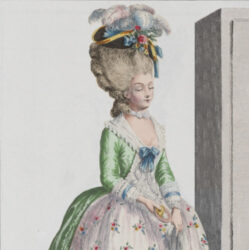
I’ve decided to fill out the ensemble based on this 1780 fashion plate from the Gallerie des Modes:

Specifically, the plan is a solid white cotton voile for the jacket and petticoat, with trim in a windowpane cotton. The fashion plate’s dress is a sheer cotton lined in pink taffeta, an idea about which I started to get very excited, until I realized that I didn’t have any solid silk taffeta that I could use in my stash, I really shouldn’t go buying a bunch of silk taffeta given my current budget, and when I held up swatches under the sheer cotton the lining color didn’t show enough to make me love it as much as I did in the abstract. So, I’m hoping I can maybe wear a colored petticoat from another outfit under the skirt, and of course a kick ass silly hat!
Next post: draping and sewing the jacket!
Now that I’ve finally posted about the last costume event of 2012, I can finally post my end-of-year recap!

In late December/early January, I made a 1575 Florentine veste & petticoat to wear to Sarah’s laurelling ceremony.

In January, I wrote an article on 1912 evening wear…

…and another on hair, makeup, and accessories.

In April, I bought some Indian wedding jewelry, slightly altered my 1910 Lady Maud evening dress, and went to the GBACG Titanic event.

In May, I made a new Venetian Renaissance dress to wear to Bella Donna performances….

…and it had its first outing when Bella Donna performed at the Valhalla Renaissance Faire.

I spent way too much time in June handsewing an 18th century Turkish ensemble, which I wore to the Lumieres Salacious Salon.

In July, I made the 1938 Marie Antoinette sorta-rocket dress, which I wore to Costume College.

Over fall, I worked on a tambour embroidered fichu, which is nearly done (but not quite).

In September, I performed with Bella Donna at Much Ado About Sebastopol, a benefit Renaissance Faire that is really breaking new ground in terms of authenticity AND entertainment.

For Italian Heritage Day, Bella Donna walked in the SF Italian Heritage Parade and performed for two North Beach Italian restaurants.


In October, Bella Donna got dressed up and took a gondola ride on Lake Merritt in Oakland with Gondola Servizio.

In early November, I recovered and trimmed a had, did some stage makeup, and wore my Maja dress to the Vampire Ball…

…where I performed with Bella Donna.

Later that month, Bella Donna performed at the SCA West Kingdom fall Collegium feast, a beautiful dinner and dance set in 1530s Corregio. I actually reworked my green Venetian dress a bit, but I have no photos yet so I have yet to post about it!

In December, I reworked the failed Champagne fancy dress costume, which I wore to the Dickens Fair.

At the very end of December, I added a placket and wore my Gwendolen dress and had tea with the GBACG.
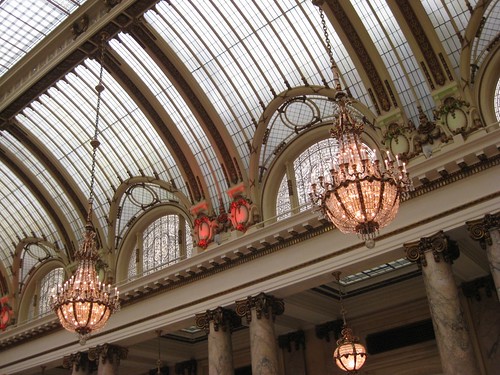
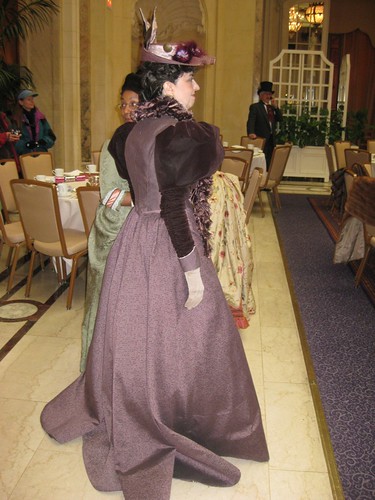
At the very end of December, the Greater Bay Area Costumers Guild held a bustle-era tea at the Palace Hotel in San Francisco. The Palace is super fancy and dates from 1875 but was rebuilt after the 1906 earthquake — the restaurant where tea is served is what used to be where carriages would pull in and is just beautiful:
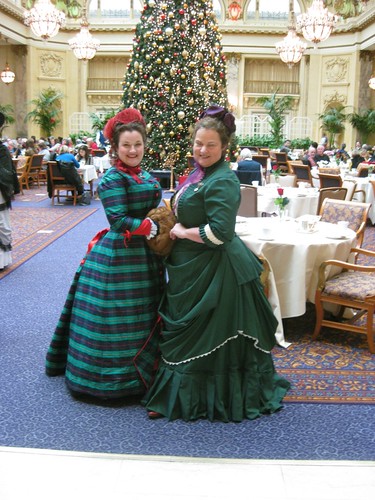
The tea was hosted by Mrs. Vanderbilt (Cynthia) and THE Mrs. Astor (Catherine), both tres chic in their bustle gowns:
Costumes ranged from the 1870s to the 1890s:
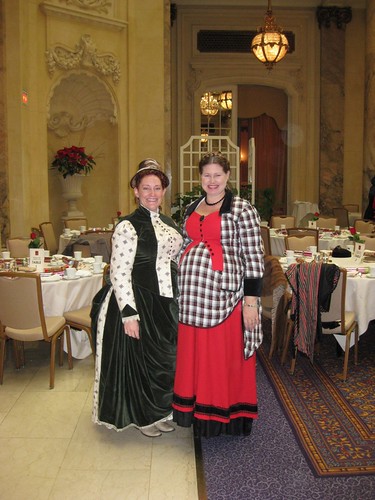
Teresa and Bridget were both super pregnant and super cute with their unbuttoned bodices:
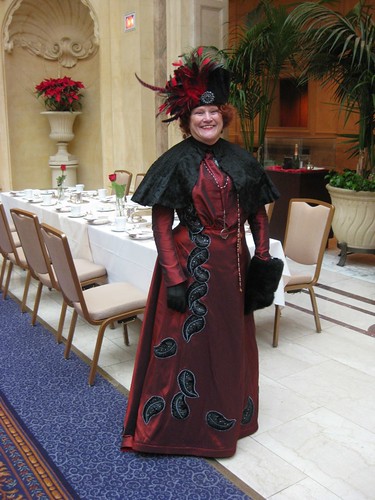
There was lots of gorgeous beading and fabulous hats:
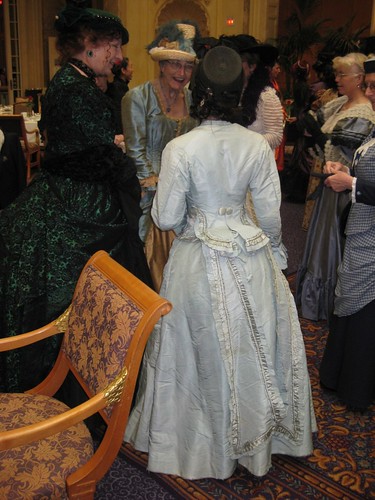
And a lovely lady wearing an actual antique late 1860s/early 1870s gown:
I wore my purple and white striped Gwendolen dress, this time without the lower hoops as I wasn’t in the mood to wrestle them on BART (our local commuter train). The bodice appears to have (ahem) shrunk, but luckily I saved scraps of the fabric and hit on the faaabulous idea of adding a V striped false waistcoat front — I’m so glad there are two runs of buttons on each side of the bodice opening!
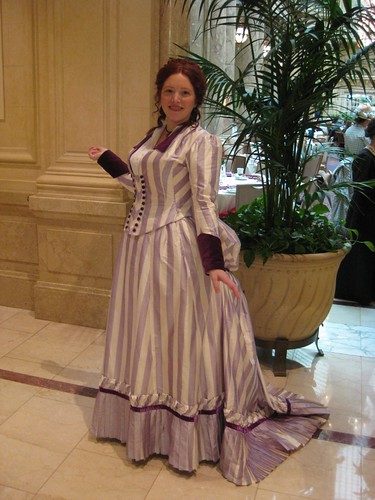
Sadly the hat I made to go with the outfit just doesn’t want to work over 1870s hair. I could have jammed it on my head and not liked the effect, so I chose to go without (shocking!).
Tea was scrummy — I couldn’t even finish all of my sweets and had to take some home! And the hotel had lots of beautiful photo spots:
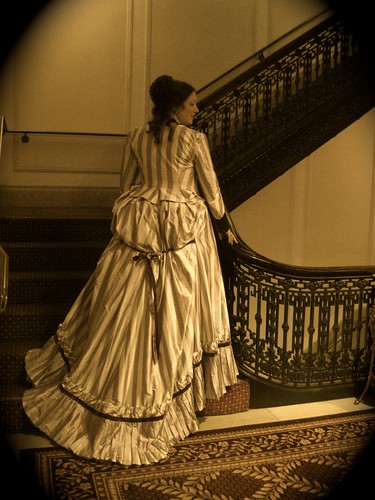
All in all, a lovely afternoon! You can see a few more photos in my Flickr set.