Ham Pants!

One random thing I do is make up dorky songs.  Mostly these get sung to the critters, but sometimes they are sewing-related.  This is relevant because I came up with a song about “ham pants,” and thus Michael’s trunkhose got their name.  (Okay, they were Ood Pants for a while, because the panes were very tentacle-y, but now they’re Ham Pants).

So, uh, yeah, I’ve worked on these.  A LOT!  Boy clothes are boring, I have decided.  Although I am having crazy thoughts of making some super over the top 18th century man’s outfit for myself and cross-dressing, just because 18th c. men’s clothing is fab and when will I ever have a chance to make it?  But now I am off topic.

So I made Michael’s shirt a loong while ago, working from the Tudor Tailor book.  All very easy, rectangular construction, except for the fact that the collar was about .5″ too small, so I cut a new one and somehow brilliantly cut it even SMALLER, so ended up making/attaching the collar 3 times.  Someday it will get ties at the neck and cuffs.  It will probably never get a hem (hey, I often leave my shifts unhemmed, so it’s standard practice!).

But the trunkhose were made using the Tudor Tailor sized patterns, which are EXPENSIVE given the exchange rate.  They really need a US supplier!

And let me tell you about this pattern.  It was drafted very nicely — all the pattern pieces matched up and went together.  Fitting the pants was relatively easy, as it was just a matter of fitting the fitted lining, then extending the length on the various pattern pieces to match (my husband is 6’5″).

BUT:

1. The pattern sheets are HA-UGE.  I mean seriously, ridiculously, crazy huge.  I took a picture to show you how it basically covered 1/2 of the square footage of my sewing room, but I seem to have lost it.  It made tracing off the various pieces a serious pain.  Luckily the doublet is on one sheet, and the trunkhose on two, so it’s not that crazy Simplicity hunt for a tiny piece on a random sheet.  But DUDE, that’s a seriously big piece of paper.

2. Even more importantly, THE INSTRUCTIONS SUCK.  The pattern instructions included with the (scaled, not the book) pattern are exactly the same ones as in the book.  I first looked at them and though, “Eh, no problem.  I’m a pretty decent seamstress, and I don’t usually bother to follow pattern instructions anymore (when I bother to use patterns).”  But this was my first time sewing this garment, and I admit I needed a bit of guidance.  Now, yes I could have gone and read every bit of Janet Arnold and scoured the web, but I don’t think I should NEED to do this in order to make up your pattern.

There are a few more photos vs. the book, but they are faded color copies and are hard to make out.  One photo completely puzzled me until Teresa figured it out, explained it to me, AND I looked at it upside down.  It still makes no sense when I look at it right side up.

Most importantly (and this goes for the book too):  they tell you to do some things out of order.  To wit, in case anyone else decides to make up this pattern from the scaled pattern or the book:  Go ahead and put the darts in the trunkhose lining bottom, but do NOT gather and/or attach the trunkhose lining top to the waistband UNTIL you have figured out the panes length.  Do what I did:  attach the panes at the bottom of the trunkhose lining, then figure out the pane lengths, then gather/attach the trunkhose lining top to the waistband, then cartridge pleat the panes.  Also, I have no idea if it’s because I was making a larger size, but I found that there really wasn’t much fabric to cartridge pleat in the panes.  I mean, I had to gather them, yes, but they basically made waves rather than tight cartridge pleats.  I doubt it’s period, but if I ever made these again, I would just do two rows of gathering stitches across all the tops of the panes, sew that to the waistband; then I would gather the trunkhose lining and hand sew it to the waistband/panes (I think it would be too thick to machine sew; you’ll have to handsew anyway if you cartridge pleat).

Some positives?  Again, all the pattern pieces went together well.  I would personally think about adding some balance marks, but hey, I didn’t need them.

One thing that could go either way:  the patterns are drafted without seam allowance.  This will be great if you work like me, where you make mockups and worry about the seamlines, perfect your pattern, and then add seam allowance — it saved me the step of removing the seam allowance before making a mockup.  But I know that freaks some people out, so I thought I’d note it.

So, they are done, minus lacing holes.  And the husband is super cute, because I put him into his shirt and Ham Pants to check that they were done, and then told him I was done, and he said, “Hey, don’t you have a blog where you post photos?”  So he gets a gold star for volunteering to have dorky photos of himself wearing Ham Pants on the interwebs.  Winston just walked right into the photo and sat very nicely for his portrait, so I had to include him too.

Yes, the Ham Pants(TM) are mostly black, so it’s hard to tell what’s going on here… but they’re done, and minus some loose cartridge pleating, I’d say they’re decently well made.  And I am now SO over boys clothes, and really just want to work on my own stuff (which, I admit, I did last weekend… but more on that in another post!).

There’s Been Lots of Sewing

But not a lot of posting!  Mostly it’s because I have been slowly slowly working on binding my 1780s stays, but also because I’ve been working on Michael’s 16th century trunkhose (but they keep seeming to stay in a not-excitingly-photographed condition – update soon!).

I think red is my color of the moment, because that’s the theme here…

First, I made the Costume Close-Up cloak for the Lumieres seaside stroll.  I was worried about freezing to death, so I took some lightweight red wool, fulled it, and made up the cloak — which I have to report is SUPER easy, because of the fulling… you don’t have to finish any of the edges!  I debated and debated what to line the hood with — I wanted to do something solid so it would work for any era (because how often do I make cloaks?), but the only thing in the stash that worked was a green & red 18th c.-style indienne print.  Oops!  Guess it’s not going to work for 16th century!  Also, a report — according to the book, the hood is cut large to accomodate the big hairstyles of the period.  Well, obviously they don’t define “big” the same way I do — there is no WAY that hood was going to fit over my hair!  So I’ll have to make another version at some point with a bigger hood, and this time of some heavier wool so it will work for REALLY cold events.  Luckily, although we expected rain, we had a beautiful day, so it worked out just fine.

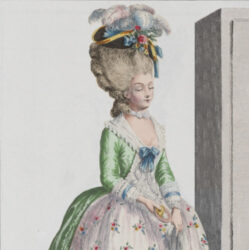
Next, I went to the GBACG Duchess of Devonshire tea, which Cynthia and I organized.  We had planned one tea (obviously), but it sold out so quickly we added a second date the following weekend!  I didn’t want to stress myself out by trimming my hat at the last second, so planned to wear something else… but then got the wild hair the night before to wear the hat.  Silly costumer!  So I put some burgundy ribbon and a burgundy feather on it, all with straight pins, and called it good.  I had experimented with using green ribbon, as in the original fashion plate, but it just looked like a Christmas hat.

I finished binding my 1780s stays in time to wear to tea #2 (ie late the night before).  I really wanted to wear them because — hey, they’re new!  Plus I wanted to find out how comfortable they’d be.  I handsewed ALL of the binding, top and bottom, both sides, because I really wanted it to look good.  And while I’m not 100% happy with it, I think it’s my best binding job so far.  The petersham worked well and I think it looks good — I was worried it would scream “petersham!” but I think it just looks like a ribbed ribbon.  I did discover some cosmetic changes I want to make when I do version #2, mostly that the side tabs are shorter than the back tabs, and I’d like to even that all out.  Also, I don’t have a back picture, but I want to make the line of the straps at the top back of the corset merge more.  I’ll post really REALLY final photos once I have the right color ribbon on hand to lace them with — I had to just use what I had on hand, which meant the straps are tied on with black, and the back got laced 1/2 with burgundy and 1/2 with green!  I wore it under my chemise dress, which is the only dress I had that (because it’s gathered) fit — all the rest of my dresses are too small in the bust and too big in the waist to fit!

I haven’t yet posted my photos from the first tea, but I’ll do so very soon!  I do have photos from the Devonshire tea #2 up.  Both teas were lots of fun — yummy food, good conversation, and we had lots of fun playing forfeits!

Yet Another Half-Done Try On Post

So my plastic German/Wissner boning finally showed up from Farthingale’s Canada, which I’m using in this version for the very short vertical pieces (mostly the tab pieces on the side front piece — can’t buy pre-cut boning quite short enough), and the slightly narrower than 1/4″ boning (5 mm I think?) for the horizontal bones.  Oh, and 1/2″ for the separately cased horizontal bones. I bought enough so that I can bone my version 2.0, when I do my handsewn/linen version.

Report on the German plastic boning (more reports forthcoming as I work with it and wear it):  it’s definitely sturdier than the crappy Joann’s plastic boning, but it’s also DEFINITELY flexible.  I can’t imagine using it without using some steel to reinforce.

So of course I got distracted from Michael’s costume — nothing is more interesting than your OWN sewing!  I stuck all the boning in, and machine sewed around all the edges.  I sewed in one side of the separately cased 1/2″ horizontal plastic bone, and thought I’d better do one more try on, just to be sure that the placement was going to work.  The horizontal boning (both the narrow – there are 4 rows of that) and the wider bone definitely seem to curve the stays even more, although I would say the difference seems slight.  If you’re looking at the pics below, I have the 1/2″ horizontal bone in on the left side (ie my right).  It didn’t do anything WONKY tho, so I’ll go ahead and put it in on the other side.

I also finally patterned the strap, which is coming in to the front at a slightly weird angle.  The original pattern has the strap sewn to the front and laced in back; I’ve seen this on a few other pairs of stays, but it just reads as weird to me, so I’m flipping it.  I’m not sure if it’s because I changed the width of some pieces, but the strap is fitting well but not coming straight down over the shoulder — more at an angle; mostly I can see this when I curve the end of the strap.  I decided to go with it and not try to do anything funky, because hey, if it works don’t fix it, right?

I also wanted to test out the petersham I’m going to use to bind & cover the seams.  I looked HIGH and LOW for some kind of silk ribbon that looked like the silk ribbon I’ve seen on extant stays.  Yes yes, “all” stays were bound with leather or linen tape — actually, no they weren’t.  Higher end stays were often bound with what most sources call “silk ribbon”; and I’m sorry, I’m just not excited about snoozeriffic natural colored linen tape (can’t even find it in white!), and leather is squicky to me (sad critters don’t need to die for my costumes).  I looked all through the 18cwoman list, all over the web, every fabric/trim store I could find, and it doesn’t seem like anyone has a better option than petersham — because the ribbon needs to have some real weight to it to stand up to its job.  From what I can tell in the images of extant stays that I’ve found, it looks like silk taffeta or possible faille — the pink 17th c. stays (yes, a century early) from the V&A that are on the cover of Historical Fashion in Detail have a very ribbed faille look.  The only currently available possibility that had the right look was vintage (in order to get the right fiber content — silk or rayon) seam binding, so I bought a little bit off Etsy — but it’s SUPER lightweight, so that’s a no go.  Plus it seems like the widest available is 5/8″, too narrow for binding.

So yeah, back to the rayon petersham I bought forever ago!  The plus is that I was able to get both narrow (for covering the seams) and wider (for binding) in a matching color.  And I’m happy enough to go with rayon, since silk seems totally not doable.  I want the look of the 1770s red V&A stays (also in Historical Fashion in Detail), so I went with ivory colored ribbon.  The narrowest I could find was 3/8″, so I held that up to the stays to see how it would work — definitely too wide.  So I folded it in half and hand stitched some lengths of it, and it looks right to me!

Wow, I can yammer about piddly things, can’t I?

And no, I’m not going to split the tabs until I’m 100% ready to bind the bottom — just don’t want to mess with the fraying!

Boys Are Skerry

But I’m making one an outfit, anyway!  Okay, he’s my husband, so he gets special dispensation from the skerry-ness (altho I still may need a lot of hand holding through this process, as I don’t DO boys’ clothes as a rule).  There’s a 16th century event coming up that he is (SIT DOWN FOR THIS ONE) attending, so I’m going to make him an outfit!

The inspiration: Moroni’s Gentile Cavaliere, 1564-5

Specifically, a 1560s Italian gentleman’s ensemble.  I wasn’t terribly picky about geography or decade, so long as it was 16th century; I had vague ideas that if I made his Italian, it would coordinate nicely with my Italian wardrobe; but it was only once I found specific paintings I liked, it all worked out, as they happened to be Italian!

I bought the Tudor Tailor Elizabethan Peascod Doublet & Trunkhose pattern, as yes I could spend 10,000 hours sizing up out of The Tudor Tailor… or I could accept that I don’t love men’s clothing (or know them very well), so having someone do that work for me was worth the insane cost of the pattern.  (I get SOME credit for scaling up the shirt pattern from TT, altho that was so not hard).

Originally, I was thinking all wool — I thought the more straightforward masculine-by-contemporary-definitions, the more comfortable he’d be.  He’s a winter color-wise (which has been WEIRD to shop for, as I am all about the warm colors), so we were thinking blue and black.  But when we had a design consult the other night, we veered off and ended up with the idea of all black wool, with dark silver silk damask accents.  Be still, my beating heart!

So here’s the plan:

  • Shirt (mostly done, will post about that soon)
  • Doublet in black wool flannel
  • Trunkhose and canions in black wool flannel
  • Dark silver accents, as in the Moroni portrait (swapping the gold for silver):  dark silver silk damask for the trunkhose lining, and dark silver couched braid on the doublet

I spent a LONG time looking for the silver damask, and was shocked at how little I could find that fit my mental image.  I finally found this 80% silk/20% poly damask on ebay.  Now I’m on the hunt for some kind of dark silver braid/cord that looks like the trim in the painting.  So far I can’t find anything closer than soutache braid, but it seems like there should be some other options?  I’ve checked MJ Trim, ebay, Farmhouse fabrics, minidolls… all my usual trim sources!  Even checked Calontir, but they’re all about the jacquard celtic stuff.  So I’m still hunting – suggestions welcome!

Sausage + Sleeves = Nearly Done!

So my one hour per night sewing resolution was super helpful last week (this week, not so much).  I stayed up late on Friday just for that sense of accomplishment of having the sleeves DONE.

I did one more mockup, moving the upper/lower sleeve seam down.  Looking at it now, I think I should have angled it up even more towards the back, but what’s done is done and I was happy to move on to the real deal.  I cut the sleeves with a motif going down the front outside of the arm, and while there is a break in the pattern because of the elbow seam, I don’t think it’s very noticeable.

I also went through and fixed/reinforced all the gores that were pulling… altho one has pulled yet again.  Sigh.  So I need to get in there with some duct tape or hot glue or… I KID, I KID!

So it’s all done, minus the hem — which is going to be a total BASTARD.  I gotta start thinking of what I can offer as bribes to get someone to mark it for me!

And man, do I look like a sausage.  I’m really going to need a porn star wig (for any Pre-Raphaelite wearings) to detract from the sausageness.  Please to enjoy that monster horizontal wrinkle in back!