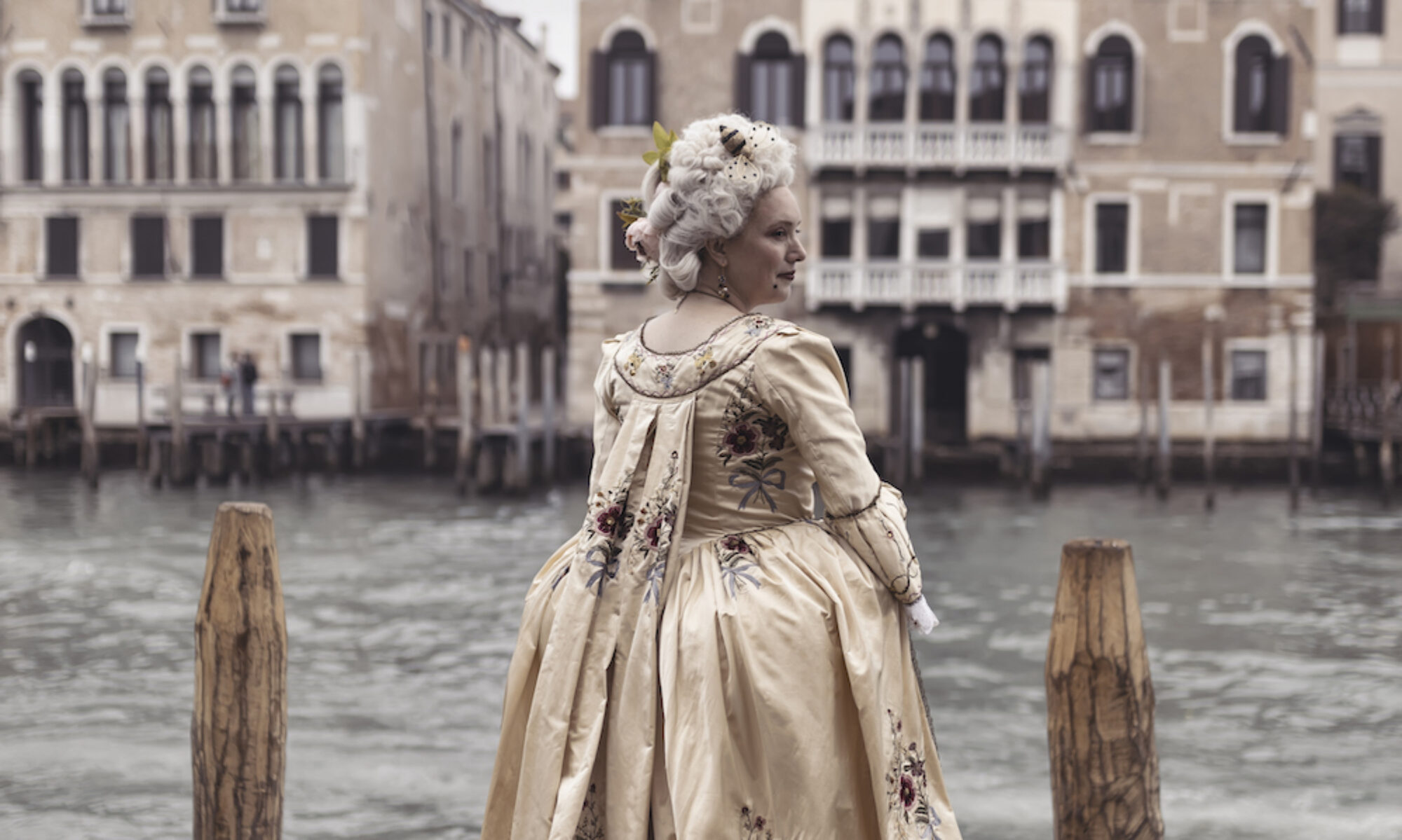
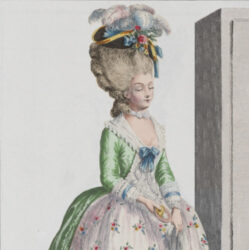
So I FINALLY got off my butt and scanned the better resolution picture that I have of the Maja portrait… and I’m really glad I did, because of course I am now finding little details that I missed! Like, the black trim around the armhole has the occasional spangle on it!
Now, I am trying to figure out the buttons. I had assumed they were all the same style, and were some kind of passementerie/thread wrapped button. But now that I look at them in higher resolution, I see there are TWO different styles — one that looks like some kind of spiky, knotted? or passementerie? button, and something that I think may be a toggle… but then has some spiky-ness involved. OR are they buttons and toggles that are laid on top of some kind of embroidery? WTH?
I got the book 50 Heirloom Buttons to Make which is really great, hoping to find something in there that would look similar. So far, nothing obvious… there are toggles, and knotted buttons, and thread wrapped buttons, and they all are similar, but nothing really close.
I didn’t know I was going to make some silly headwear to wear with my 1785ish round gown, until I ran into this silk gauze with tiny gold stripes at Stone Mountain & Daughter! Oops! I basically cut a giant circle and gathered it in two places, attached a bunch of vintage green rayon moire ribbon, and some feathers and a vintage rhinestone pin that belonged to my grandmother. I may need to put some flowers on there somewhere, too!
Lest you worry that I have been permanently distracted from the Maja gown, don’t! I have been spangle-ing like a madwoman, and am in fact starting to put the jacket together.
I did all the spangle embroidery I could do while the jacket was still in pieces. So that includes 3 facings (1 waistcoat, 2 jacket), one side of the waistcoat, and parts of the jacket fronts & back. I’ve been using Peri’s tambour frame (thank you Peri!!) and it’s been working fabulously. I love having a base to the frame and the ability to flip it around when I need to. Even tho I’ve been primarily doing this on my lap, not on a table, it’s great to be able to use your hands for the embroidery and not for having to hold the frame.
I’ve been hemming and hawing about whether to make the waistcoat separate or integral. Separate would be nice because this could end up being a hot (temperature wise) outfit, so the ability to take the jacket off would be nice… but then, I’m never going to do that, because then it won’t look fabulous! So I decided in favor of an integral waistcoat, saving myself one layer of fabric in back.
I had some debate about the jacket facings & lining. If you look at the original painting, you can see a black turnback/revers at the top of the jacket on her left (our right) side… but if you look at her right/our left, there’s some black that folds over about 1″. Obviously the revers flips OUT, so why is that black edge flipping IN? I did some more hemming and hawing, and looked back through the research I’ve done on the dress style, and everything I’ve seen has been symmetrical in terms of jacket revers. So I decided that maybe that was the edge of the facing folding around the front, or an artist screw up, or just something that doesn’t work in real life. I don’t know! But I’m happy with symmetrical revers. I did end up deciding to line the jacket fronts, given that you can’t see any stitching from the spangles on the inside of the jacket; I used more of the off-white silk taffeta, because I have seen some things lined with silk where it will show, and this will definitely show, and be much prettier than linen.
Now I’ve got the fronts sewn to the back, so it’s on to spangle embroidery on the seams. I had foolishly marked that pattern, only to have to futz with various things and then have the pattern no longer be placed correctly. Yay for water soluble ink! So I’ve wiped that off and am waiting for it to dry before redrawing those lines.
I should mention that I finished binding the handsewn 1780s stays! Yay! I finished it on the plane over to Paris, where I ended up having a funny conversation about them with a fight attendant who had a friend who was a stage costumer.
I ended up using the silk petersham ribbon sold by William Booth — it’s REALLY pretty, although a tiny bit more delicate than I would like. We’ll see how it holds up over time. I used vintage rayon seam binding for the welting.
Anyway, now all that’s left is lining… except that the front lacing holes are starting to rip! I’ve NEVER had that happen to me before, but I think it’s because I’ve been using a gros-grain ribbon to lace it shut, and I’ve been wearing them a lot (lots of try-ons lately). So, I’m planning to restitch the eyelets in front, and then lace a ribbon through each side as a protection against the lacing ribbon.
Speaking of which, does anyone have any good sources for period appropriate lacing? I always end up using narrow satin or gros-grain ribbon, which works but it’s not the kind of the cord they would have used in the 18th c. So far, I haven’t found a good alternative except for a waxed cord that is sold for beading, but it only comes in black, which would look bad on these stays!
So on July 9, the GBACG is hosting the Evening at the Petit Trianon, which besides being my favorite era is going to be at the Bellevue Club in a really outstandingly amazing room (see Sarah’s post for a great pic).
I’m going to be playing the Duchesse de Polignac, and baby needs a new dress! Not because I don’t have a wardrobe full of 18th c., but besides my recently-worn-to-death peach francaise, I don’t have anything that seems perfect. Originally I was thinking I’d be wearing the Maja dress, but Trystan rightly pointed out that it’s not very Polignac-y. And I’m really feeling the mid- to late-1780s pull for this event/character. Trawling through my image morgue, what really appealed was an anglaise or roundgown with a big black sash with a big rhinestone buckle, and a big lace collar, like on this minor character in Jefferson in Paris.
If I weren’t broke right now I surely would have gone out and bought some new fabric, but in this case it’s a good thing I can’t, because it finally forced me to pull apart my ill-fitting 1780s robe a la polonaise to rescue the gorgeous fabric. I’ve been hanging on to the scraps I have left, assuming I would just piece in some pieces to the bodice. But as it never fit well to begin with, and as it definitely doesn’t fit over my new 1780s stays, I redrafted a new pattern and cut out new pieces.
Initially I was a little big leery of using this fabric, which works for me as a faux-painted Chinese silk worn in the 1760s, for a gown this late. I mean, I know they were all about reusing old fabrics/dresses, but I couldn’t find any examples of the painted silks being reused… but I went ahead and hoped it would work. Last night, I was happy to discover two painted Chinese silk dresses that were remade as 1780s styles in the new, revamped Kyoto Costume Institute digital gallery! Yay, my hunch was right!
I had to piece the hell out of it, particularly the bodice front and the sleeves, but hopefully it won’t detract! Because right now I am all about saving my hardcore handsewing energy for the Big Projects (like the Maja) and allowing myself to just bang out a Pretty Dress when that’s all I want, I bag lined and machine sewed this sucker — whee!
The contrast solid green doesn’t work for me anymore, so that’s all out the window. I want it to be somewhat simple and sophisticated, with a focus on the pretty fabric, a big lace collar, and the black velvet sash. I’d been thinking round gown, since I don’t have enough of the fabric to make a petticoat, but I really want a train and am worrying about putting a train on a round gown. So I decided to put what I had on the dress form to see if it would work for me with my white stripey cotton petticoat, but… nope! I like the roundgown best! The white petticoat is just too glare-y and detracts from the sophistication.