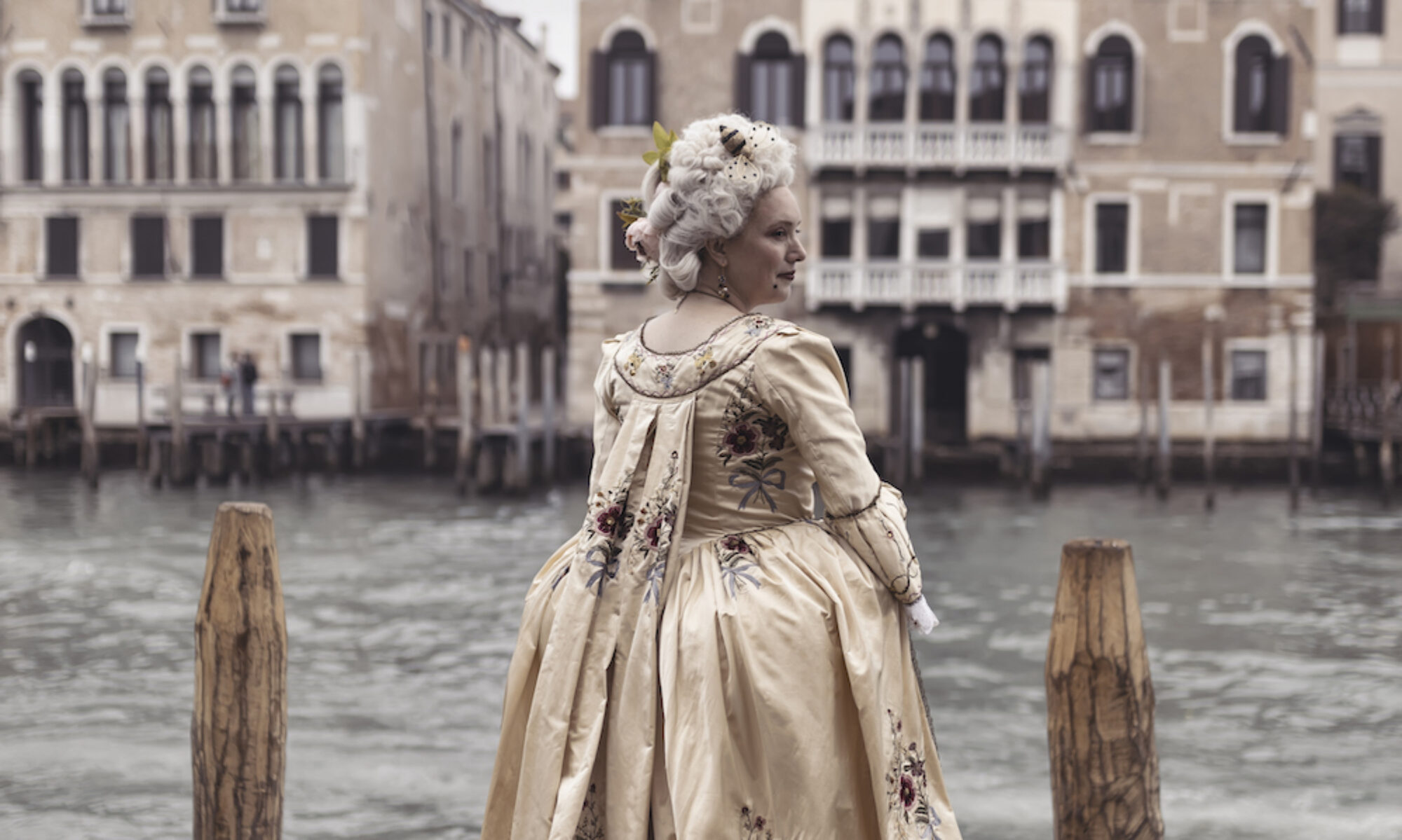
I had an absolute blast at Costume College this year, which has totally reinspired me to want to blog! It was so much fun to reconnect with everyone and get to spend quality time with friends, and to play dress up and talk shop!
The down side was the tickle in my throat on the day I packed developed into a full-blown cold, which meant I wasn’t sleeping much (from coughing) and progressively lost my voice so much that I couldn’t really talk at the gala!
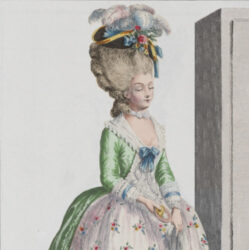
On Friday, I taught one class — 18th century dress variations. I made my OWN eyes cross multiple times putting together the presentation, and the class did an admirable job keeping up with the numerous styles we discussed. I decided to focus it somehow by including only the dress styles that appear to have been popular — there are just so many, we would all need a lie down to talk about them all. I think I talked about at least 15 different styles… I was inspired and so wore my Pre-Raphaelite/Gothic Fitted Dress, and it felt fun to dress up for classes — in something that didn’t require a corset!
Friday night, we had our usual Pretty Pretty Princess Party, which was tons of fun! Lots of people in silly Pink Drink Commando uniforms, plus some people still in costume from the Ice Cream Social. I skipped the Social this year — last year it was so crowded that I just got overwhelmed and stressed out. I’m kind of bummed I missed seeing all the pretty costumes, but given that I was sick and my roomies were tired, it was probably good we conserved our energy for the party!
Saturday I taught two classes. The first, on 17th/18th c. beauty patches, had massive technical failures and I ended up not having a projector. Luckily I’d put lots of images in my handout, but they were cropped and black & white, so it just wasn’t the same. Thankfully it was a short class! I know they’d never fit all the classes in, but it would be so great to have a decent chunk of time between classes to set up. The instructor before me went over time, and then had a lot of stuff so it took her a while to pack up; meanwhile we’re tripping over each other as I’m trying to set up.
I had 30 min. before my next class so went out in the hall to try to get my projector to work, but no dice — I think it was a cord issue. Luckily Francis saved the day by bringing down his laptop and (importantly) projector cable, and I was able to have images for my Social History of Hair (18th c. – Regency) class — yay! I was pretty stressed out nonetheless, so didn’t enjoy teaching as much as I could have, although there were a lot of interesting questions and I enjoyed the discussion part.
Saturday afternoon I hung with the Bitchy Romans for a while — I didn’t have time OR anything in my stash to make anything, so I just admired them, then I was off for a nap (see again about not sleeping well) before it was time to start prepping for the gala.
I have been sewing up a storm, but like I’ve mentioned, had zero desire to blog about any of it, so that meant my cool Gala costume idea ended up being a secret project. A while ago Sarah, Trystan, and I were talking about doing something different than straight historical for the gala. They tried to sell me on 18th c. sea creatures, but I couldn’t get excited about it. I remembered someone I’d seen post on the LJ Vintage Hair community a while back who had done a 1920s black & white starlet costume for Halloween, where she’d done greyscale makeup as though you were watching her on screen. I thought it was a cool idea, and as I was fishing for something other than sea creatures for the gala, hit on the idea of doing a costume from the 1938 Marie Antoinette with Norma Shearer in greyscale. S&T liked the idea, even more so when I suggested that we didn’t all have to do the same movie, and plans were made! I enlisted Leia to help me shop for fabric in NYC, and she got excited about joining in, but doing a current 1930s starlet look. Sadly, life intervened for everyone, and they weren’t able to join me, which was a little sad because it’s always fun to do things like this with other people, but I’m glad they didn’t stress themselves out or wear something they weren’t excited about.
I’ve posted a write-up about the project here, but I’ll expand on it:
Being an 18th c. nut, I love the costumes in this movie — but it took me a while to like them! I only first saw the movie about two years ago, and while the wigs jumped up and hit me in the head with their fabulousness, all I saw with the costumes was the lack of historical accuracy. When I hit on this idea to do 18th c. thru the 1930s lens, suddenly I saw just how fab all the costumes were, and I had a hard time choosing. I almost went with a dress of the Duchess of Polignac’s that is covered in a gazillion ruches, but that seemed too similar to a real 18th c. dress, so I decided to go with something even LESS historically accurate: the piece de resistance from this movie, the so-called Rocket Dress!
The original dress is made in gold lame, but I really don’t think our modern crappy lame is the same thing — I think vintage lame must have had some silk or real metal in it. I just couldn’t see making this dress out of crappy materials — sure, it would be cheap, but it would look it, plus I hate wearing synthetics and didn’t want to sweat to death all night.
When I went shopping in NYC, I came across some silver silk duchesse satin for a really good price (can’t remember what it was, but it was seriously affordable), PLUS the same shop had embroidered silver tulle yardage also for a good price! Obviously duchesse satin is a totally different weight and look than the sheer, metallic look of the original fabric, so I immediately gave myself permission to make a dress that was very-heavily-inspired-by, but not a strict recreation. Also, I am no Norma Shearer figure-wise, and trying to look exactly like here was never going to happen.
Now that I’d found fab materials and a vision, I decided to make this as fast as I could while keeping it as nice as I could. That meant I ended up with a mixture of 18th century, Victorian, and modern techniques.
Again, I’m no Norma Shearer, so I’m wearing a Victorian corset underneath. The bodice is patterned in a Victorian style, with bust darts, and I tried to follow the lines of the original movie gown as much as possible. The back closure is an 18th century court approach, with the lacing built into the lining, and the silk layer separate and laid on top — but there are metal grommets and a placket in there! I tried to bag line the bodice for speed, but of course things didn’t line up perfectly, and I ended up having to set in the lining by hand. All the lace appliques are cut from the yardage and hand applied.
The skirt was draped using a ginormous rectangle and Katherine’s 18th c. court skirt tutorial, with some modifications for a different hoop shape. It’s all mounted to an underskirt of grey cotton, with two layers of silk satin on top.
I was originally going to try to stick to the swag drapery in the original dress, but apparently I have Teh Dumb when it comes to swags, because they refused to happen (the dress almost went to boarding school because of this). Luckily, I draped the lace yardage over the dress on my form when I went to bed, and I realized in the morning that the lace was beautiful enough on its own, so went for swags of lace instead. Also, I misread (visually) the top swags to think they were a separate layer, only to later realize they were yet more applied swags, but oh well, it all ended up fine!
Everything was covered in silver sequin star appliques, as in the original costume.
For makeup, initially I tried using Kryolan’s Aquacolor, of which I’d heard good things, but it seriously looked like calamine lotion when applied. I ended up using Supracolor, which is an oil-based makeup and SO much easier to apply. I used white mixed with a little bit of black for grey, covered with setting powder and finishing spray. The rest of my makeup I did with grey and black eyeshadows and eyeliners. Leia helped a lot with figuring out the makeup approach, and it was really good to have someone hold my hand! I didn’t get to 100% desaturated color on my skin, but I’m pleased enough with what I achieved, esp. given this was my first try at any stage makeup.
For the wig, I started with a long silver wig, to which I added wefts where needed to (mostly) cover my hairline. I always have problems having wigs fit, and this time I figured out that where I’m missing is along the hairline — the hairline itself just isn’t long enough to cover me from temple to temple. Since I’d had a hard time matching extra hair to the wig (you’d be surprised how many variations there are, even when you’re working with the same color #), and since I was too lazy to head back to the wig store for wefted hair, I worked with the loose hair I had and hauled out my hair weaving frame that they gave us when we took the 18th c. wig class at Colonial Williamsburg and hand-wove extra wefts. It actually went pretty quickly, since I only needed about 3′ of weft. I built out the wig base in front with netting, sewed the wefts to that, and then styled the wig itself over a wire frame with separate, glue-set rolls.
And now, back to the CoCo writeup! I was definitely dragging Saturday afternoon, but rallied and managed (with Leia’s help) to get makeup’ed, wigged, and dressed. And despite basically having lost my voice at that point, I had So Much Fun! We’d skipped the dinner, which we did last year, and which has actually worked out great because it means we show up during dinner and have no line in the photo room.
Once the gala opened up to us non-ticketed losers, we went in and got to see everyone’s costumes. I didn’t have a camera last year as my husband killed our’s with a water bottle, so I have only a few crappy iPhone photos to prove just how amazing everyone looked. There were tons of gorgeous 1930s bias gowns straight out of Anything Goes, tons of 18th c. fabulosity (including a few 18th c. Disney princesses!), Victorian fancy dress, bustle gowns, lots of 1910s evening elegance, and more more more. It was tons of fun to wander around the room checking everyone out, and then I joined my peeps for some cocktails and a lot of dancing!
Of course, being sick, I hit the wall around midnight and while some of my roomies were off socializing until 2am or so, I attempted to sleep… I didn’t have anything scheduled Sunday, but was planning to A) sleep, B) hit the dealer’s room, C) maybe attend some classes, and D) socialize… but when I woke up Sunday morning (after a semi-decent sleep-in), I realized I wasn’t good for any of that. I could barely talk, and I was so tired, that all I was honestly going to do was lounge/sleep in my room. My husband threw out the idea that I could fly home early, which suddenly sounded enticing, given how useless I was and the fact that my roomie had to leave that day and so I had to pay for the room on my own. When I mentioned this to Sarah & Francis, who I was supposed to drive home with, they realized that they’d had a blast and while staying would be nice, they also wouldn’t mind leaving that day — so we hustled, packed in 1 hour, and were off, texting goodbye to our friends. I always love the mellow hangout fun of Sunday night, but I was really not up for it, so leaving was the better option, altho I wish I could have said real goodbyes.
So, now I’m home, and inspired, even if I’ve spent the past 2 days on the couch blowing my nose and sleeping! I have lots of costumes to catch you up on, so I’ll be doing a lot of posting over the next few days.
Hopefully I’ll get some nice photos out of the official photographers, plus many friends still haven’t posted their pics, but for now, here are some shots of my Marie Antoinette costume:


