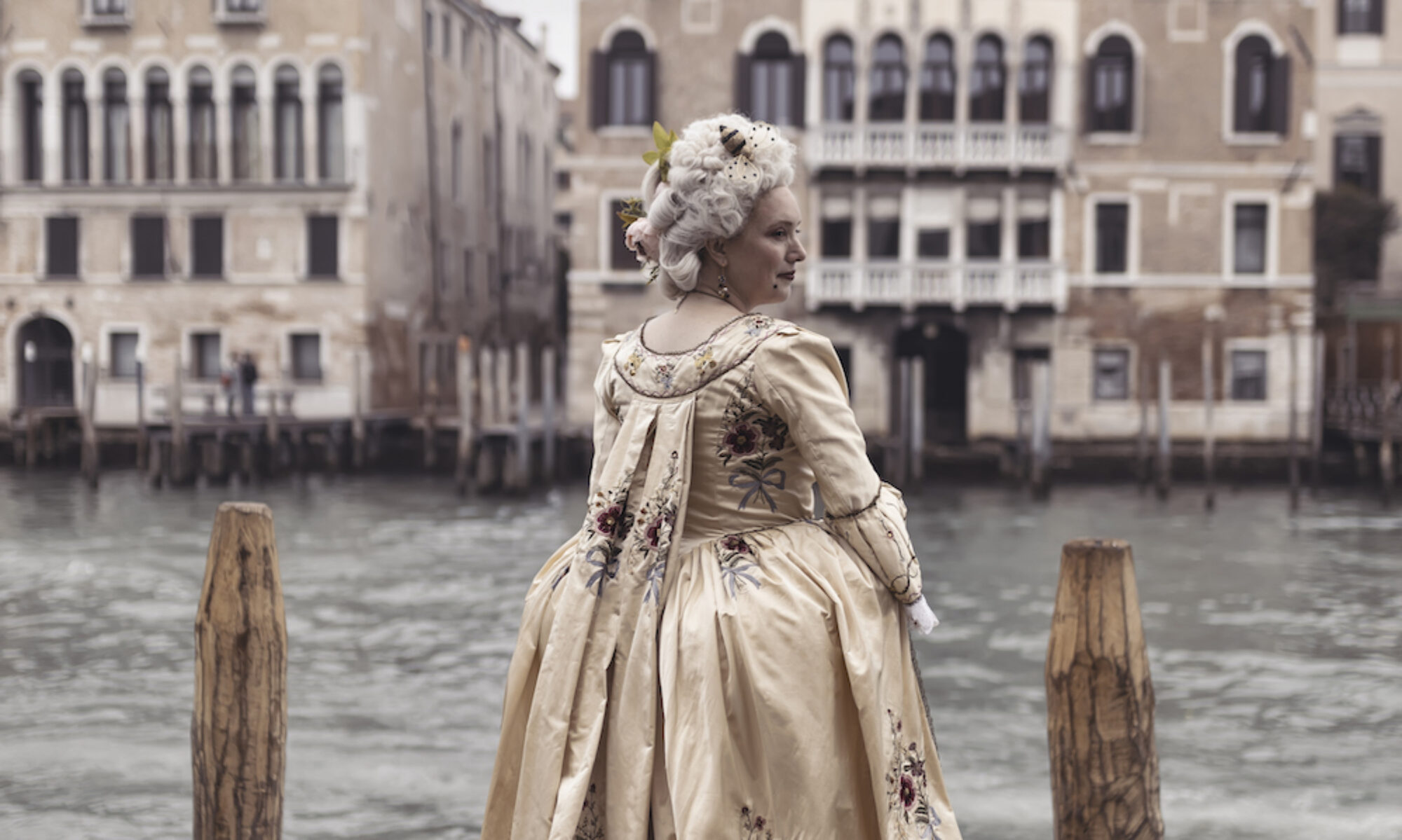
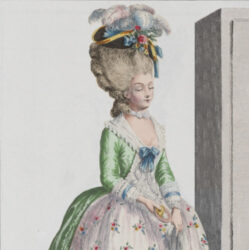
So the next thing I want to talk about with the Marie Antoinette redingote project is how I patterned/cut the back. From what I’ve seen from various late 1770s redingotes, they’re generally cut with the center back pieces in one with the skirt, but without the pleats that we associate with what modern historians/costumers call “en fourreau.” There does seem to be an interior box pleat at the center back, where the bodice merges into the skirt:

Source: demodecouture.com via Melissa on Pinterest
This one is a lot later (1790), but still has the one-piece center back/skirt with interior box pleat:

The method I used is similar to The Merry Dressmaker’s lazy en fourreau back tutorial. First I patterned and fitted the back lining, which only goes down to where the bodice meets the skirt, as shown in this post.
Next, I used that same pattern to cut out the center back piece, but I didn’t cut away the side extra, since the lower part of that would become the skirt, and I wasn’t sure exactly what the waistline would end up looking like. I also made sure to leave an extra 2-3 inches along the center back seam, from the waist down, to create the center back pleat:

Next, I sewed together the center back seam of the skirt, then separately the center back of the bodice. I laid it all down on the ironing board:

Notice that the seam of the bodice has to overlap the seam of the skirt, so that there can be seam allowance to stitch down and support that CB pleat:

I lined up the center back seams, pinning the pleat open on top of the bodice seam (now we’re looking at the outside). This will all get stitched down when I attach this to the lining, which ends right where that horizontal pin is.

Then I put the lining on my dress form and pinned the CB bodice portion to the lining. I tried to be careful not to cut all the way to where I wanted the center back side seam to end, as I was worried about the weight of the fabric ripping further down. Well, I was right, and the fabric did rip, but luckily just to where I wanted it to end! So be careful with that point, and support the side fabric by holding or pinning it up — otherwise all the stress is right on that point.


Now I could pleat up the skirt onto the lining, cut away any excess above the waist, and attach the other bodice pieces. And, sew across that center back piece where the lining ends, attaching the lining and supporting/placing that pleat. Here’s what it looked like when I’d done all of that:


And the front:

And yes, I am machine sewing a good deal of the interior of this dress. I’m a little bit surprised at myself, since I do love to handsew 18th century garments, but with all the sewing I need to do for France this May, I needed to get the base of this sucker slapped together so that I could have that feeling of accomplishment. Of course, I put in the lining by hand, and I’m finding lots of things needing to be ripped out and handsewn, but that’s the next post!


