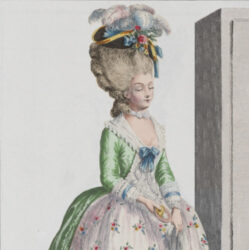
Winter Break Is Upon Us

Which means it’s time for the sewing room to get cleaned and used!  I’ve been knitting a lot lately — it’s cold and I’m lazy, and knitting requires no getting up off the couch.  I’ve finished one mitt, from a very modern pattern, that will be used for 18th century, but now that I have almost two weeks off, I need to get more ambitious.

My early 2010 docket looks like this:

A medieval and/or Pre-Raphaelite dress, for a Pre-Raphaelite event.  I’m torn between doing something very historically accurate so that I can use it for SCA purposes, or going all Waterhouse-y because hey, no one’s going to kick me out of an SCA event for not being historically accurate!  I have some silk damask drapery sheer fabric (it’s weird, you can’t tell that it’s sheer until you hold it up to the light) that I’m thinking I’ll use, lined with linen.  I’m going to hire Sarah to drape the dress on me because it needs to be draped on the body, and my arms aren’t that long.

A man’s Elizabethan outfit — shirt, trunkhose & canions, doublet, and hat.  Sit down for this one – my husband is going to get gussied up for a 16th century event!  Oh, and HE chose the puffy pants option over Venetians!  Color me shocked! I’ve ordered the Tudor Tailor pattern as hello, boy clothes are not my forte, but until it shows up I can’t do much except for the shirt.

Those are the two things I NEED to make before May, and is probably more than enough!  So I won’t continue to ponder new 16th century and 18th century outfits for myself.  I am debating whether I want to make a machine-made version of my new 18th century stays, as the handsewn-outfit-from-hell Maja project is going to get pushed back to summer/fall.  I did start hand sewing a new 18th century shift, then realized halfway through that it was ridiculous to hand sew a new shift when I desperately need one NOW, and it will get a lot of heavy wear & machine washing.  So I finished it on the machine!  I’ll make the handsewn one once the Maja dress is actually made.

Mothballs & More Mockups

It’s felt good to throw off the mothballs and stretch my sewing skills again — it’s been too long since I’ve sat down to sew!  I finally found some time to get some decent mockup fabric a few weeks ago — I love Stonemountain & Daughter for having 10,000 weights of white cotton in house.  Usually I go there for batiste, this time I bought a ton of cotton canvas.  I cut out the latest draft of my mockup, which didn’t take long, and then traced all the boning lines.

How do you make pattern markings?  Often, if the (generally lining) fabric is light enough (in weight/color), I can just lay it on top of the pattern and trace the lines.  If it’s a mockup, I use a fine pen; if it’s the real deal, I usually use a plain old pencil (I’ve experimented with the various chalk products, but find that they give me a less precise line and wear off quickly).  But when I’m working with heavier fabric, and there’s a lot to mark (like in a corset), it’s harder.  Back in the day my artist husband had a light board and I LOVED using that; nowadays, I make my own by using painter’s tape to tape the pattern to the window, then tape the fabric over that, and trace (only works during daylight!).

So it’s still only boned in one half (and even then, only in the center front, center back, and some of the side front pieces), and I haven’t slit the tabs… but at least it’s in sturdier fabric with no revisions.  Next, I need to find time to hang out with Jenn and get her to look things over, but I’m really pleased with where it’s at!

I did finally settle on fabric.  I am 100% thrilled with Burnley & Trowbridge — I emailed Angela with questions about which of their linens would be most appropriate, and she put up with about 3 or 4 rounds of further emails, mailed me swatches at no charge, and ended up selling me some fabric out of her personal stash!  I bought some heavy linen canvas (that was the stash fabric), as well as some linen/cotton fustian in case the canvas piece isn’t big enough for two layers.

Stays Plans, Mockups, & Fabric Quandries

First, I played a bit more with the JP Ryan stays pattern I had chosen for this project and became increasingly unsatisfied (with the boning layouts, and the idea of using a commercial pattern). I looked again at Lynne Sorge-English’s article on 18th c. stays and was reminded of the beautiful 1780s stays from the Worthing Museum (England)… which she helpfully patterns. Yay!

I’m going to be using this as the base pattern, adjusting it to fit me, changing the CF to be functional lacing rather than decorative, and using fancier fabric to cover — so not an exact recreation, but close enough.

So I worked on mocking these up over Labor Day weekend, and here’s where the Twilight Zone music comes in. I was happily scaling up and almost done, when I realized that I had forgotten that I had blown up the pattern on a copier to 200% (I think), and so the scale I was using was off by half. So then I remeasured, and found that the CF was only 6″. Ignoring the idea that these stays were worn by a pygmy, there’s no way that’s possible! The scale I had them at was a CF of 12″, which seemed far more reasonable. So I continued along my merry way with the scale that I was using (all the other pattern pieces seeming reasonably sized, of course), and made a mockup, and (insert Twilight Zone music) they kind of fit me (in fact, they were slightly too big). I know. This is weird. I am a generously sized, 5’11” modern woman. WTF, I say?

Not one to question a gift horse and all that, I sewed up my mockup, discovered it was slightly too big, and then started taking it in in various places — here you can see the various stages, from “too big” to “kind of right.” Note that I had waaay too little boning on hand, so only one side is boned, and even then not in every channel.

Now I just need to find some time (the next month being JAM PACKED for me) to get some better mockup fabric, make another mockup, and then bat my eyes at Jenn to get her to do a fitting on me.

Now, on to quandries:  I think I’ve “solved” my boning one in that I’ve thrown my dart as far as boning decisions go, and am sticking with the idea of using German/Wissner plastic boning (supported with some steel).  I had long conversations over on LJ about this (thanks very much to all who weighed in) and here’s my logic:  I want to make as accurate a reproduction as I can.  I can’t get baleen (and I’m glad I can’t, because I don’t want to kill whales to make stays), so therefore I have to pick what is most like baleen.  Reed/cane/wood is period, but was considered substandard and the research I’ve read (particularly in the Dorsey dissertation [full citation here]) says that reed/cane/wood was only used (in the US) in homemade, lower quality stays.  German plastic boning is designed to be a baleen substitute, and while it’s not the same thing, it’s closer in properties than reed/cane/wood… or so it seems.  Who knows, the point is I have to throw a dart, and there’s no one choice, so that’s what I’m going to try for this project.

But I am still in a quandry about fabric!  Obviously, linen is what is period — my research tells me that linen buckram stiffened (I forget what with – gum arabic?) is what was used in the period, and we can’t get that now.  I’ve considered using coutil, but I’d really like to at least try to be more historically accurate in my fabric choice.  So I’ve been emailing with Angela Burnley of Burnley & Trowbridge who has been immensely helpful in suggesting fabrics, and who mailed me some fabric swatches to choose from.  Some of them seem a little loosely woven, or have a bit of stretch, so those are out… I had thought I had nailed it down to one of the heavier/no stretch fabrics, but then I showed the swatches to Jenn & Cynthia and they both think the fabrics are too light to support the bones/not have the bones wear through.  So, I turn to you, fabulous people, to tell me — what kinds of linen fabric have you used in your stays, and has it held up?  I have heard the suggestion to use linen artist’s canvas, but that runs about $60/yard and I’d like to avoid paying that much if possible.

In case it helps, here’s a picture of the swatches from B&T — I know that you can’t actually feel them, which is what you really need to do:

Tweaking the Vision

This project is undergoing a tweak — I think it’s going to become the opportunity for me to make one costume, inside to out, to the best of my abilities and as historically accurate as possible (read more philosophizing on why). Now, there will inevitably have to be compromises made, but I want those to be really conscious compromises. And most important, I give myself NO DEADLINE for this project. I will probably pick it up and put it down a million times.

So! I’ve wanted new 18th c. stays for a while, particularly something more shaped as in the 1780s styles, and was excited to see JP Ryan’s new shaped stays pattern. I spent the day tweaking the pattern based on various extant examples in Corsets & Crinolines, the Kyoto book, the Salen Corsets book, and Historical Fashion in Detail. I love playing with boning patterns and layouts!

I’ve got three questions for y’all:

1) I’m planning to bone these with plastic boning (with possibly a bit of metal boning as well for support, which is period per Norah Waugh). I am having a hard time getting over the desire to gag at the words “plastic boning,” but I have accepted that it is the best modern substitute for baleen (which, sorry, even though apparently it is theoretically possible to purchase from Inuit sellers, I have real ethical objections to). Yes yes, you’re all saying “Why don’t you use reed? It’s historically accurate and cheap!” I’m not, because while it was used in the period, it was considered a substandard material and I am not trying to create a lower class outfit. Stays of the sort I want to make would be boned with baleen, so it’s a baleen substitute I need. And I have seen the substandard-ness in action, with many friends who’ve made (beautiful) reed boned corsets whose tabs have broken. I’m not willing to put tons of work into a pair of stays that are only wearable for a year or so!

So given all that preamble… does anyone have recommendations for quality plastic boning? I’ve used metal for so long that I’ve never really paid attention to the various discussions. I was considering these 1/4″ wide plastic bones from Farthingales LA – opinions?

2) Linen is what’s period to use as interlining/support layers, but my experiences using it have been less than happy — it stretches! Who wants stretchy stays? Any advice on how you’ve dealt with stretchy linen? I’ve got some pretty heavyweight stuff, but it still stretched when I used it for my Nell Gwyn bodice. Do you just cut it down after you’ve sewn in the boning channels, or pattern the stays slightly too small assuming that they’ll stretch?

3) I can’t wrap my brain around butting the various pieces together and sewing them. What kind of stitch do you use, and how do you make certain they can take the strain? Should I use heavy thread? And how are the seam allowances on each piece handled — are they turned inside out like you would if you were bag lining? I’ve been checking Costume Close-Up and other sources, and can’t find any good explanation of this process.

Any advice much appreciated!