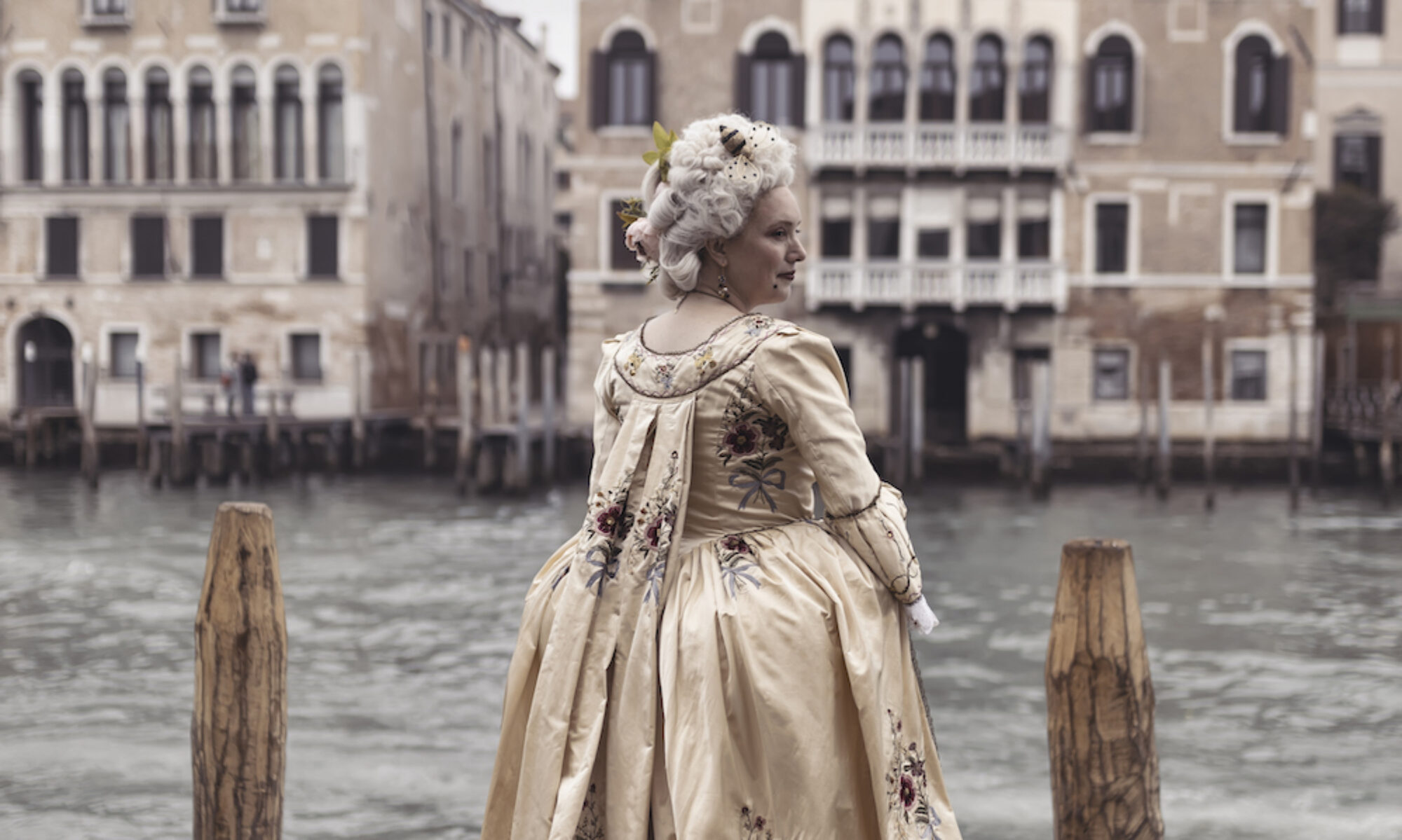
1550s Venetian Gown Wrap-Up: the Mermaid Dress!

I have put off finishing this dress diary for literally months, simply because I am too lazy to put the dress on the dress form so I can take a picture of a particular construction element.  Well, it obviously isn’t going to happen, so I’m letting that go!

The last thing I wanted to talk about was the skirt. For the first time, I decided to sew the skirt to the bodice — I wanted to see if having fewer layers around my waist was more slimming, plus I’ve now made two dresses with separate bodices and it isn’t THAT much of an advantage to have the skirt separate.  However, I wanted to keep one theatrical element: the flat front of the skirt. It’s far more flattering, in my opinion, especially on a larger girl such as myself. However, it’s totally not historically accurate — what would be would be cartridge pleating all the way around, with a slit down the center front of the skirt and/or a CF skirt seam, so that you can get in and out of the gown.

Jenn has made a few of these trying different solutions.  The one that sounded the most promising was that she gathered the CF of the skirt up on a drawstring. Sadly, she says that it doesn’t work in practice — no matter how tight you try to make the drawstring, the center front piece still sags and she had to do complicated hooks & bars to the underside of the bodice.

So I thought for a few days and then hit on making a fall front, with ties at the sides the way 18th c. skirts are closed. Of course, since the back 3/4 of the skirt is sewn to the bodice, you are only tying off the center front 1/4.  I made a waistband for just that section and attached ties to each side.  I had originally thought I would put my arms into the armholes of the bodice, tie the ties in back, and then lace up the center front — but I found it was too hard to get my hands under the bodice in back, so I cut really long ties that cross in back and come all the way around to tie in front.

So, that’s basically it! I still haven’t gotten around to the new partlet and ruff, but I will — at some point.  The only other fiddly things I need are some velvet ribbon around the skirt hem to protect it from wear, and I need to tack down some more of the shell ornaments because they kept flipping up in back.  Oh, and my girdle kept getting wonky — I think I’m going to to suck it up and do what (I think) Sarah does, which is baste the girdle to the waistline of the gown — which I can finally do, now that everything is one piece!

It was fun to finally have a new gown, and I like the blue, even if the colorway is a bit more muted than I usually go for.  Oh, and my friend Janice named this “the Mermaid Dress,” which I totally love!

Let’s Pretend!

Let’s pretend that I haven’t spent the last month ignoring this here blog, and take up where we left off with my blue 1550s Venetian gown, eh?

One of the key elements of the portrait — why I love it — is the trim.  I knew I wanted to try to reproduce those shell applique thingies, but clearly nothing premade was going to do it.  I also loved the double row of trim around the edges of the bodice and sleeve.

Veronese - Woman Holding Gloves, 1550-60 (via Realm of Venus)

I bought a bunch of vintage 1/4″ wide flat gold braid on Ebay with the idea that I could couch the braid onto something.  I originally thought just silk organza, but then felt it would look better with some kind of filler inside the various loops.  I headed off to Lacis where I found two different gold nets — one was cheap and pretty widely spaced, the other was perfect but pricey… luckily, before I put the pricey stuff back, I did the math and realized I’d only need about 1/4-1/3 of a yard, which brought the price down to something reasonable!

It looks like there are two different sizes of shell — the larger is around her hip area and shoulder, the smaller are the three around the bodice center front.  I futzed a bit and came up with a pattern, which I then traced onto silk organza using a water soluble marker. I cut one layer of silk organza with the pattern drawn onto it to serve as a guide, one layer of the gold netting, and one more layer of silk organza for a backing:

I tried making the first prototype entirely on the machine, but felt that it looked clunky:

So I did the rest of the shells with the couching done by hand — which went surprisingly quick. I first basted the netting to the drawn-on layer of silk organza, so I’d have a guide for the couching.

Then I sewed the couched piece to yet one more piece of silk organza, right sides together, trimmed off most of the excess, and turned it right side out.

Sadly, making all those appliques took more of the gold braid than I’d originally anticipated, so that meant doing something different for the gown trim. I ended up using the left over braid from my 18th c. riding habit waistcoat. I didn’t have enough for the double row of trim all the way around, so I futzed and ended up doing it just along the center fronts:

Another key element that I really wanted to try was the decorative “stomacher” (under kirtle? who knows, so I made it a stomacher).  Many of them, including the one in my main inspiration portrait, look embroidered, but I’ve seen some that look like lace laid on a backing fabric:

This seemed a lot more do-able, so I stalked Ebay for a long time and finally found this beautiful metallic gold lace piece:

Vintage gold lace for a Venetian stomacher

I decided I didn’t want the high contrast of a white backing, plus some of the faires we perform at are pretty dusty, and I was worried about white getting dingy. So I ended up laying the gold lace on top of some gold silk taffeta, which I then backed with corset coutil for stiffness, and edged the top with a tiny gold metallic lace. The lovely thing about the stomacher approach is while you CAN baste it into your bodice, you don’t have to — the tension of the bodice and lacing, over the stiffness of a corset, keeps the stomacher perfectly in place.

Next up — a theatrical solution to a skirt issue, and final pictures of the gown!

Bodice Construction Details

So I’ve tried to make my previous Venetian gowns to varying degrees of historical accuracy, always with some concessions for theatricality and for the fact that the Renaissance is not my toe-curling era (that would be 18th c., where I completely geek out on trying to do things 1000% accurately).  This time around, I am trying to make some aspects even MORE historically accurate (shoulder straps; wider CF opening at the bodice waist; contemplating a cartridge-pleated all-the-way-around skirt, but I haven’t decided), and there are other aspects that I’m going for accurate look, theatrical method.

Specifically, this applies to the bodice.  Another member of my Renaissance singing group (Bella Donna), Jenn, is a mad sewing demon.  She has one of those super left brains that is totally analytical and engineering focused, and she’s come up with some really fabulous construction methods for these dresses — not only has she made a number for herself, but she’s also made them for other members of our group.  She’s all about making it look gorgeous but making the construction/wearing as practical as possible; in fact, she has a giant zipper down the front of her stays, and has incorporated a hidden zipper into at least one of her gowns.  (Confession time:  I was contemplating putting a zipper in my newest corset for this outfit, and then Linda told me that our friend Judith was mock-horrified that my standards were slipping — so all those hand sewn eyelets are for you, Judith!).

So!  The point of all this is that I am using her method for bodice construction.  Two things she’s figured out that work really well:  1) Jen of Festive Attyre (another Jen!) was one of the first people to attack these dresses, and she came up with a cool method for keeping the center front lacing straight (see her first post in her dress diary).  I used this method in my first two gowns and it worked well, but Jenn/Ruby Raven found that the two rows of lacing strips plus spaced 1/4″ boning meant that the bodice crumpled (mostly on the interior) in between the lacing strips.  What Jenn/Ruby Raven has done that’s worked so well is to make one wide lacing strip — she used a piece of cotton twill tape, I didn’t have any on hand so used some petersham from my stash — supported by a wide 1/2″ bone.  So the lacing area is still wide, but it’s supported throughout by a wide bone underneath.

Creating the lacing channels

What I did was to baste the petersham down so nothing got squidgy, then used a water soluble marker to draw out the lacing channels.  Of course, after I took this picture I realized that I’d done some mismeasuring, so I had to redraw these a few times.  Then I sewed the horizontal seams of the lacing channels, removed the basting, and sewed vertically down the petersham in between the lacing channels — which means that the lacing channels are open, but there’s no chance of accidentally sticking your lacing needle into the wrong slot, because the non-lacing-channel sections are closed.

Petersham lacing strip sewn down; 1/2" bone underneath inside

Jenn/Ruby Raven attaches the 1/2″ bone to a separate piece of fabric (she suggested a twill), which goes from the CF opening and extends about 4″ into the bodice.  This then gets laid in between the lining and the interlining/fashion fabric.  She’s found that her underside doesn’t pull, and she doesn’t need to attach the boning/fabric the boning is sewn to to anything else.  I tried this, and found that the lining still pulled forward and you could see the petersham/lining:

So I accepted fate and handsewed a channel on the other edge of the boning, through all layers including the fashion fabric, to keep things in place (you can see the handsewing on the finished lacing channel pic above), which I’ll now have to cover with trim (altho in the period, they had to do this too):

But I do think this method is cool, because on my other gowns I DID get some weird crumpling on the lining around the lacing strips, and now I don’t have that on this version.

I found that the shoulder straps stretch given that they’re on the bias, so I ended up having to take off 1″ from the front strap to keep things from totally falling down:

I (kinda) take it back!

Just found a couple of Venetian portraits that show some curvature in front, and so some distortion of the CF lines. I’m still not going to claim I’m being period accurate, but at least now I know I’m not TOTALLY out of line.

Sewing, It Is Occurring!

First, I wanted a new corset, as I’m forever trying to avoid the dreaded quadra-boob.  I finally accepted that my 1780s stays are the best shape on me for a flat front look, and made a strapless version of these for Renaissance wear.  No, it’s totally not period, but I wear these costumes frequently enough that I just want it all to WORK — and we all (in Bella Donna) have made some concessions to theatricality and modern sense of attractiveness vs. historical accuracy.  So, long story short, non-period corset shape it shall be, which at least gives me the cone shape.

I draped the bodice based on the fabulous pattern Sarah draped for me for my 1575 Florentine.  Obviously I’ll be changing it to a wide front opening with ladder lacing, a lower neckline, and shoulder straps on the shoulder point.  On my last two Venetian dresses I didn’t put the shoulder strap quite as far into the armpit as I’ve seen in all the portraiture, but I decided to go for it on this one and hope it doesn’t totally bind my arms!

The one downside to the corset I’m using is that because it curves in at the waist, I can’t get a visually straight line on the front opening of the bodice — it’s straight on the fabric, but because it curves in it LOOKS like it’s a slightly curved seam. Jenn (also in Bella Donna) gets a similar effect on her dresses, so I think it’s just a factor of the non-period corset shape.  Judge me all you want!