This exhibition explores the sumptuous costume of British monarchs and their court during the 16th and 17th centuries through portraits in the Royal Collection. During this period fashion was central to court life and was an important way to display social status. Royalty and the elite were the tastemakers of the day, often directly influencing the styles of fashionable clothing.
In Fine Style follows the changing fashions of the period, demonstrates the spread of styles internationally and shows how clothing could convey important messages. Including works by Hans Holbein the Younger, Nicholas Hilliard, Van Dyck and Peter Lely, the exhibition brings together over 60 paintings, as well as drawings, garments, jewellery, accessories and armour.
A book related to the exhibit is forthcoming, written by the curator of paintings at the Royal Collection:
It looks like I may be in the UK this June, so I’m hoping to catch this exhibit while I’m there!
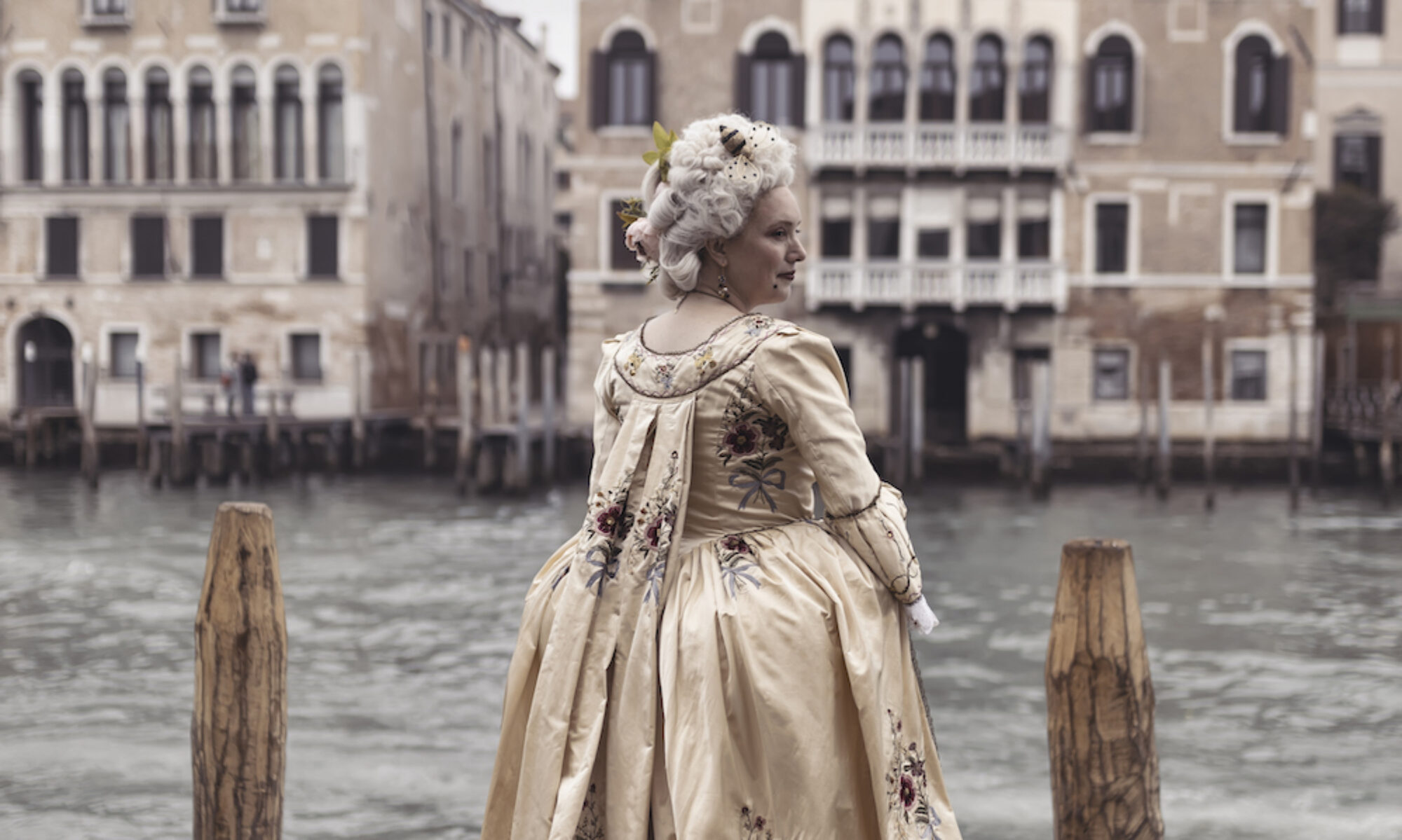
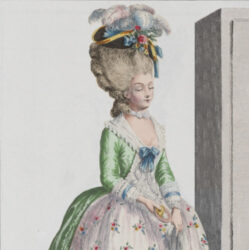
So, a potentially crazy idea… A conversation at Costume College got me thinking about the possibility of writing a book on 18th century hairstyling (and makeup?) — using modern techniques to achieve a historically accurate look, working with your own hair, adding false hair, and wigs. Now, this could be a lot of work, so it wouldn’t really be worth the time unless people would buy it.
Here’s what I picture:
Something along the line of Lauren Rennells’ fabulous book on vintage hairstyling
Start with some history, include lots of pictures and source material (if possible? gotta look into that whole public domain images thing)
Go over some basic your-hair styling techniques, like ways to curl your hair, tease, etc.
Go over some semi-advanced wig/false hair styling techniques, like different ways to curl/straighten synthetic hair, ways to create volume, ways to create rolls, how to attach wigs/false hair to your head, how to match colors, how to not look like you’re wearing a Wig, how to adapt a wig for different hairlines, etc.
Step by step instructions that walk you through hairstyle for different eras — I picture 1-2 styles for each decade, with some info on variations
Hairstyles would be those worn in France and England (there’s some differences b/t the two, and lots of similarities) — the English stuff could be extrapolated to those doing American
Possibly 1-2 styles that are appropriate for lower/middle classes, but most would be upper class styles — I would talk about ways to tone things down if you’re doing middle class
Mostly I’m picturing this focusing on women, but it could also talk about men’s styles
Possibly including some brief info on creating an 18th c. makeup look using modern products
So, crazy idea or good one? I’ve created a survey that I’d love if you would fill out so I can try to figure out 1) if there’s a market for such a thing, and 2) what specifics people would want. Please feel free to share any thoughts in the survey or by commenting here — I wonder if people are concerned about geography, class, etc…. And my forte is NOT “here’s how this recipe from this 1764 beauty manual makes up,” so again, we’d be talking modern/theatrical techniques — would that work for you?
Please feel free to forward this survey around! The more input I get, the clearer an idea I’ll have as to whether or not this is a viable idea.
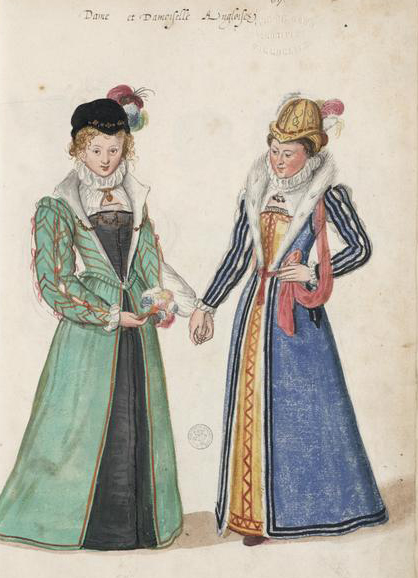
Researchers of 16th century English costume are probably familiar with Lucas de Heere’s sketch of middle and lower class London ladies (discussed here, higher resolution image here). It’s an important source, given that de Heere is documented as having actually BEEN in England when it was drawn, and it shows the common people. Most images depicting common people of this era are drawn/painted by people who may never have seen a commoner of whatever-country in their lives. There are a couple other famous-within-the-costuming-community images by de Heere: his images of Irishdress and his allegory of the Tudor succession.
About five years ago, I found some further images of Englishwomen by de Heere in a book on the Valois tapestries, but they weren’t the highest resolution and were only in black and white, which started me on a hunt to find more. It turns out that he published a costume book with a number of images I’d never seen. I found an online copy of a dissertation written somewhere in the Netherlands or Belgium which included all of the images, but the resolution was TINY. So, every year or so I’d do some poking around and hope to find an online or print source with usable images. And today I found it, digitized at the University of Ghent!
There’s a lot that’s in it that I think will be very interesting to 16th c. costume researchers. The book is a mix of representations of historical and contemporary dress. Some of the illustrations are probably pretty accurate, and some may be completely made up. However, there are enough images that are likely to be correct to make it a great source for costume research, and importantly costume books like this often served as models for future painters (ie an artist needed an image of some French peasants to fill out his/her landscape, so they’d copy those peasants out of a costume book).
It sounds really cool, particularly all the info on stays:
Book Two in the V&A’s groundbreaking new series presents 17 patterns for garments and accessories from a 17th-century woman’s wardrobe. It includes patterns for a loose gown, a jacket, a pair of stays and a boned bodice, ivory and wooden busks, shoes, a hat, a stomacher, linen bands and supporters, a bag, and a knife case. It also features a description of the stay-making process. Full step-by-step drawings of the construction sequence are given for each garment to enable the reader to accurately reconstruct them. There are scale patterns and diagrams for making linen and metal thread laces and embroidery designs. Multiple photographs of the objects, close-up construction details and X-ray photography reveal the hidden elements of the clothes, the precise number of layers and the stitches used inside.
If it’s anything like the first book, it will be of interest to those into 16th c. costume as well!
Classic Beauty: The History of Makeup is written by the founder of Besame Cosmetics, so you know she knows what she’s talking about! Covers the 1920s-present, with over 430 photos, timelines, and color palettes.
Facing Beauty: Painted Women and Cosmetic Art is written by renowned costume historian Aileen Ribeiro so again, you know it’s going to be good. According to its description, it “discusses the shifting perceptions of female beauty, concentrating on the period from about 1540 to 1940” with lots of illustrations.
Slightly further afield… ie of interest to niche markets:
And in a similar vein, Politics of Fashion in Eighteenth-Century America (Gender and American Culture) “explores how and why fashion–both as a concept and as the changing style of personal adornment–linked gender relations, social order, commerce, and political authority during a time when traditional hierarchies were in flux” — again, analytical rather than illustrative.




 , comes out on May 1, and can be preordered now.
 features examples of Russian dress from the State Historical Museum, from the 15th-20th centuries, looking at both Russian peasant dress and Western styles worn in cities.
 is written by the founder of Besame Cosmetics, so you know she knows what she’s talking about! Covers the 1920s-present, with over 430 photos, timelines, and color palettes.
 is written by renowned costume historian Aileen Ribeiro so again, you know it’s going to be good. According to its description, it “discusses the shifting perceptions of female beauty, concentrating on the period from about 1540 to 1940” with lots of illustrations.
 could be interesting to those who geek out on this era. It looks like it’s going to be more analytical than illustrative.
 “explores how and why fashion–both as a concept and as the changing style of personal adornment–linked gender relations, social order, commerce, and political authority during a time when traditional hierarchies were in flux” — again, analytical rather than illustrative.