Trawling the Web

While we wait with bated breath to see the outcome of all TOBG(YN) [The Other Boleyn Girl] costume brouhaha, I found this LA Times article that talks about the costumes in TOBG(YN) and The Tudors (Showtime), and interviews Sandy Powell (costume designer). I like how the author actually acts like Joan Bergin (costume designer for The Tudors) wasn’t on crack.

Also, Trystan found these podcasts from Colonial Williamsburg — near the bottom you’ll find, “Clothing Speaks,” with Linda Baumgarten (textiles and costumes curator, and author of, “What Clothes Reveal”). Haven’t listened to it yet, but I definitely will!

Queen of Fashion Book Review

Since work and life have been so busy that pretty much NO sewing has been happening, I thought I’d keep things interesting around here with a book review! I recently finished Queen of Fashion: What Marie Antoinette Wore to the Revolution, which in addition to having a fabulous title, was a fascinating read.

After seeing the movie last year, I went back to read Antonia Fraser’s biography (which I’d read about 1/3 of years ago but never finished). Queen of Fashion really compliments a conventional bio of MA; it actually includes a lot of biographical information, but there’s (obviously) lots that it can’t go into. So I recommend reading it after having read one of the major MA biographies.

But I was struck how much clearer my understanding of MA, and particularly why she became such a focus for the revolution, was after reading Queen of Fashion. In fact, I would now argue that it is impossible to really understand MA without understanding her clothing, and the public perception of her fashionable image.

In particular, it is author Weber’s argument that it was precisely because MA abandoned court dress in favor of fashionable attire that she became a focal point for public criticism. By leading the mode, and by leaving Versailles to mix with Parisian society, MA shattered earlier understandings of royalty as godlike. Previously, French queens had dutifully followed court protocol, which kept them wearing very formal attire and kept them physically removed from the majority of the populace. MA, on the other hand, became all too real, both in the fact that you could see her at the Opera or shopping in Paris, but also because she wore what was being worn by other fashionable women of her era. Real equals human, and human equals faults, so while early on she was very popular, when public sentiment began to sour with the current regime, she was a fair target — one who was wearing not only what other aristocratic women wore, but also (to some degree) what actresses and prostitutes wore.

This all helped me understand the Diamond Necklace Affair in a way that I hadn’t previously. After seeing the film The Affair of the Necklace, I went back to Fraser’s bio to try to understand why this incident had such a negative impact on MA’s public image — but just really didn’t get it. Queen of Fashion spends a lot more time (I think a whole chapter?) on this incident. Weber argues that by acquitting Cardinal Rohan, the parlement basically said that it was reasonable for him to assume that MA would spend huge sums of money on a ridiculous necklace, and also reasonable to assume that she would participate in secret assignations — all of which publicly confirmed the popular perceptions of MA.

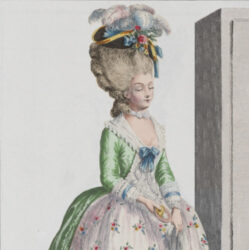
There’s also lots of interesting costume history interspersed throughout, such as the whole “MA refused to wear a corset” actually was about her not wanting to wear the grand corps, an apparently even MORE rigid and uncomfortable set of stays that only royalty were allowed to wear — not that she didn’t want to wear a corset at all. And there’s lots of discussion of the “pouf” hairstyle and the gaulle, which is the early term for the chemise a la Reine.

I was excited to find, while scanning footnotes (I’m a history geek, I read the footnotes) that while Rose Bertin’s records were destroyed, the records of another dressmaker (Madame Eloffe) that MA used during the revolution have been published (I’m waiting to get these via interlibrary loan). And that the Musee Carnavalet in Paris has a few items from the queen’s wardrobe, including a shoe and a fan that is on permanent display (going to have to hunt these down on my next trip to Paris! I may have even wandered right by them on my last trip).

The only disappointment I had was that there was not more details on the specifics of MA’s wardrobe (oh, for a Marie Antoinette’s Wardrobe Unlocked!), but that wasn’t really the aim of the book and there are few records preserved.

The book is really well written and very readable; if you’re into the topic at all, I highly recommend it.

Next up, I really want to read Sexing La Mode: Gender, Fashion, and Commercial Culture in Old Regime France!
A Bit of Salaciousness….

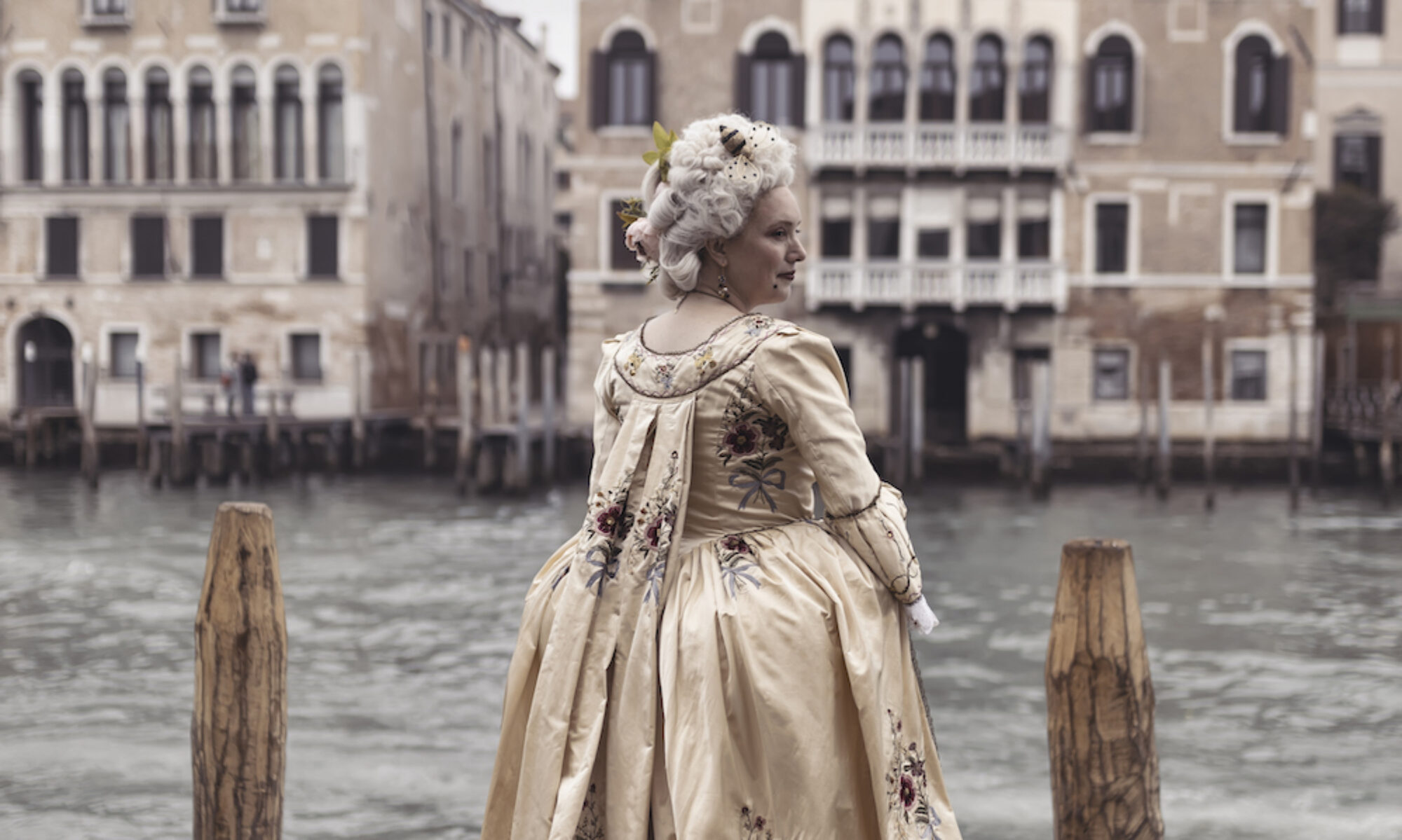
Last Saturday, La Societe des Lumieres held our first (hopefully more than annual!) Salacious Sleepover. The whole idea was to get together (as our 18th century characters) wearing our period undies, eating lots of dessert, and reading/viewing 18th century literature (ahemeroticaahem). Although we were a small crowd, it was WAY too much fun. Everyone looked fabulous, we had a huge spread of food that we didn’t even make it halfway through (champagne cake! yum!), LOTS of champagne, and some blush-inducing literary readings. Shocking, I say!

We lit the whole place by candles, which really added to the ambiance, but it means the pictures turned out pretty dark. Plus, we weren’t really going for standard “here’s my costume” shots but rather fun portraits. But, of course, as any good costumer, we did take lots of photos! So here they are. Don’t worry, all is SFW (it wasn’t THAT kind of party!).

You’ll note that I’m wearing a new corset — it’s not really new, actually. I’ve always been bored by my white and silver stays, plus the silk satin has been fraying at the seamlines. So I, crazy woman that I am, sat down and ripped apart my old stays (which I love the fit of, I should add!), and recovered it in peach taffeta (left over from my recent francaise) with green binding and corded seams. I’ll take some better pictures and post more info; plus, I also recovered some shoes (which aren’t done yet; I’ll also post some photos & info on those soon).

I’ve been sick as a dog, which is what’s been inhibiting all of this picture taking and posting… I’m nearly better, so I promise to actually START on my Gwendolen dress soon!

Book Recommendation

I recently received my copy of 18th Century Embroidery Techniques and while yeah, okay, I haven’t exactly READ it yet, it looks really exciting. A comprehensive overview of the techniques of embroidery in the period, including good clear descriptions so you can do it yourself, plus lots of really pretty color pictures of period embroidery examples. I recommend it to anyone interested in the period.

18th Century Sack-Back Gown Workshop Report

Wow, am I wiped! I spent the past two days sewing sewing sewing, with side trips to the land of fabulous friends, wine, and too little sleep. But the workshop was really really cool! It was taught by Janea Whitacre, who is the supervising mantua maker at Colonial Williamsburg. What a job! We focused on the sack gown of the 1770s, spending Saturday learning how to make the gown (and splitting up the actual making of the various parts of one gown among ourselves), then Sunday we draped our own.

First, fabric report: I did go peach, and was saved by the fabulous Diana of Renaissance Fabrics who sold me this peach/gold shot silk taffeta, which was far more interesting than the paler, more muted fabric I had found before.

The draping method Janea taught us was very intuitive. It was so helpful to hear her experience looking at a bazillion period examples. What it really brought home to me was how because this style of gown was handmade, and draped on the body, there aren’t really “right” ways to do anything. Of course, there is a range, but if you needed a tuck here or a piecing there, they would have had the same problems and come up with the same solutions. So it felt liberating to just go with what worked rather than “but Janet Arnold shows a slit there!” Janea is able to measure everything just using handspan and fingerspans — she said she banishes tape measures for her apprentices — so again we went with just what worked or looked right.

I think the best part of the workshop, overall, was working on our own dresses on Sunday. There is nothing like having a gown draped on you by about 2-5 very talented costumers, or to be draping someone else and being able to call those 2-5 costumers over to get their opinions on that slash you’re about to make. We were draping our gowns out of the fashion fabric itself, which was fine when it happened on me, but was terrifying when I was working on others. I just kept cutting only teeny tiny little bits, and triple checking, before going any further. The responsibility!

My dress is only very partially assembled. The back pleats are basted on to the back lining, and the front is pretty well fit (the back needs some adjustment), plus I have the sleeve patterned (draping sleeves really works well when you’re not trying to do it on yourself!), and the petticoat pieces cut. Otherwise, I’ve got a lot left to do (luckily with lots of fabric left over). I am planning to hand sew the whole sucker (for the glory, and because I love handsewing), and I’m hoping to have it done by Costume College (don’t be sad, 1910s fans, but I am hoping to wear this to the gala rather than the Lady Maud 1910 evening dress). I’m not a believer in secret projects, but I do think that since I’ve started this offline I will keep it offline, so at least people will be surprised by seeing it in person even if they know what I’m working on.