Silk taffeta ribbon?

I really want to post my recap of the Burnley & Trowbridge Brunswick workshop, which was amazing, but WordPress is being fussy and not posting galleries… and what’s the point of a costume post without pictures, I ask you?

So in the meantime, I will whine and ask y’all if you have any suggestions of where I can find silk taffeta ribbon (about 2″ wide-ish)?  I’ve been googling, and all over ebay and etsy, and all I’ve found has been the wrong color (I need ivory), or not silk, or not taffeta, or questionable whether it’s real heavyweight taffeta or just china-silk-esque, or something crazy like $50/yd.  I suppose I could get some yardage and do a teeny tiny hem, but… I just want silk taffeta ribbon!  Any ideas?

England Trip Report #2: What I Wore (and Made)

There was a mad rush of sewing to get ready for the England trip, naturally.

As previously posted, Michael’s doublet was nearing completion but he felt it was too tight.  I thought about piecing in a gusset in the CB, then realized that would just get wonky, so I literally took out the whole back and remade it.  Ugh!  I know I could have made him suffer, but I wanted him to be happy.  I really wanted to make him a hat, and bought the pattern and everything, but the timing was just too tight.  Maybe if he ever wears it again!

Final photos – and by popular request, a ruff (okay, some ruffled eyelet lace) for Sir Winston:

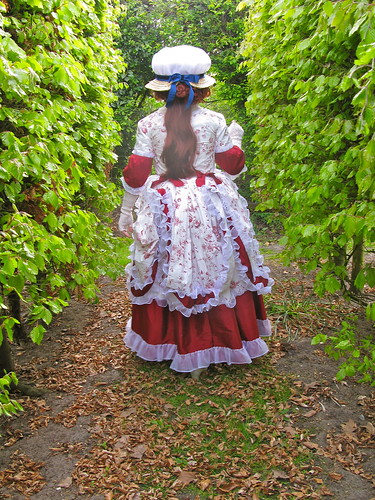
For me, the big project was a c. 1780 robe à la polonaise, which I took pictures of while I was making but totally neglected to do a dress diary… the reason for which will need to be another post! It’s made of red and white printed cotton (a duvet cover from Ikea), trimmed with red taffeta (which was supposedly silk when I bought it in the $7/yd silk taffeta garment district madness, but when Sarah burn tested her fabric, she reported it was not silk – bastards!), and yards of white organza ruffles.  I handsewed most of it, except I hemmed and gathered all the organza ruffles on the machine (hey, I’m not crazy!) except for the bottom ruffle on the petticoat, where the ruffling would show… and I ran out of time, so a lot of the sleeve was done on the machine.  I’m really pleased with it, especially the fit — I’m tired of always being the boobed wonder when I wear 18th c., so I made the neckline pretty cover-y — it might even be TOO narrow, but I’m not changing it now!  I do still need to add some braid to the back seams, but I can easily get that done before Costume College.  I’m thinking I’ll wear this to the Gala unless I get a wild hair to make something new… but that’s another post, too!  I promise to do a full write-up on the dress at some point, but again, more on this subject in another post.

I also remade my 1780s capote to have a poufier top (ie remade it in a couple of layers of silk organza), and retrimmed it as the green scheme made the outfit Christmas-y (I figured blue was complimentary without being matchy).  I used a vintage feather trim that I got at Costume College a few years back.  Finally, I wore the lace knitted mitts that I’ve been working on for a while – a totally modern pattern, unfortunately, as the only period patterns I could find were very butter churn-y and winter-y.

Finally, I did widen the neckline on the medieval gown — it was a rush job the night before we left, so I just put the dress on inside out, marked a wider neckline, cut some bias silk and finished it quickly.  I was worried it would stretch out or do something funky, but it seems to have worked!  I have a LOT of bust in it, but otherwise it turned out to be prettier than I’d thought and I had fun swanning about in the bluebells in it.

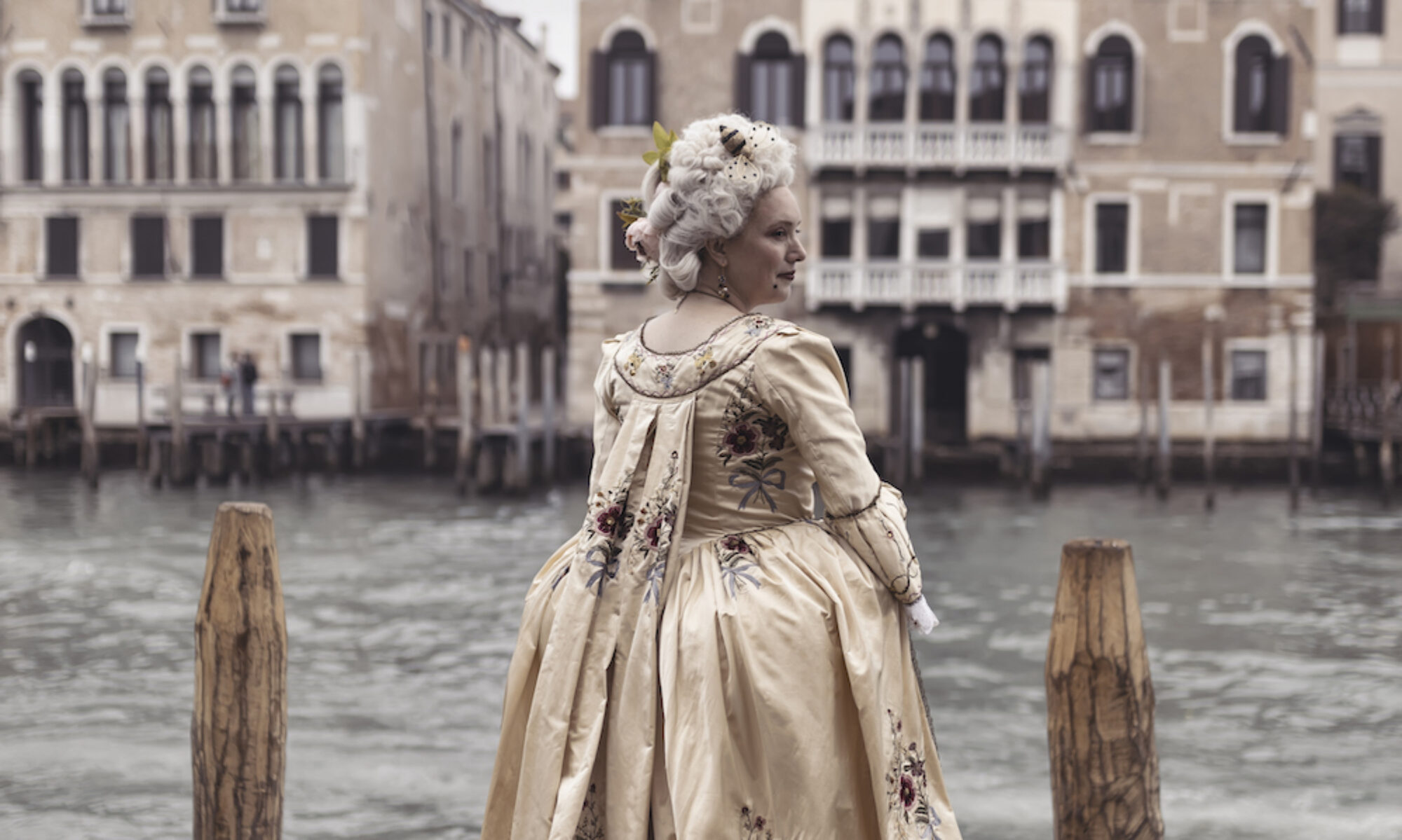
Oh, and I wore my green Venetian, but that’s very this-old-thing to me these days!
Brunswick Workshop Opening – SF Bay Area

West Coast costumers take note — a spot has opened up in Burnley & Trowbridge’s Brunswick workshop, May 28-30 in Vallejo.  I’m going to be taking this workshop, and I highly recommend that anyone interested in 18th costume grab this spot!  It will be taught by Janea Whitacre, who is Milliner and Mantua-Maker at Colonial Williamsburg.  She taught the sacque draping workshop that I took a few years back, and I was incredibly impressed by how much detailed knowledge she has about 18th century dressmaking.  Even if you’re not thrilled with the Brunswick style itself, this is an amazing opportunity to learn 18th century dressmaking techniques, which could be applied to any number of garments.

18th Century Brunswicks and Jesuits

As previously mentioned, I’ll be taking the Burnley & Trowbridge brunswick workshop in May.  Of course, I had to immediately scour my sources to find information about this garment, which until about 2 days ago was a relative mystery to me!

Aileen Ribeiro, in Dress in Eighteenth-Century Europe, writes that a brunswick or “German Habit” was, “A long-sleeved version of the sack, usually three-quarter-length and with a high neck and a buttoned, unstiffened bodice…. widely worn in Germany in the middle of the century” (146).  Colonial Williamsburg’s glossary of colonial lady’s clothing says a brunswick is, “A three-quarter length jacket worn with a petticoat, the Brunswick was an informal gown or a traveling gown. It had a high neck, unstiffened bodice that buttoned, long sleeves, and frequently had a sack back (loose pleats) and a hood”; while a jesuit is, “Similar to the Brunswick, but the skirt of the gown was full length.”

The style appears to have been most popular in the 1760s. They were cut like a sacque gown, with the full box pleats in back.  The full length sleeves were made by connecting the usual elbow-length sleeves (complete with sleeve ruffles) to a separate lower sleeve.  According to posts on the 18cwoman list, this was because they were made by mantua makers, who did not use the technique of a shaped long sleeve (used by tailor’s on men’s garments); the separate lower sleeve allowed the sleeve to fit the elbow. Ribeiro writes that while early sleeves had a break at the elbow with a ruffle, by the end of the 1760s that was replaced with a small ruched cuff (although it is unclear whether she means that the elbow ruffle was replaced, or whether that was dropped and the ruffle is now at the cuff) (146). According to the information provided to those of us taking the workshop, brunswicks were not worn over any skirt supports (ie side hoops or bumrolls), although I have found one image (below) of what is probably a jesuit worn over side hoops.  It appears that most are high necked, although at least one of the confirmed brunswick images (Sophia Pelham) has a lower neckline; there are other possible brunswicks/jesuits with low necklines as well below.

Barbara Johnson’s Album includes two relevant fashion plates, one of each style. The brunswick has military-esque folded back revers with buttons.  The jesuit is very similar, except for a longer length overskirt.  Both have the usual petticoat ruffle and loopy-patterned ruches that you’d expect to see on a 1760s sack, as well as straight ruches along the overskirt openings.  There is one swatch for a brunswick:  “a Manchester Brunswick twelve yards” from 1772; the fabric is a small blue and white check, which reminds me of a modern gingham.

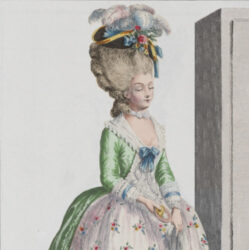
Here is a gallery of images of probable brunswicks or jesuits. Most of the fabrics appear to be silk taffeta or satin, although there is one cotton print.