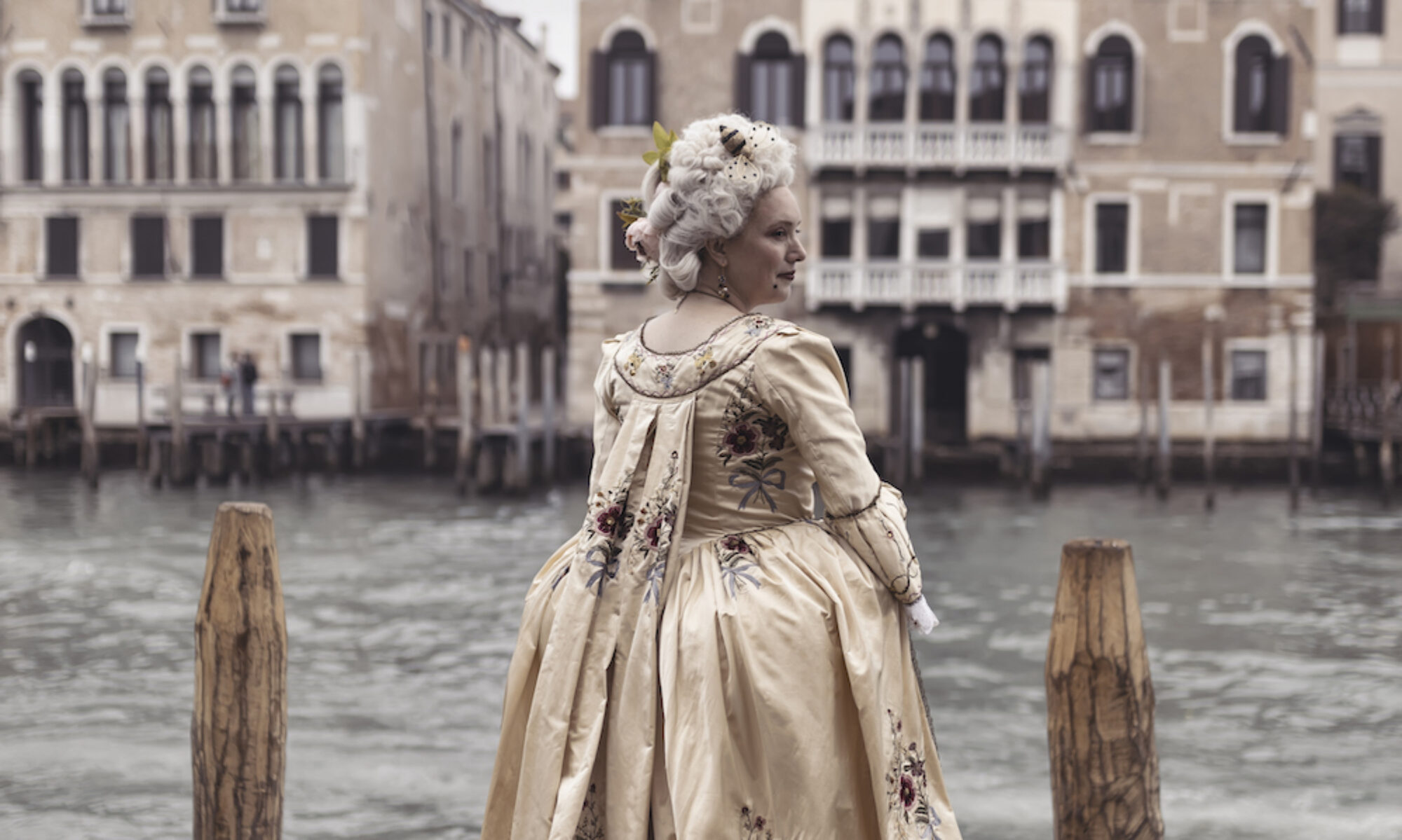
So, I am starting to stress about all the sewing I need to get done before Williamsburg, which is in, uh, a few weeks? I don’t know, I don’t want to look at a calendar. I think I can get it done in time… but there are lots of things to do! Gotta make my 1780s stays wearable, finish my Brunswick, and bang out a riding habit — it can be done!
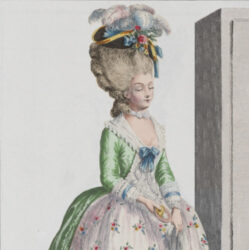
I’m starting to stress about a hat for the riding habit (and possibly the Brunswick? dunno). I want to do a blackhat with tons of feathers like you see in the fashion plates, but it’s hard to see exactly what is going on there under all the feathers… and I don’t have a lot of time!
So, this brings me to my question — is it doable to get a black wool hat on Etsy/Ebay and reblock it (steam/wet it and dry it over a form)? From what I can tell, it looks like the hats are big enough to go over the (low) wigs, which means a waaay bigger headsize than anything I’m going to find. And I just don’t have time to really make a hat from scratch, so I’m thinking get something with a decent size brim, reblock the crown, mess with the brim, and stick a lot of feathers on it. Does this make sense? Am I on the right track?
I FINALLY finished boning the 1780s stays. You know how you read about how 18th century stays were made by tailors (men), not mantua makers (women), in part because it was thought that one needed a man’s strength to get the baleen into the stays? Well, I don’t agree that men = strong and women = weak, but I gotta say, sticking that German plastic boning into the casings was HARD. No doubt, some of my channels were slightly too narrow (they were fine for metal boning, but the plastic is slightly thicker, so it takes up a little bit more room). Some went in smoothly, and others took MULTIPLE teeny-tiny shoves… so much so that it took me the good part of Saturday to (cut, sand, and) stick in the boning, and my arm still hurts a bit three days later.
I draped and drafted out a strap pattern a while ago… but apparently I am a genius, because it’s not in the pattern envelope, nor is it anywhere else in my sewing room that I can find. Sigh. So I draped yet another!
Here’s the stays with all the boning in, draped temporary straps, still no tabs cut:
As I’ve had 18th century riding habits on the brain for a while now, with my upcoming trip to Colonial Williamsburg (or, as I termed it to Cynthia the other day, “18th Century Disneyland!”), I thought I’d share some images and research! I do like a good image/source hunt, after all.
The best source that I’ve found thus far is: Blackman, Callie. “Walking Amazons: The Development of the Riding Habit in England During the Eighteenth Century.” Costume, Vol 35, 2001.
Riding habits were long worn as functional dress, but in the second half of the 18th century, they became fashionable dress as well. In addition to riding and hunting, they were worn for travelling, walking, visiting, and at home wear — in other words, informal day wear.
Stylistically, they tended to follow men’s clothing, and you will see cuts/fabrics/trims that are popular in men’s clothing show up in women’s riding habits of the same era. One area that you’ll specifically see this in is the cut of the waistcoat, which has long “skirts” in the 1750s-60s, but a simple V front in the 1770s.
From what I can tell from looking at LOTS of images, it appears that they could be worn over hoops from about the 1730s-50s; by the 1760s, it appears that they were generally worn over just a petticoat (or perhaps small hip pads?). Waistcoats cut to fit over hoops had a seam at the waist, and opened into an inverted V (from waist to hem), to allow for hoops.
Habits were generally made by tailors (rather than mantua makers, who made women’s dresses), and thus were constructed like men’s wear. According to Blackman, they “invariably buttoned left over right.”
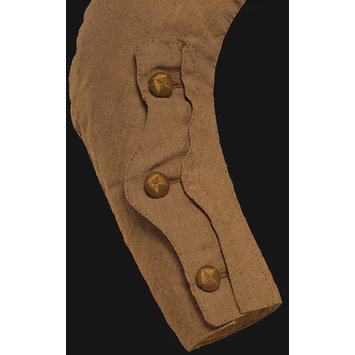
There were a variety of sleeve treatments, including cuffs, flared end, and the mariniere sleeve. Pockets could be functional or false. Early styles had simple or no collar, while later on deep revers and high collars were popular. Waistcoats could either be separate garments, or a false front sewn into the jacket. The petticoat was cut simply, with pleats concentrated at the sides (1730s-70s) or back (1780s-90s).
There were a wide range of colors possible. If it was intended primarily for riding or hunting, it was often red, navy, or green. Habits meant more for fashionable wear could also be in other colors; blue, brown, beige, yellow, and even white were popular. Fabrics were usually wool or a wool/silk blend, although there is a 1780s riding habit at LACMA that is in silk faille.
The wars of the 1770s made it fashionable to have a military look to one’s riding habit. Red was increasingly popular (I assume modeled on the British army uniform?). Habits were made to look like the uniforms of specific regiments.
By the 1780s-90s, women increasingly wore the redingote, which was styled on the Englishman’s greatcoat, although you still see riding habits pop up.
Habits were worn over “habit shirts” (see Nicole’s post for a great rundown of this style) and neckwear (cravats, stocks, or kerchiefs). Hats varied by era; tricorns were worn by English/American women only in the first half of the 18th century (but continued to be worn by Continental women — see the portrait of Marie Antoinette from 1771), followed by jockey caps in the 1760s, high crowned hats in the 1770s-80s, and tall, cyclindrical hats in the 1790s.
I recommend reading Nicole and Carolyn‘s riding habit project overviews for some nice details and construction info.
Today, part one of my giant vat o’ riding habit sources! Part II coming next week.
Seeman, 1700-30
1700-50
Van Loo, “Halt in the Hunt,” 1737
Lancret, “Picnic after the hunt,” 1740
Pesne, “Prinzessin Amalia von Preussen,” 1740s-50s – these super ornate ones seem to be a very Continental style
Pesne, “Sophie Marie Grafin Voss,” 1746
Wootton, “Lady Mary Churchill,” 1748
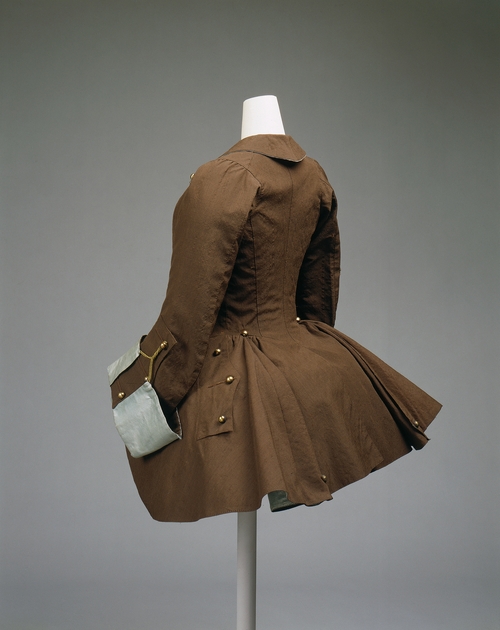
1750s habit jacket at the V&A
1750s Habit at the V&A
1750s Habit at the V&A
after John Simon, “Anne, Princess of Orange,” 1750s
Finished that final seam last night – yay! Then came the 15 min. hunt through the sewing room for the boning I’d ordered, which came last week, and (brilliantly) instead of putting it with the rest of my boning, or anywhere else logical, I stuck it in my “random sewing tools” drawer. Go, self.
I was too tired to do more than put in the metal bones, which are in the back piece (center back, and then inside of the eyelets), side front (1 right along the seam, next to the center front), and 3 in the front (center front, about midway across the piece, and then near the side seam). I’ll need to cut the plastic boning to the correct length, and I’m thinking I should probably sand the ends a bit so it’s not poky, and I didn’t have the energy to do that last night. And I haven’t yet cut the tabs. So, not a lot of boning + no split tabs = some wrinkles!
But, it fits! Next: straps! Then: attempt to bang out a riding habit while simultaneously finishing up my Brunswick and binding the stays — AGH!