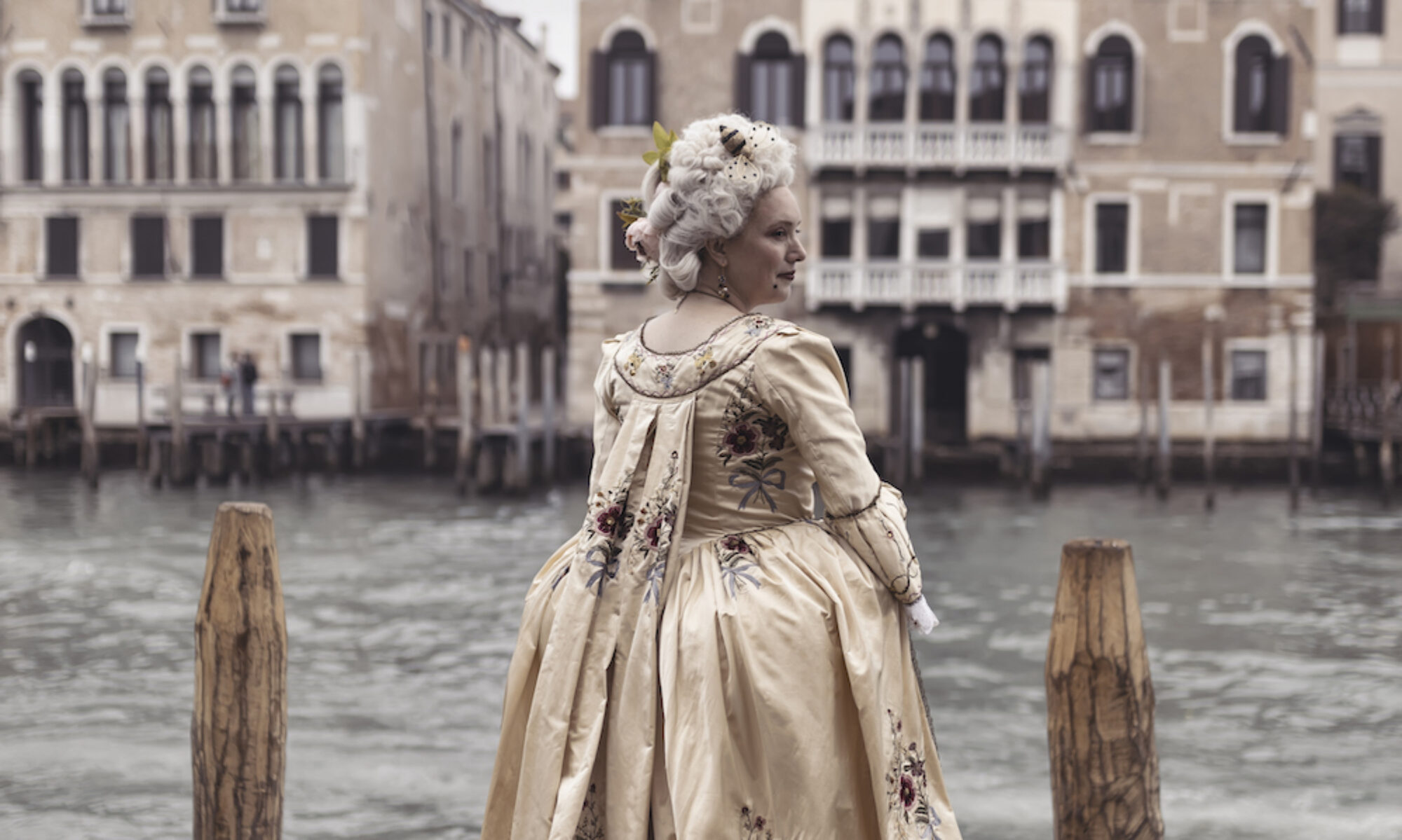
The GBACG Petit Trianon event was FAAAAAABULOUS! The venue — the Bellevue Club, located on Lake Merritt in Oakland — was simply gorgeous. The main room we were in was 2 stories tall, with pink walls, gilt accents, antique-esque furniture… one of the better venues I’ve been in here in California!
Many of us were cast as specific characters, so I had a fabulous time running around play the Duchesse de Polignac. We had Marie-Antoinette, Count Fersen, the Duchess of Devonshire, M. Leonard the famous hairdresser, the evil aunts Victoire & Adelaide (ok they weren’t EVIL), and — most entertainingly for in-character play — du Barry! I had a great time talking up how TACKY she was all night, and accusing her of stealing my feathers.
The champagne flowed, there were hors d’oevres and little desserts, the bartender was dressed in an 18th c. outfit, the conversation was fabulous, there were elegant ladies and dashing gentlemen. Yay!
I had my 1787ish round gown and silly hat done in plenty of time, which was quite nice. I added some vintage millinery flowers to the hat and safety pinned it to my wig! I’m still waiting on a light colored wig (backordered), so I used one of my darker Bella Donna wigs, just to mix things up.
Because some people have asked… I plan to soon offer earlier (1750s-60s) styles, as well as men’s styles.
While my own focus has been on historically accurate looks, I am happy to make fantasy-inspired 18th century style wigs, and/or work in crazy colors (blue, pink, etc.)!
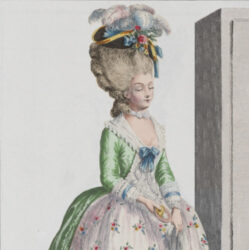
I have decided to finally take the leap into offering custom 18th c. wigs, styled by me, on commission. At this point, I am offering 1770s tall “pouf” wigs (like the one pictured below), and 1780s frizzy “hedgehog” wigs.
The Maja project is trucking along! I spangled seams! I sewed the neckline and CF edge! And then I bound the bottom of the CF and the whooooole bottom edge… which, phew, was a lot of binding! I did the 18th-c.-preserve-fabric thing and cut all the binding strips on the straight, which was fine as I just mitered the corners… except for a bit too much fraying. Uck! This was one of the longer bindings I’ve ever done, as there are 5 million tabs. I realized that my jacket turnback facing didn’t QUITE go down long enough — not sure what I was thinking! So I need to piece in a little 1-2″ square. Whatever, random!
I’ve now patterned the sleeves, cut them out, marked them, and am busy spangle-ing away. Mela said something really helpful about my recent riding habit project — she thought that the weird bust wrinkle was caused by the sleeve pattern. Well, I think she’s right! I had a weird angle going on on the sleeve cap in front, without really enough fabric in there. So I fixed the pattern for this project (oh, right, point is I started w/ my riding habit jacket sleeve pattern) and at some point I’ll make new sleeves for the habit, which hopefully will fix the problem!
Again, I’m glad I scanned that high res version of the Maja painting, because it made me realize that there is not ONE but TWO rows of spangles on each sleeve seam. And it helped me figure out that they’re not mirrored, but more interlocking if that makes sense. The spangles on the cuff were weird, and I had to redraw the line about 50 times.
Two things I’ve been wondering about:
First, there’s a little, almost heart-shaped, black line on the sleeve above the toggles/buttons. It doesn’t make sense in terms of the spangle pattern — why would there be a little blip of spangles there? So I was wondering if maybe the toggles/buttons are functional — I doubt the sleeve would OPEN there, but maybe the toggles/buttons are used to tighten the sleeve at the cuff, and so that black squiggle is a small wrinkle?
Second, I read in one of my sources (gotta go back and refind the citation) that the sleeves on Maja costumes were generally tied on. I thought that was weird for 18th c., but whatever, it’s a weird style! Well, I was remembering what an 18th c. costume expert was telling me about another costume expert who uses art historical methods exclusively, and how she therefore sometimes gets things “wrong” in terms of what is seen on extant garments. And I started to wonder if maybe the thing I read about the tied-on sleeves was actually someone misinterpreting the pleated/ruched ribbon seen on the armhole and sleeve cap of most Maja/similar styled costumes? Because in the painting, there’s no space between the armhole and the sleeve cap, the way there would be if it were tied on, nor can I see any ties except some loose ribbon at the end of the trim. And, all the paintings I’ve seen generally have one of two armhole/sleeve cap trims, shown below on some extant Spanish garments, and these don’t appear to be tied on either.
So I FINALLY got off my butt and scanned the better resolution picture that I have of the Maja portrait… and I’m really glad I did, because of course I am now finding little details that I missed! Like, the black trim around the armhole has the occasional spangle on it!
Now, I am trying to figure out the buttons. I had assumed they were all the same style, and were some kind of passementerie/thread wrapped button. But now that I look at them in higher resolution, I see there are TWO different styles — one that looks like some kind of spiky, knotted? or passementerie? button, and something that I think may be a toggle… but then has some spiky-ness involved. OR are they buttons and toggles that are laid on top of some kind of embroidery? WTH?
I got the book 50 Heirloom Buttons to Make which is really great, hoping to find something in there that would look similar. So far, nothing obvious… there are toggles, and knotted buttons, and thread wrapped buttons, and they all are similar, but nothing really close.