1938 Marie Antoinette – A little bit more + Official photos

So I thought I’d post just a little bit more about the 1938 Marie Antoinette sorta-rocket dress.

The rocket dress from Marie Antoinette (1938), designed by Adrian and conserved at LACMA.

I didn’t take very many pictures while I was making the dress, because I wasn’t blogging about it and I was focused on just getting it done!  But I did take a few photos that show a bit of the process, plus I’ve finally gotten the official con photos of the outfit, and I gotta post those!

Here's a crappy early evening/outdoor photo of the pannier from the back.

I used Simplicity 3635 — I know! — for the pannier.  I looked at the diagrams in Norah Waugh’s Corsets & Crinolines and Jean Hunnisett’s Period Costume for Stage & Screen, and found that they were really similar.  The only real tweak I made to the Simplicity pattern is that I put boning in the bottom hoop.  If you look at the pattern image, you’ll see the pattern breaks off around mid-calf, which I think would look really ugly underneath a skirt!  Plus, I’m 5’11”, and I can use all the length I can get.

Because I am cheap and couldn’t stomach the thought of paying for all that hoop wire, I ended up using 3/8″ half-round caning from the Caning Shop, which was super cheap!  I was, however, terrified that it would break, particularly when packing the giant hoop o’ doom into the car for the drive down to Costume College.  So I ended up doubling the cane in each casing, which worked out great in terms of supports — no cracking, breaking, etc.  One thing I did that you may want to avoid, however, is I initially thought that the half-round cane should go into the casing flat side to flat side, so that it would make one whole round — I thought a flat side against curved side might lay weird.  Well, I found that the cane wants to go around with its natural bend, and when you put the second piece in flat to flat, you’ve got one piece of cane that is trying to bend against its natural curve — and things go wonky!  It didn’t curve nicely and ended up sort of warped looking.  So I pulled it out and put it back in, flat side to round side, both pieces curving along their natural curve, and it all laid fine and made a lovely shape.

A super crappy shot of the base skirt.

I wasn’t sure whether I’d need a petticoat to avoid the individual hoops sticking out, but I decided to make the skirt first and see if I needed one.  I made a base skirt of grey cotton, because in looking at the original dress, I misread the top lace swags as a separate piece, not just applied swags like the lower pieces.  I used Katherine/Koshka’s 18th c. court skirt tutorial to start, although I had to do a lot of futzing to get the end pleats to hang where I wanted them.  It was REALLY hard to level the skirt given that my dress form was a floor model and so has a decided lean and rickety-ness to it!  I ended up marking one side, and then matching the other side to those markings, and crossing my fingers.

The pannier/skirt was SO huge, I had to move it all into the living room while I was working on it.  Luckily my husband was out of town for about 5 days, so I was able to take over!  Unfortunately, the dogs discovered the joys of “I hide under the skirt and get you,” so I had to swat them away.  A lot.

(C) Andrew Schmidt, http://photos.theshotwellcollection.com/

I attached the satin skirt to the cotton underskirt.  The base of the satin goes up to about where the hoop starts to go down rather than out.  The cotton underskirt and upper satin skirt are all sewn into the same waistband.

The lace around the overskirt is cut from that same yardage and hemmed.  I made the flowers from the same satin, after trying to find some vintage silver flowers (no dice) or modern fabric flowers that weren’t cheesy (ditto).

A crappy shot of the bodice in progress (crappy photos seem to be a theme here!)

This is the only in-progress photo I took of the bodice, which is very Victorian in approach.  I tried to follow the lace layout on the original, cutting motifs out of the lace yardage I had and hand sewing them to the bodice.

(C) Andrew Schmidt, http://photos.theshotwellcollection.com/

The bodice closure uses the technique found in most 18th c. court dresses, where the bodice and lining are separate for about 1-2″ along the center back.  Lacing holes are put into the lining layer, and therefore don’t show through the fashion fabric.

Makeup test #1: Kryolan Aquacolor in white

I did a number of makeup tests with Leia, which didn’t start off too well.  We read a number of posts on Cosplay.com, and most everyone recommended Kryolan Aquacolor.  Although we planned to use grey, I had some white on hand that I messed with… and I swear, anything more than the first layer seen above made me look like I was covered in calamine lotion.  NOT good.  And one layer left a lot of pink showing through.

Makeup test #2: Kryolan Supracolor in white mixed with black

Luckily there’s a Kryolan store here in San Francisco, so I went in for help, and they showed me Supracolor, which is an oil-based makeup and therefore SO easy to apply!  It goes on smooth and moist, and you can mix colors easily on your skin or beforehand (I mixed white with black to get grey), and it’s very moveable until you set it with powder and setting spray.  The rest of my makeup I did with standard makeup — grey and white eyeshadows and a grey eyeliner.  I’m a lip balm addict, and was REALLY worried about putting something drying on my lips and having to not touch it all night.  I ended up covering my lips thickly with my usual lip balm, and then coloring over that with the grey eyeliner, which actually made a bit of a lipstick-y paste… and I managed to go all night without wanting to rip my lips off and dunk them in a bath of Burt’s Bees, which is saying something!  (Come on, fellow lip balm addicts, you know you feel me).

Detail from a photo (C) Andrew Schmidt, http://photos.theshotwellcollection.com/

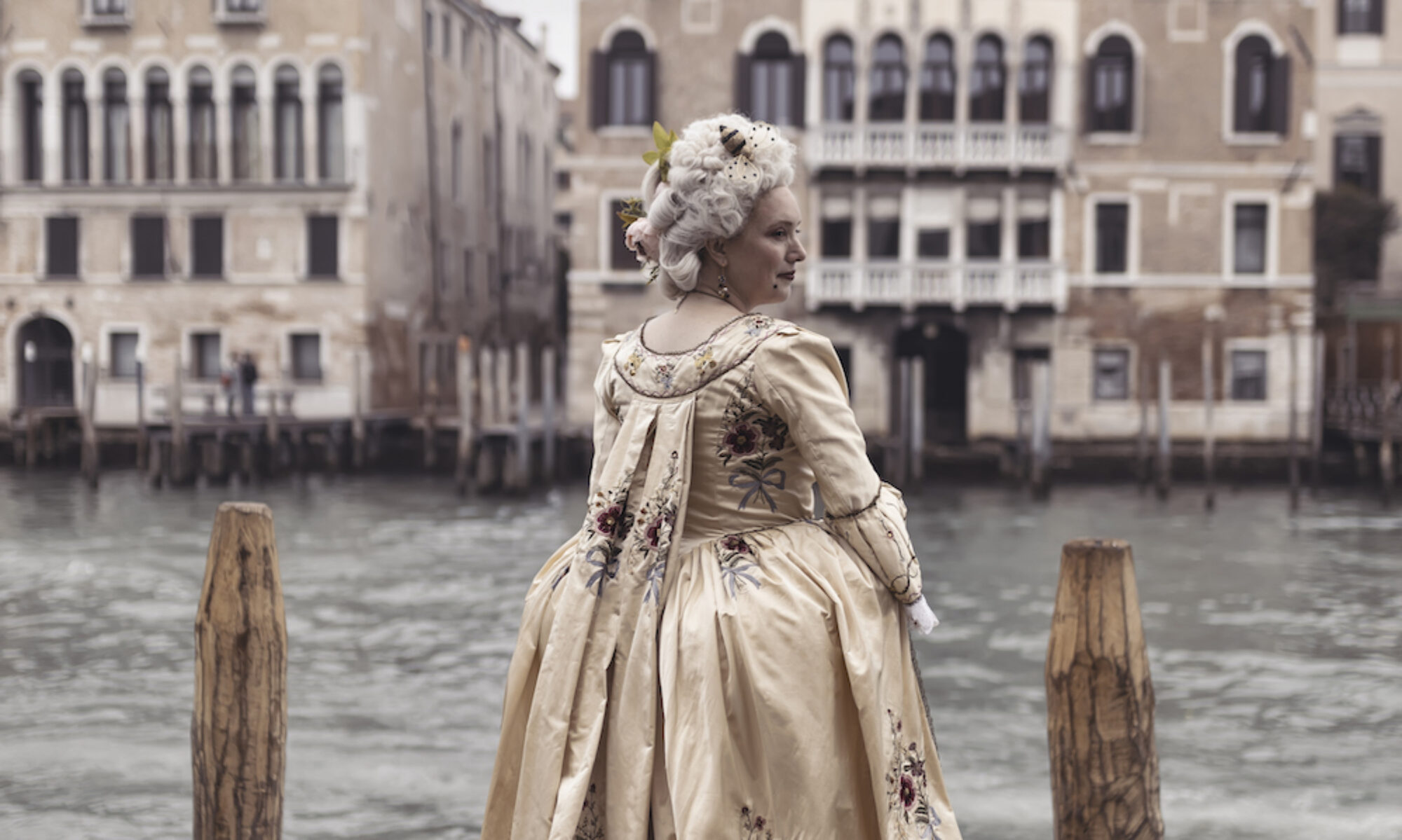
I was super excited about my jewelry.  The necklace is FABULOUS and, shockingly, came from H&M a year or so ago, a present from the fabulous Trystan.  A couple of people asked about the matching rhinestone bracelets I wore, which were dirt cheap (like $4-5 each with free shipping!) from Alilang on Ebay.  And this was the first wearing of my SUPER-EXCITED-ABOUT QVC Marie Antoinette earrings, which are amazing reproductions of a real pair of Marie Antoinette’s earrings, conserved at the Smithsonian.

And lastly, a few more official photos!

(C) Andrew Schmidt, http://photos.theshotwellcollection.com/

18th C. Hairstyling Book – Houston we are GO!

Thanks SO much to everyone who gave me your feedback on the idea of an 18th century hair/wig-styling book!  I got a TON of positive, useful feedback and I really think it’s viable, so I am going to go for it!

I’m still crunching the data I gathered on the survey, and exploring options for images.  I’ve ordered myself a practice mannequin so I can work out the specific styles I want to do.
And there are some things I want to do a bit more research on, like caps — how ubiquitous were they?  Etc.

I even appreciate those who said they WOULDN’T buy the book, because that’s helpful to know!  It seems like those few are more interested in a book on 18th century techniques, which I agree are interesting, but I just don’t see myself (or the bulk of costumers/theater people) wanting to make pomade out of beef tallow and setting curls by baking hair on clay curlers in ovens.  It just doesn’t sound viable.  I’ll certainly be researching how they did it, and including information about that in the book.

~~~

My goal is to have the book ready to go for Costume College 2013!

And — what I’m going to do is use Kickstarter, which is a site that allows people to fund a project.  You can donate $1 or $500, depending on the various levels that I set it at.  Obviously I will have the basic “donation” be a discounted price on the book, and you’ll get a copy of the book at this discounted rate for pre-funding the project.  This way I can figure out the cost of the book and essentially pre-sell it… And the way Kickstarter works is that you figure out what your funding goal is, and if you don’t make that goal, nobody’s credit cards get charged — so basically you’d be buying the book, but if for any reason I can’t get enough people to buy a copy and the project falls through, you wouldn’t be out a cent.

So my plan is do more research and figure out hairstyles over the next couple of months, and hopefully do the real work with photography and writing over winter/spring.  I won’t start the Kickstarter pre-sale until I have things pretty firmly lined up with a finish date — so when a lot of the writing is done and I’m starting to work with models, and have a firm end date in site.  So, watch this space for lots more updates!

18th Century Hairstyling Book?

So, a potentially crazy idea… A conversation at Costume College got me thinking about the possibility of writing a book on 18th century hairstyling (and makeup?) — using modern techniques to achieve a historically accurate look, working with your own hair, adding false hair, and wigs.  Now, this could be a lot of work, so it wouldn’t really be worth the time unless people would buy it.

Here’s what I picture:

  • Something along the line of Lauren Rennells’ fabulous book on vintage hairstyling
  • Start with some history, include lots of pictures and source material (if possible?  gotta look into that whole public domain images thing)
  • Go over some basic your-hair styling techniques, like ways to curl your hair, tease, etc.
  • Go over some semi-advanced wig/false hair styling techniques, like different ways to curl/straighten synthetic hair, ways to create volume, ways to create rolls, how to attach wigs/false hair to your head, how to match colors, how to not look like you’re wearing a Wig, how to adapt a wig for different hairlines, etc.
  • Step by step instructions that walk you through hairstyle for different eras — I picture 1-2 styles for each decade, with some info on variations
  • Hairstyles would be those worn in France and England (there’s some differences b/t the two, and lots of similarities) — the English stuff could be extrapolated to those doing American
  • Possibly 1-2 styles that are appropriate for lower/middle classes, but most would be upper class styles — I would talk about ways to tone things down if you’re doing middle class
  • Mostly I’m picturing this focusing on women, but it could also talk about men’s styles
  • Possibly including some brief info on creating an 18th c. makeup look using modern products
So, crazy idea or good one?  I’ve created a survey that I’d love if you would fill out so I can try to figure out 1) if there’s a market for such a thing, and 2) what specifics people would want.  Please feel free to share any thoughts in the survey or by commenting here — I wonder if people are concerned about geography, class, etc…. And my forte is NOT “here’s how this recipe from this 1764 beauty manual makes up,” so again, we’d be talking modern/theatrical techniques — would that work for you?
Please feel free to forward this survey around!  The more input I get, the clearer an idea I’ll have as to whether or not this is a viable idea.

Here’s the survey:  http://www.surveymonkey.com/s/KDVJZY7

And, in case you aren’t a regular reader of this blog, here’s some examples of hairstyles and wigs that I’ve done:

18th c. costume exhibit in Brussels

Oh, if only I lived in Europe!  Another fabulous sounding exhibition:  Paniers, Baleines, et Jabots: la Mode au 18e Siecle at the Musee du Costume et de la Dentelle, in Brussels.  That being said… I visited this museum back in 2005 and wasn’t thrilled.  It’s relatively small, and what I mostly remember was cluttered exhibits and dim lighting.  Of course, it’s possible they’ve improved their set-up in the past seven years!  If anyone sees this exhibit, or just has been to the Museum in the past few years, I’d be interested to hear what you think.

Side note:  apart from this museum, Brussels has some AMAZING museums.  The Royal Museums of Fine Art, in particular, have some incredible collections.  If you’re interested, I took a bunch of pictures of costume-related art when I was there in 2005.  It’s mixed into a larger set — if you start with this picture and work left, you can see about 30 pictures that I took there.

Catherine the Great Exhibition in Scotland

If you can get to Scotland, check out the Catherine the Great exhibition at the National Museum of Scotland.  It looks fabulous for those interested in the 18th century in general, plus looking through the image gallery, it includes at least four costumes:  one of Catherine’s uniform dresses, two men’s suits, and a 1780s Russian court ensemble.  For those of us who can’t go in person, the museum has some interesting-sounding podcasts on Catherine herself and as a collector.