On Saturday, Lumieres (our 18th century role-playing group, for lack of a better description) held a dinner at the court of Catherine the Great of Russia… or Babushka restaurant in Concord! It’s a small restaurant out in the burbs, but perfect because the food was great, the staff were super accomodating (they even dressed up in loaner costumes!), and the decor (if you ignored the disco elements) was oldey-timey enough to look great by candlelight!
It was an absolute blast — everyone was literally resplendent in gorgeous gowns, fabulous wigs, and sparkling jewels. There was lots of in-character banter (my favorite), nice champagne, and flirting. Francis and I got together ahead of time and practiced the minuet, which we learned a few months back, and we performed it for the guests with only one false start!
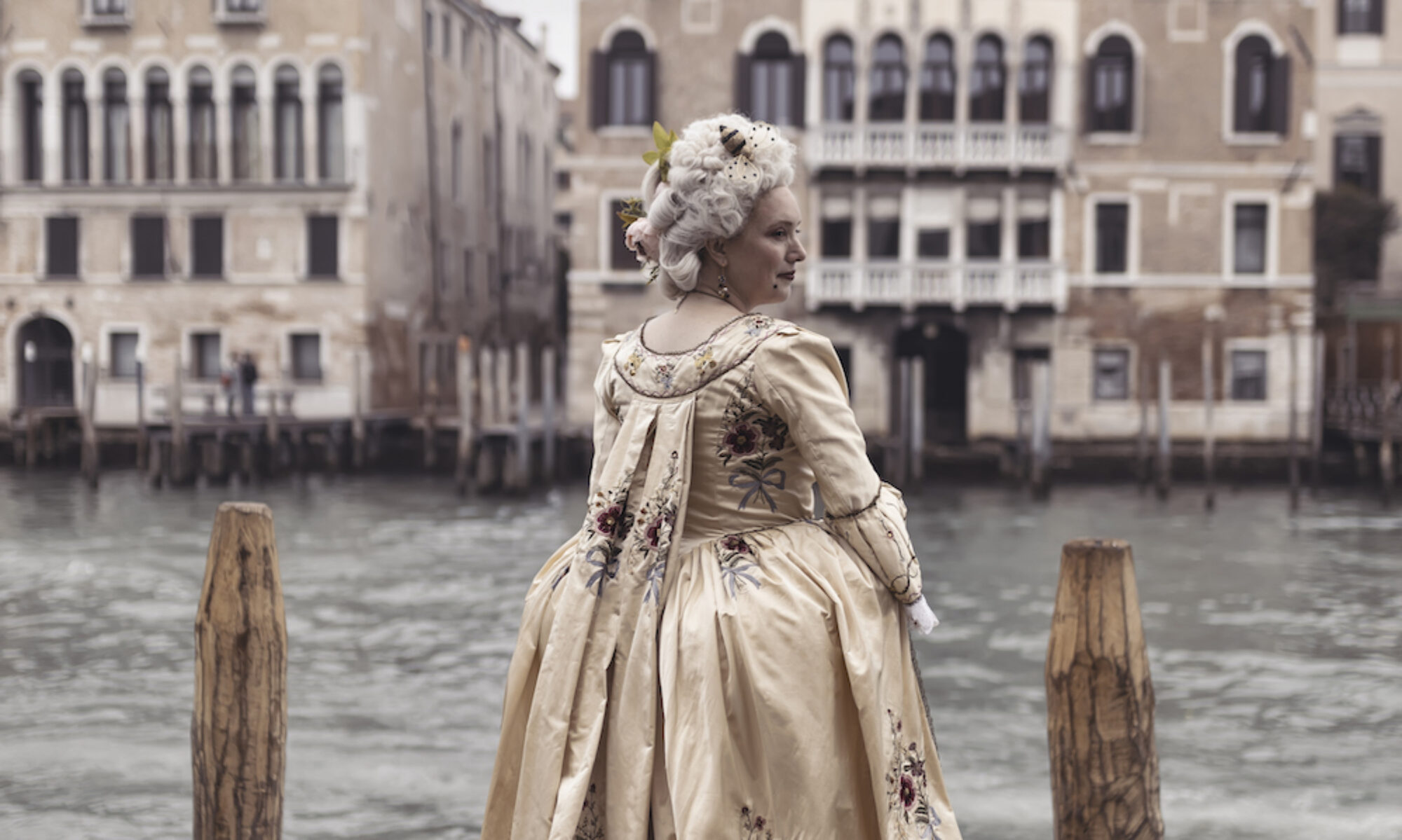
I wore my this-old-thing black francaise. I was itching to do a c. 1780 super powdered wig like one of these Roslin portraits, so I set to work with a blond wig I had bought a while back, hoping powdering over blond would maintain some warmth and work better on my skin tone. Well, I can report that powdered blond hair is still blond — duller, yes, but still blond — which totally doesn’t work on me. So that wig will get finished and sold on Etsy! Instead I pulled out the 1760s tete de mouton wig I styled for the Vampire Ball, which actually fits the era of the dress better, and powdered that. So nothing new, just a slight tweak. In the candlelight, it ended up looking like this:
(C) Linda Wenzelburger
Although here’s a flash photo that shows the warts & all — I’m posing with Trystan’s fabulous husband Thomas:
(C) Trystan L. Bass, via Flickr http://www.flickr.com/photos/trystbat/8441051749/
We were welcomed by Catherine the Great herself:
(C) Diana Habra via Flickr: http://www.flickr.com/photos/11524510@N04/8444027212/
And there was a LOT of scrummy scrummy costumes:
Cynthia
Liam in a wig I made for him, with his wife Karen
Cathy in a gown made by http://www.dazeoflaur.com/
Francis of http://raisedheels.com
A trio of loveliness: Toni, Katherine, and Catherine
Tara in a gown and wig made by Victoria Ridenour
Trystan of http://trystancraft.com with her husband Thomas
Sarah of http://www.modehistorique.com
The Empress with her ladies: Cathy, Diana, and Katherine
About a year and a half ago, I wrote an article for Foundations Revealed: The Corset Maker’s Companion on late 18th century skirt supports (called “bums,” “rumps,” and “culs” in the period). I’ve been interested in this topic for a long time, as the shapes I had seen and used didn’t seem to create the same effect that I saw in paintings and fashion plates.
I did a lot of research and pulled together as many sources as I could find, and then set about making test mock-ups to see how the different shapes would work. I ended up making a small version of each shape as well as a large, and then photographed each on an appropriately-sized model.
It’s long past the Foundations Revealed embargo period, but it’s still taken me forever to cross-post this article to my own site, as it’s so image intensive — but I finally have finished it. So, if you’re interested in what they might have worn under their skirts in the 1770s-1790s, please check out the article.
And since you might be wondering… I have ditched my “bumroll” shape (shape #2 in the article) in favor of #3 for 1770s-85, and and #7 for 1785-95. You can see more examples of me wearing these two shapes under my 1780 polonaise (shape #3), 1775 Maja costume (shape #3), and 1787ish roundgown (shape #7).
Because this ensemble is in white, I don’t know how riveting all these various pictures are going to be. Apologies! So, as mentioned in my last post, I’m going to be making this polonaise jacket and skirt. Because what is better for running around the garden of a French chateau, I ask you?
Before Christmas, I draped the bodice and took it to my mom’s house so I’d have some hand-sewing to work on. I’ve been debating exactly what I want to do for the underbodice effect — period options include a false waistcoat, separate waistcoat, or a stomacher. Since I’ve done the false waistcoat a number of times, and I like the idea of a solid front “underbodice” (ie no center front closure), I think I’m going to make a separate stomacher. But for fitting purposes, I initially made the lining close CF, so I could be sure everything fit well.
Here’s the extant jacket I’m copying. It’s a good example of the fact that there are numerous variations in the vertical pleating of the bodice — this one only has one pleat at the side front, unless something’s hidden under that sleeve, but I don’t think so:
Caraco, entre 1770 et 1780. Musée Galliera, Musée de la Mode de la Ville de Paris. GAL1992.177.X.Caraco, entre 1770 et 1780. Musée Galliera, Musée de la Mode de la Ville de Paris. GAL1992.177.X.
I’ve seen many variations in these pleats, which are what allow you to get some level of fitted-ness. I found that, with my high waist to hip ratio, I needed something more at the side or side back, so I ended up pinning in a pleat at the side which gives the jacket some shape.
Then during the holiday I managed to get all of that sewn down into place:
So if you’re an 18th century costume geek, you’ve probably noticed the discussions floating around about what is a “real” polonaise. I’m excited to report that Brooke Welborn, the researcher who discovered that what many modern day historians were calling a polonaise was not the same thing as what eighteenth-century people defined as a polonaise, and I (who had been researching the very similar robe à la turque for a few years) decided to put our heads together and research and write an academic article on the topic. It’s been accepted by Dress, the journal of the Costume Society of America, and will come out this May. I plan to write a summary of our findings and post them here as we get closer to the publication date (as well as info on how to get the full article), but the in the meantime, here’s the two sentence summary — no news to those of you who’ve taken Brooke’s polonaise workshops through Burnley & Trowbridge, or been to my classes at Costume College, or read the various blogs mentioning our research:
In the eighteenth century, the “polonaise” was a term for a style of dress or jacket that was cut differently from the robe à l’anglaise: it had a cutaway front, with the bodice closed at the neckline and sloping away into an inverted V shape (incorrectly called “zone”); the robe/jacket front and back were cut without a waist seam, with inverted pleats opening up from the seams, like a man’s coat. The term “polonaise” was never applied to any dress worn with skirts looped up; these were called “retroussée” in French (e.g. robe à l’anglaise retroussée), with no specific equivalent term found in English (dresses were worn “back” or “up”).
So look for a longer summary in the next few months, as well as my research into that pesky term “zone,” which I would like to hereby banish from everyone’s vocabulary!
Of course, I’ve had to experiment with recreating this style — a few years back I made a proper robe à la polonaise, but didn’t blog it as the more information you put out there, the more likely you’re going to get scooped! I will, however, post some more information about this dress as I get that research summary posted.
Now, I’d like to make a jacket version of this style, specifically this polonaise style jacket from the Musée Galliera in Paris, which I love for its froofy trim:
Caraco, entre 1770 et 1780. Musée Galliera, Musée de la Mode de la Ville de Paris. GAL1992.177.X.Caraco, entre 1770 et 1780. Musée Galliera, Musée de la Mode de la Ville de Paris. GAL1992.177.X.
I particularly love that if you look at the trim up close, you’ll see that it’s done in a windowpane cotton, while the jacket itself is in a solid:
Caraco, entre 1770 et 1780. Musée Galliera, Musée de la Mode de la Ville de Paris. GAL1992.177.X.
I’ve decided to fill out the ensemble based on this 1780 fashion plate from the Gallerie des Modes:
Camisole à la Polonaise, de Mousseline des Indes, doublée de Taffetas rose. Gallerie des Modes et Costumes Français, 31e. Cahier. 1780.
Specifically, the plan is a solid white cotton voile for the jacket and petticoat, with trim in a windowpane cotton. The fashion plate’s dress is a sheer cotton lined in pink taffeta, an idea about which I started to get very excited, until I realized that I didn’t have any solid silk taffeta that I could use in my stash, I really shouldn’t go buying a bunch of silk taffeta given my current budget, and when I held up swatches under the sheer cotton the lining color didn’t show enough to make me love it as much as I did in the abstract. So, I’m hoping I can maybe wear a colored petticoat from another outfit under the skirt, and of course a kick ass silly hat!
I keep wanting to do a 2012 wrap-up post, but am stymied by the fact that I have yet to upload photos from the GBACG holiday tea last weekend and then to post about said event. So in lieu of those posts, which are indeed forthcoming, let’s talk about the coming year!
I’m going to France! Specifically, the same group of friends who rented a manor house in England a few years back are getting together to rent a petit château in the very south of France, near Toulouse. I’m going to get to play dress up in this:
We are, as all sane and right-thinking people would do, making it all 18th century, all the time (for our costume events). So while I have some things in my wardrobe that I may bring along (one of my françaises, my Turkish ensemble for lounging, my proper polonaise for sure; maybe the round gown, or the gaulle, or the riding habit, or the Brunswick — oh god, I need to start whittling!), I am of course making some new things. Although after looking at that list, I am wondering why a bit…
For sure, I am going to make:
1. A 1770s camisole à la polonaise, this jacket filled out by this fashion plate:
Caraco, entre 1770 et 1780. Musée Galliera, Musée de la Mode de la Ville de Paris. GAL1992.177.X.Camisole à la Polonaise, de Mousseline des Indes, doublée de Taffetas rose. Gallerie des Modes et Costumes Français, 31e. Cahier. 1780.
2. This c. 1780 redingote as seen in this sketch of Marie-Antoinette:
Drawing of Marie Antoinette, about 1785, ink and color on paper, Artist unknown. From Lofstad slott, Norrkoping, Sweden. From the blog Fashion Is My Muse.
3. I’m also going to be making a hand tambour-embroidered waistcoat for Francis.
If I have time, I may also make either this robe à la turque:
Wille, Young Woman Admiring a Miniature, 1778
Or a 1770s robe à la française from this striped fabric:
Phew! I’ll be posting lots more about each of these projects — the camisole and redingote are actually under way — shortly. Plus that tea recap, and the 2012 recap!