Sleeves & Collar

Next up with the redingote was the sleeves and collar.  The sleeves are a pretty boring story, except:

1) I wasn’t sure whether to make a slightly elongated one-piece sleeve, or a shorter two-piece sleeve — I saw examples of both in Janet Arnold and Norah Waugh.  I tried the one-piece first, but the portion below the elbow gets so weird, that I decided it would be easier to go two-piece.  So I grabbed my pattern from the Maja dress and shortened it.

2) The cuff (and the collar) I’ve decided to make in black velvet, mostly because peering at the black pleated ribbon trim on the skirt makes me think black velvet ribbon.  I suppose it could be taffeta, but this is what I’m going with!  Anyway, the vertical stripes on the cuff are weird, and I had to play a bit to figure out number and positioning.  Sewing those down wasn’t too annoying, but the binding SUCKED.  I’m using pieces of white taffeta cut on the straight the way they would in the period, and hand sewing it down, and I even basted it… but no matter what, VELVET IS SO SQUIGY!  AGH!  The binding kept migrating so it’d be 3/8″ wide here and 5/8″ wide there and I had to unpick so many sections and resew them… what worked was 1) ironing the turn under, 2) ironing the point where the binding wraps over the edge of the cuff, 3) basting, and 4) unpicking/restitching over and over.  LORDY.

For the collar (SQUEE I’ve always wanted to make a big ole redingote collar!), I started with the pattern from Norah Waugh’s Cut of Women’s Clothes.  I’ve seen a number of redingotes in paintings with that extra triangular piece at the front of the collar, but I wasn’t sure about whether there should similarly be anything underneath the back of the collar.  I tried experimenting with a few different shapes and they all looked dorky, given that the illustration doesn’t show a double collar over the shoulder.  The collar looked so much like the one on this redingote:

Source: flickr.com via Jozlyn on Pinterest


But without the wider under-collar. So I followed something of the line of that collar in back, but again, just the one collar:

Source: flickr.com via Martina on Pinterest


Surprisingly, binding the collar was a piece of cake — possibly because I’d figured out the best way to approach it, or maybe because those curves made the velvet less squigy?  No idea, but I’ll go with it!

I was originally thinking maybe I’d finish the collar separately and then whip stitch it to the finished robe neckline, but then decided that would be annoying. So I opened up the neckline seam, herringboned the collar to the robe fashion fabric, and still need to stitch the lining back in place.

Cutting the Back, Putting Together the Robe

So the next thing I want to talk about with the Marie Antoinette redingote project is how I patterned/cut the back. From what I’ve seen from various late 1770s redingotes, they’re generally cut with the center back pieces in one with the skirt, but without the pleats that we associate with what modern historians/costumers call “en fourreau.” There does seem to be an interior box pleat at the center back, where the bodice merges into the skirt:

This one is a lot later (1790), but still has the one-piece center back/skirt with interior box pleat:

Source: dhm.de via Jennifer on Pinterest

The method I used is similar to The Merry Dressmaker’s lazy en fourreau back tutorial.  First I patterned and fitted the back lining, which only goes down to where the bodice meets the skirt, as shown in this post.

Next, I used that same pattern to cut out the center back piece, but I didn’t cut away the side extra, since the lower part of that would become the skirt, and I wasn’t sure exactly what the waistline would end up looking like.  I also made sure to leave an extra 2-3 inches along the center back seam, from the waist down, to create the center back pleat:

Next, I sewed together the center back seam of the skirt, then separately the center back of the bodice.  I laid it all down on the ironing board:

Notice that the seam of the bodice has to overlap the seam of the skirt, so that there can be seam allowance to stitch down and support that CB pleat:

I lined up the center back seams, pinning the pleat open on top of the bodice seam (now we’re looking at the outside).  This will all get stitched down when I attach this to the lining, which ends right where that horizontal pin is.

Then I put the lining on my dress form and pinned the CB bodice portion to the lining.  I tried to be careful not to cut all the way to where I wanted the center back side seam to end, as I was worried about the weight of the fabric ripping further down.  Well, I was right, and the fabric did rip, but luckily just to where I wanted it to end!  So be careful with that point, and support the side fabric by holding or pinning it up — otherwise all the stress is right on that point.

Now I could pleat up the skirt onto the lining, cut away any excess above the waist, and attach the other bodice pieces.  And, sew across that center back piece where the lining ends, attaching the lining and supporting/placing that pleat.  Here’s what it looked like when I’d done all of that:

And the front:

And yes, I am machine sewing a good deal of the interior of this dress.  I’m a little bit surprised at myself, since I do love to handsew 18th century garments, but with all the sewing I need to do for France this May, I needed to get the base of this sucker slapped together so that I could have that feeling of accomplishment.  Of course, I put in the lining by hand, and I’m finding lots of things needing to be ripped out and handsewn, but that’s the next post!

Marie Antoinette Redingote: Starting the Project

So we’re just going to pretend that I’m not further along on this project, so that I can go back a bit and blog its beginnings!

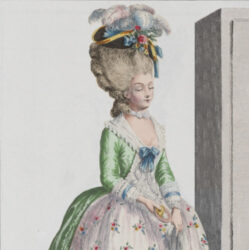
Like all sane, rational people, every time I came across this sketch of Marie Antoinette in a redingote I thought, “Wow, I need to make that.”  I didn’t have any firm plans, however, just a general wanty-ness.

Drawing of Marie Antoinette, about 1785, ink and color on paper, Artist unknown
From Lofstad slott, Norrkoping, Sweden. From the blog Fashion Is My Muse.

Similarly (and somewhat weirdly), every time I walked past this Victorian house down the street, I always admired the color combination of cream, white, and black, and thought that it would be great for a costume.

Color scheme inspiration -- cream, white, and black

But it wasn’t until Leia was selling a bunch of yards of the silk/wool blend that she used for her riding habit (which I LOVE LOVE LOVE) that it all came together, as I was thinking of what to do with that fabric that wouldn’t end up being a copy of Leia’s habit (which, have I mentioned? I love).  So we were off and running…

Now, the original drawing sometimes reads as cream, white, and black to me, and other times as just white and black, but I was happy to read that the color is probably a later addition to the drawing.  Not that it would matter, just that it lets me let myself off the hook for possibly not doing it 1000% RIGHT.  I’ve always thought the brown fur detracted from the color scheme, so I’m going to make that element black.  Just cause I wanna.

One other tweak I want to make is that from what I can see of the drawing, it’s being worn over one of those relatively wide hoops that are one full garment and cross in front and back of the body (like this one).  I don’t love that look, so I’m going to use my standard pocket hoops and call it good.

So out came the dress form and the stays and I started draping!  I referenced a number of different extant redingotes for seamlines, including this one from the Palazzo Mocenigo, and this one from the Fastes de Cour exhibition/book.  Here’s the drape and mockup; I didn’t bother fitting the center back pieces below the waist, since that section doesn’t matter for fitting!

History of Patches & Regency Court Costume

Two random links of interest!

Madame Isis has posted a fabulous write-up on the history of the beauty patch covering the 16th to the 20th centuries on her historical toilette blog.

Reading Natalie Garbett’s post on on studying and producing historical costume referred me to the free Chateau de Malmaison (the former home of Empress Josephine) costume app, which has some stunning images of Regency court costume.  Did I mention it’s free?