Paris – I’ve been very busy!

Bonjour from Paris!  I’ve been here since Tuesday and already it’s been a whirlwind.  In addition to being on vacation (I leave tomorrow for the south for our two weeks of playing dress-up), I’m also here in France doing research!  See, the research I’ve been doing for years on the robes a la polonaise, turque, and circassienne have been growing and growing.  First they turned into an article that’s coming out this month in Dress (the journal of the Costume Society of America).  But it’s kept growing, and so… I’ve decided it’s a book!

What’s the book about?  Well, partially about what exactly these styles are, how they were cut and what was different/the same about them vs. other dresses of the period.  I’ve been doing tons of research, but I also really need to study more extant dresses and I especially want to take patterns.  So I applied for, and am incredibly excited to have received, some research grants!  I’ve received funding from the Design History Society’s Research Grant, and the Society of Antiquaries London’s Janet Arnold Award (hey, I won a grant in honor of Janet Arnold — how cool is that?).

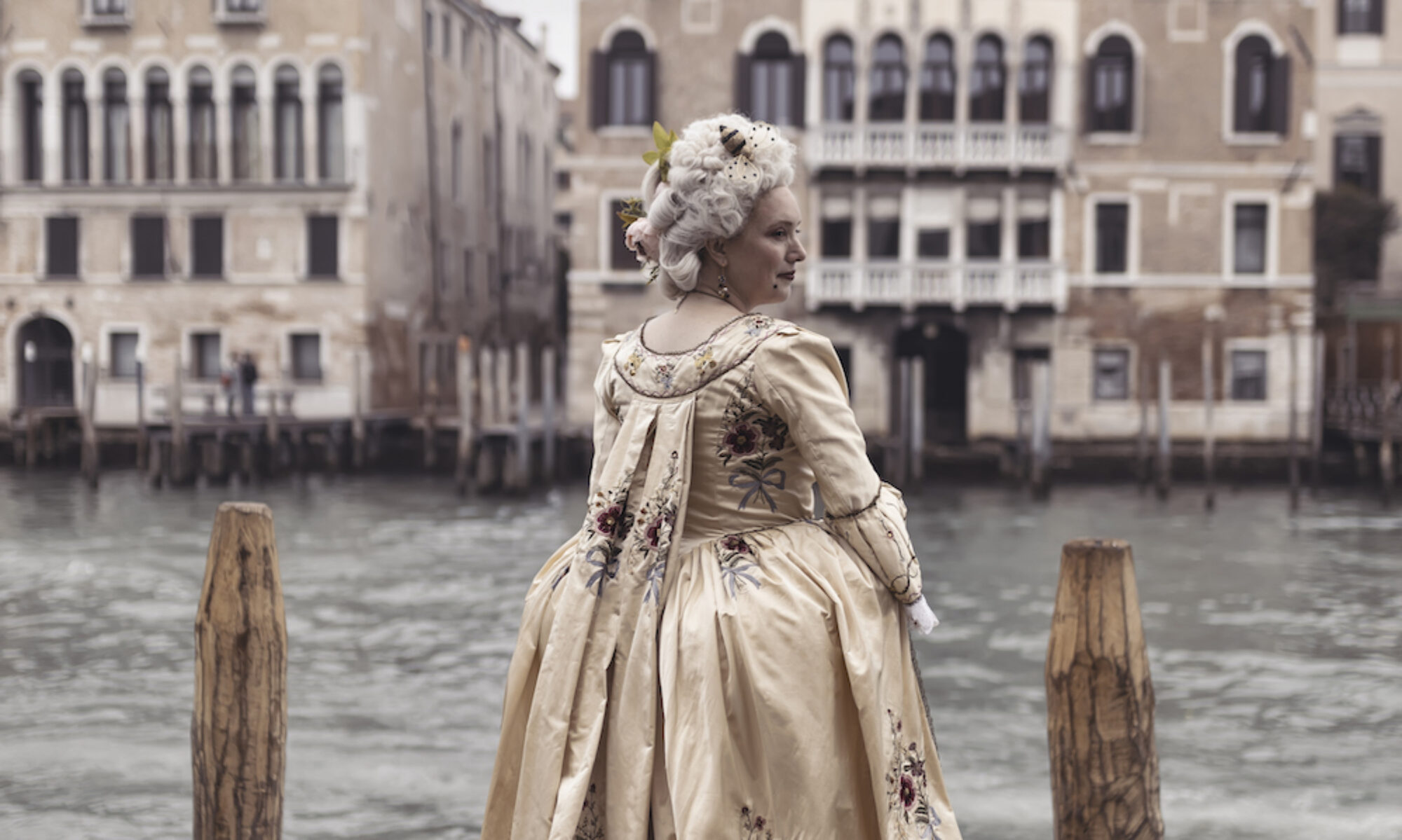
So here in Paris I’ve just spent a day at a half at the Musee Toile de Jouy, a small museum about an hour outside Paris.  The museum focuses on printed cottons and the history of the Oberkampf fabric printing factory.  They have a dress that I’ve studied before, which belonged to Mme Oberkampf (the wife of the owner), which they’ve been calling a robe a la turque but that I have determined was a polonaise longue — a trained version of the robe a la polonaise.  Confusing, because the polonaise was looped up, right?  Well, one version featured the specific cut of the polonaise but had a long train, and that was the polonaise longue.  Here’s a not-great photo of the dress I patterned:

Robe a la turque de Mme Oberkampf (actually a polonaise longue), Musee Toile de Jouy: http://www.museedelatoiledejouy.fr/dynPopup000101b5.html

Then this afternoon, I went to Versailles to the chateau of Mme Elisabeth, the youngest sister of Louis XVI, to see the exhibition that is all about her.  Her chateau is very pretty, the gardens are stunning, and it’s waaaaay less crowded than the chateau de Versailles proper.  The exhibition is really nice, with some great paintings of Elisabeth, Marie Antoinette, Louis XVI, and more, plus personal objects of Elisabeth and related people.  And, best of all, there’s a room with about 8 costumes on display, including this tambour embroidered stunner that I think I’m going to have to make, now that I’m a tambour-ing demon (more on that shortly, I promise!):

Caraco et jupe, 1775-1785, Musee Galliera. Image courtesy of Madame Elisabeth, Une Princesse au Destin Tragique exhibition website: http://elisabeth.yvelines.fr/oeuvres-et-lieux/caraco-et-jupe/

Okay, I have more to write about but I’m exhausted (jet lag!) and I have to get up really early for my train to the south, so more soon!

State of the Sewing – France Prep!

So I haven’t been blogging lately (obviously) — partially because I’ve been too busy, and also partially because I’m feeling like the dress diary is over.  There are so many costume blogs these days that I think it’s hard to keep up with them all, and I don’t get much feedback on my own dress diary posts, so I’ve been thinking of doing more wrap-up posts — here’s what I made and here’s how I made it.

But since I AM sew-sew-sewing for France, I wanted to show you where things are!

First off, the camisole à la polonaise is almost done.  I had a bit of quandry when it looked like I didn’t have enough of the contrast windowpane fabric to do skirt ruffles, but I managed to find a piece I’d forgotten about and have eked out enough.  Just need to gather and attach the hem ruffle, and I want to make a couple of sets of different color bows (I’m thinking green and lavender) to wear at the neckline and sleeves.

I’m working on a gazillion things simultaneously, which is kind of nice in that when I get sick of one thing I can put it down and pick something else up.  Here’s the robe à la turque, which turned into a robe à la circassienne once I realized how impractical a white silk satin gown was with a train.  This was a particular adventure because I decided to drape it on my dress form using the fashion fabric.  A great idea, except when you’re dealing with $40/yd fabric.  Yeah.  There were some screw-ups and fabric wastage.  I’ll give you the long version when I write my “how I made it” post!

Finally, there’s the redingote, of which I don’t have an up to date photo.

I still have LOTS of fiddly bits to do — sleeves to set, 10 million buttons to make, plus I am embroidering away on Francis’s waistcoat… And I want to style a new wig, and make at least one hat.  I’ll try to post more pics in a day or two!  Luckily I’m off work as of tomorrow, so I have 1.5 weeks to finish sewing, pack, and get generally organized.  EEK!

There’s also some important news to post about my research, but I’ll save that for another post….

Your Hot 18th c. Boy of the Day

Something I’ve been doing over on Livejournal is sporadically posting photos of Your Hot 18th Century Boy of the Day.  My friend Bridget suggested I start doing this on my blog, so as to share the hotness!

So without further ado, let’s get things started with:

Portrait of the chevalier Lukas Schaub by Hyacinthe Rigaud, 1721. Original is at the Kunstmuseum, Basel. Image from Wikimedia Commons.

A Useful Fitting Example?

I was starting yet another simultaneous project (this 1778 robe a la turque, more details to come soon) and realized that what I was doing could provide a useful example of fitting.

When I first started doing costuming, I was working from commercial patterns, as so many of us do.  Fitting, particularly bodices, was so annoying, and I usually went for “good enough,” getting the bodice to be close to my waist and bust measurements and not worrying about wrinkles and weirdnesses beyond that.  As I started doing more sewing, I heard various people advise, “Just listen to what the fabric wants to do,” and I found that SO annoying.  What do you mean, “listen to the fabric”?  The fabric isn’t talking!  How the hell am I supposed to know what it wants to DO?  I’m not psychic!

When I learned to drape (a bit through a workshop, mostly self-taught), a lightbulb went off in my head — OH, the fabric DOES tell you what it wants to do!  And here’s what I mean:

For this project, I’m making a separate corset (sleeveless bodice — not stays) to wear under the robe, as in the original painting there’s no center front seam (which you’d see on a false front).  It could be a stomacher worn under there, but because the fit of the robe is relatively loose, I don’t want stays showing at the side, so a corset it is.

So I started with the pattern for the underlayer of my proper polonaise.  Initially, I cut out a mockup and sewed it together, and then put it and my stays on my dress form.  The polonaise has a center front seam, and as was frequently done in the 18th century, that CF seam is curved in order to fit the curved front of my body.  Also, the fronts are cut on the bias, which helps the fabric to stretch around a curved shape.

Of course, this mockup didn’t fit when I removed the seam at the center front, because now the center front has to be on the straight.  So what to do?  Initially I just tried taking in the side seams, to see if that could do it.  But I was left with a lot of poochy un-fittedness at the front waist.

So instead, I listened to the fabric.  I ripped out the side back seam, pinned the front on the form aligning the center front, and then smoothed the fabric around the body and let it go whatever direction it needed to to lie flat.  And here’s what I ended up with:

Can you see how in order to make the front fit without a CF curve and bias, the angle of the fabric wants to change drastically?  I could have left things as is, tightened up those side back seams, and lived with a less-than-fitted bodice pattern.  Instead, I needed to change the angle of the bodice front piece, which then necessitated moving the armhole and patching in some fabric along the side waist.

This could be useful to you, because whenever you fit a pattern to your shape, YOUR curves will be different than the curves the original pattern was intended to fit — whether it be a commercial pattern, or a scaled pattern for a surviving garment.

So how can you implement this in your sewing?  Whenever you make a pattern, ALWAYS create a mockup.  Leave tons (I’m talking 5+ inches) of seam allowance on that mockup, and don’t draw around the seam allowances of the pattern — draw in the actual seamlines.  Try pinning the garment together and see if it will follow your curves.  If there’s any weirdness or wrinkling or whatever, pin each piece to your dressform or body (it helps to have a friend here!) separately.  Figure out what is your starting point (usually, the center front, back, or side) and smooth the fabric in whatever direction it will lay flat.  Then, you can adjust any seamlines that have changed and patch in any areas that are missing (I have found that masking tape works beautifully to patch in a new piece of muslin) — just make sure that any patch you use follows the same grainline as your pattern piece, because whether the fabric is on the straight or bias will affect how much it stretches and therefore the fit.

I hope you find this useful, feel free to ask any questions if it’s clear as mud!