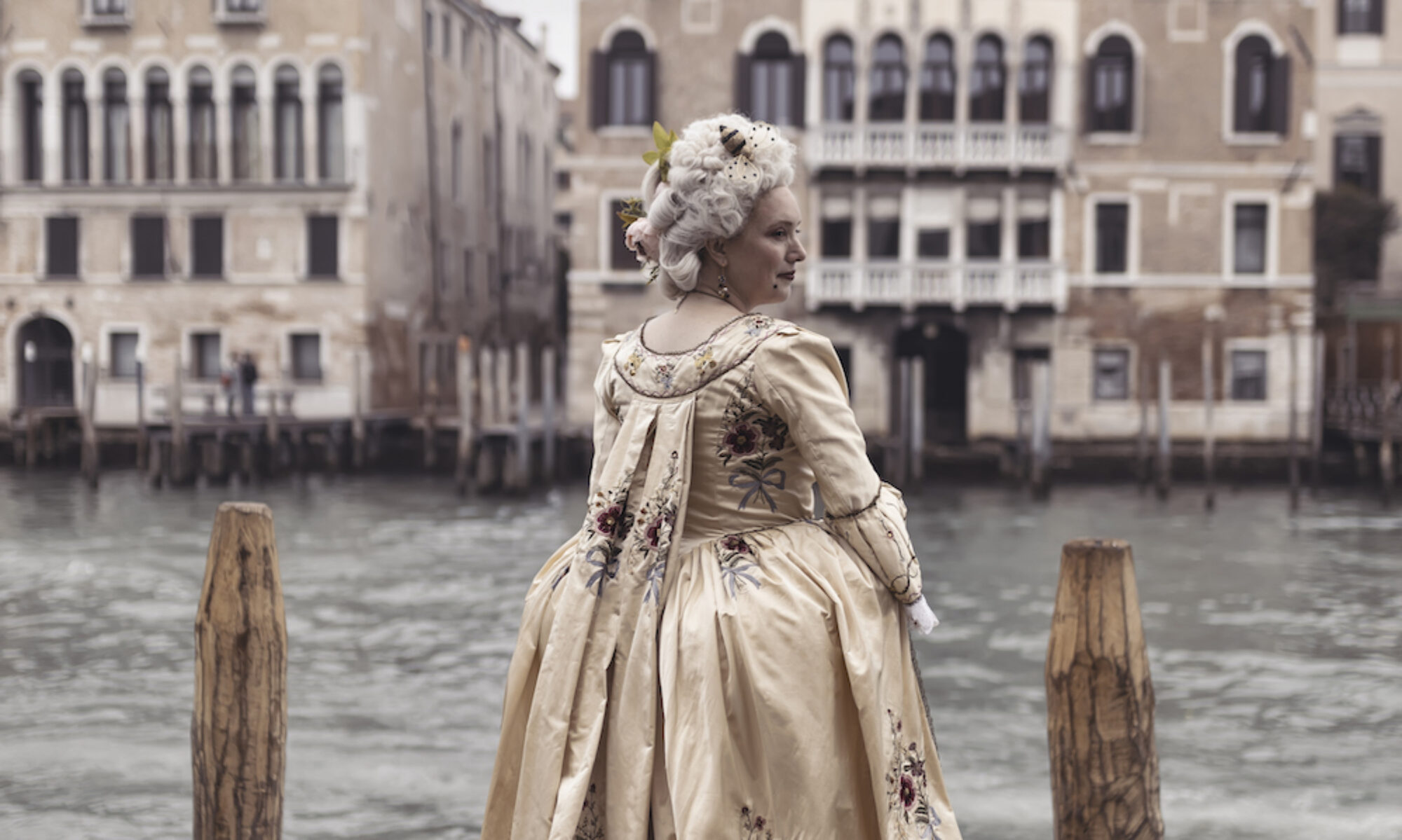
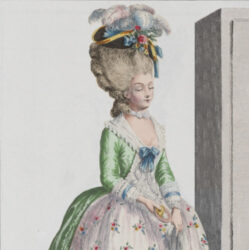
18th Century French Court Gowns – Basics

I thought it would be helpful to those making 18th century court gowns for next year to do some posts about the basics.  My interest in 18th century court wear is in the French styles, so I’ll mostly be blogging about those, but I’ll try to include some info on what was worn in other countries (and link to your posts about these topics, so please feel free to post away!).

By the 18th century, women’s court dress had become standardized, with women wearing clothing that was different from the current fashion.  The styles were based on fashionable attire from the late seventeenth century, which King Louis XIV preferred.  This style remained required for formal court occasions until the end of the eighteenth century, when things changed… but that’s another post!

So what did French women’s court dress look like for most of the eighteenth century?  The grande habit was composed of three elements:  the grande corps or corps de robe, the jupe, and the queue.

The Grande Corps/Corps de Robe

The “formal bodice” or “dress bodice” was a boned bodice (in other words, no separate stays — the boning was built into the bodice) with a high off-the-shoulder neckline and a pointed, tabbed waistline.  The sleeves were elbow length and made up of pleated lace, with short wings on the top of the armscye.

Swedish Queen Sofia Magdalena's wedding dress (1766) is based on the French style. Here you can see the essentially 17th century cut of the bodice, and the pleated lace sleeve.
Interior of Sofia Magdalena's corps de robe, showing the boned foundation | image via themendedsoul.wordpress.com

The Jupe

The “skirt” was wide and worn over huge paniers.  I’ve seen references to “medium paniers” and “large paniers,” so obviously there was some room to maneuver (ha ha).

Wedding dress of Edwige Elisabeth Charlotte, Queen of Sweden

The Queue

The queue was an immensely long train, separate from the skirt, that attached at the waist.

The train on a doll's French court costume at the Fashion Museum, Bath | image via blog.catherinedelors.com

As you can guess from the Swedish dresses, French court dress provided the prototype for court dress across Europe… but some countries (most notably England) wore different styles.  More on those, and the fiddly aspects of the French styles, in the coming weeks/months!  This is just a primer.

Sources

Fastes de Cour et Ceremonies Royales:  Le Costume de Cour en Europe, 1650-1800

20,000 Years of Fashion The History of Costume and Personal Adornment by Francois Boucher

Isis’ Wardrobe:  How to make a robe de cour in six weeks and hopefully not go crazy, part 2

Another Digital Exhibition: Royal Danish Costume

Kongedragter is an online exhibition that features one outfit for each Danish king or queen, from Frederick II (1559-1588) to Margarethe II (1972-present).  Unfortunately, Margarethe’s is the only female outfit included, but still… if you’re into men’s costumes, there’s some really nice stuff in there!

If you’re like me and don’t speak Danish, click on the photo of a king/queen from the top right thumbnails. Wait a second and the clock will turn into an image of an ensemble, which you can then zoom (magnifying glass), rotate! (loop-y arrow), and get info about (“I”).

18th c. Court Costume Book Now Available

If you’re interested in buying the catalog for the 18th century court costume exhibit discussed below (Fastes de Cour), it’s now available at the cheapest price here from Amazon.fr. Yes, the interface is all in French, but the layout/buttons are exactly the same as the English language version, so it shouldn’t be too hard to figure out — and you can sign in to your Amazon.com account and it will pull up all your info. (Random site note: adding tags to this post to see if those are useful; if so, I’ll eventually go back and tag older entries too.)

Court Fashion Exhibit at Versailles

If you don’t live anywhere near Paris, be depressed with me that you are missing what looks like one of the more fabulous costume exhibits ever: Fastes de Cour: Le Costume de Cour en Europe, 1650-1800, currently on exhibit at the Chateau de Versailles. The website is fabulous, I’ve just ordered the catalogue, but I am still depressed. I am even more depressed to miss the symposium in early June. Do check out the website. Make sure you zoom the pictures. Le sigh.