Books to Pre-Order (Woot!)

There’s nothing like knowing that a Really Good costuming book is coming out.  Having FOUR to look forward to?  I may need a chaise lounge and a fan!

[Full disclosure – I’m an Amazon Associate, so the links to the books below take you to Amazon and will give me like $.02 (and support this site) if you buy from them.  If you’d prefer not to support this site, don’t buy from these links!]

First, there’s Fashioning Fashion: European Dress in Detail, 1700 – 1915 (coming out Sept. 1, 2010).  This accompanies the Fashioning Fashion exhibition (Oct. 2, 2010 – April 3, 2011) at the Los Angeles County Museum of Art (LACMA).  LACMA recently acquired a HUGE collection of European costume from the 18th century through the early 20th century, and this exhibition will feature this new acquisition.  According to their website, “Highlights will include an eighteenth-century man’s vest intricately embroidered with powerful symbolic messages relevant to the French Revolution; an evening mantle with silk embroidery, glass beads, and ostrich feathers designed by French couturier Émile Pingat (active 1860-96); and spectacular three-piece suits and gowns worn at the royal courts of Europe.”  I’ve seen a sneak preview of just one of the 18th century dresses, and it is to DIE for.  Thanks to Kim for the heads up that at the same time as this exhibition, they will also be exhibiting a number of paintings and sculptures from big names like Boucher, Vigée-Lebrun, and Fragonard.  YAY!  Finally something SUPER exciting happening on my side of the country!

Then on Nov. 1, 2010, our friends the Victoria & Albert Museum will be releasing Underwear: Fashion in Detail and Toiles de Jouy: French Printed Cottons, 1760-1830.  The Underwear book is another in the Fashion in Detail series, and will highlight the V&A’s collection with incredibly detailed close-up shots.  According to the book description, they’ll be including garments “from rare 16th-century examples to Dior’s curvaceous New Look, to Calvin Klein’s notorious briefs.”  Toiles de Jouy will be of interest to 18th century costumers — I don’t know too much about the book, but since it’s coming from the V&A, it has to be good!

Finally, on April 1, 2011, the V&A will do it again with Seventeenth-Century Women’s Dress Patterns: Book 1 (thanks to Catherine for the heads up!).  I’d heard a while ago that they were working on a book related to 17th century costumes — they’d taken down some pieces from exhibit for the book — but I’d forgotten about it until Catherine emailed me yesterday.  According to the book description, “This breathtakingly detailed book presents dress patterns, construction details, embroidery and making instructions for fifteen garments and accessories from a seventeenth-century woman’s wardrobe. Full step-by-step drawings of the construction sequence are given for each garment alongside photographs of the objects and the groundbreaking use of x-ray photography revealing the hidden elements of the clothes, the precise number of layers and the stitches used inside.”  I am SUPER excited about this, after making my Nell Gwyn dress (altho I’m also grumbly, because how helpful would this have been?).  Oh well, I’ll just have to make another 17th century gown!  I’m also excited about the “Book 1” in the title — does this mean we can anticipate MORE 17th century costume books from the V&A?  Be still my beating heart!

England Trip Report #3: Costume Museum Fiesta!

So I have been to the UK many times — I studied abroad in Scotland in college, and I’ve probably spent a combined 3 months in London.  Which means that while I’ve done most of the London museums multiple times, I haven’t spent much time in England beyond London… which means that there are many interesting costume museums I’ve never visited!  Which is all to say that a large point of this trip was to hit some out of the way museums.

I did go to the V&A to meet up with Kate, Christina, and Leia.  Leia had never been, so we did go through the costume wing, but we spent more time in the new Medieval & Renaissance galleries and in the Textile Study Room.  There was lots that was interesting, but highlights for me included seeing this Florentine bust in person — it is great to see a 3D view of mid- to late-16th c. Italian fit. There’s a nice curve to the bustline, and the neckline comes up past the bust point… and check out the waistline wrinkles, consistent with a bodice that’s stiffened with heavy fabric but not boning!

VAbust

In the Textile Study Rooms, I bypassed the embroidery to look at the printed cottons, but luckily Kate mentioned this pair of mid-18th century jumps. One whole front was there — I think it had never been sewn together? And the teeny tiny embroidery stitches were absolutely to die for — maybe like 20 stitches to the inch?

VAjumps

Blaise Castle House Museum had a couple of nice rooms full of period costume (altho heads up, they had some signs up that they’re working on a [late?] 20th century exhibition – sigh). Probably the best moment was looking at this Charles Worth gown, when some very small (ages 5-6?) children ran in. Boy #1: “Is this what they wore in the Victorian era?” Boy #2: “Yes.” Boy #1: “NASTY.”  My husband and I ran around saying “nah-sty” for the rest of our trip.

BlaiseWorth

I happened to check out the Royal Albert Memorial Museum website, and saw they were doing an exhibit at the Lawrence House Museum in Launceston… otherwise I wouldn’t have known to stop in! This gown, from their regular display, is signed as being from the 1880s, but I say it looks about 1908ish.

Launceston

The special exhibit, “Curious Curves,” would have been very cool if I wanted to try on reproduction period undies (bustles, panniers, etc.), but turned out to only have one extant dress on display — this late Victorian beaded number.

LauncestonCurves

Killerton had a lovely exhibit called, “Elegance,” which included a number of really fabulous items.  These pair of leather 18th c. stays had me peering up close for a while…

KillertonStays

…and this 1770s sacque, with teeny tiny ikat pattern, was just gorgeous in person.

KillertonSack

I was super fortunate to have a study appointment with the curator of Killerton and the Royal Albert Memorial Museum. I was looking at late 18th century gowns, and was super excited to find one in the particular style I’m researching, plus to look at a lot of other pretties.  Unfortunately I can’t post pictures of any of them due to copyright.

I did find out that they recently photographed all of their collection, which will eventually (in a few years?) make its way onto the National Trust website.  I don’t know if this means that other National Trust collections are also being photographed?

Many small museums that I didn’t think of as “costume museums” had period costumes on display. The Sidmouth town museum had this lovely fan front taffeta 1850s dress.

Sidmouth

Chawton, Jane Austen’s home, was really really cool.  REALLY! The jacket is from Mrs. Austen’s riding habit, which was recut by younger family members for fancy dress.  And the quilt on the bed was made by Jane and Cassandra (and Mrs. Austen?) out of dress scraps.

Chawton

Finally, the Winchester City Museum had a display of Tudor costumes recreated by Herbert Norris (author of Tudor Costume and Fashion) in 1908 for a town festival. I thought some of you 16th century costumers might like to see what he came up with!

Norris

All in all, it was a lovely trip, and I’m glad I got to cross so many small but interesting museums off my list.  If you’re interested, you can see the full set of travel photos (including many from museums, but also just my general travel photos too) on Flickr.

England Trip Report #2: What I Wore (and Made)

There was a mad rush of sewing to get ready for the England trip, naturally.

As previously posted, Michael’s doublet was nearing completion but he felt it was too tight.  I thought about piecing in a gusset in the CB, then realized that would just get wonky, so I literally took out the whole back and remade it.  Ugh!  I know I could have made him suffer, but I wanted him to be happy.  I really wanted to make him a hat, and bought the pattern and everything, but the timing was just too tight.  Maybe if he ever wears it again!

Final photos – and by popular request, a ruff (okay, some ruffled eyelet lace) for Sir Winston:

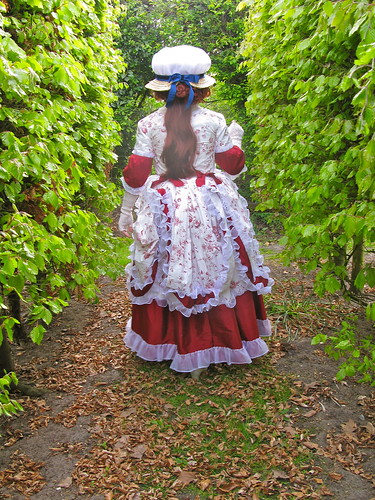
For me, the big project was a c. 1780 robe à la polonaise, which I took pictures of while I was making but totally neglected to do a dress diary… the reason for which will need to be another post! It’s made of red and white printed cotton (a duvet cover from Ikea), trimmed with red taffeta (which was supposedly silk when I bought it in the $7/yd silk taffeta garment district madness, but when Sarah burn tested her fabric, she reported it was not silk – bastards!), and yards of white organza ruffles.  I handsewed most of it, except I hemmed and gathered all the organza ruffles on the machine (hey, I’m not crazy!) except for the bottom ruffle on the petticoat, where the ruffling would show… and I ran out of time, so a lot of the sleeve was done on the machine.  I’m really pleased with it, especially the fit — I’m tired of always being the boobed wonder when I wear 18th c., so I made the neckline pretty cover-y — it might even be TOO narrow, but I’m not changing it now!  I do still need to add some braid to the back seams, but I can easily get that done before Costume College.  I’m thinking I’ll wear this to the Gala unless I get a wild hair to make something new… but that’s another post, too!  I promise to do a full write-up on the dress at some point, but again, more on this subject in another post.

I also remade my 1780s capote to have a poufier top (ie remade it in a couple of layers of silk organza), and retrimmed it as the green scheme made the outfit Christmas-y (I figured blue was complimentary without being matchy).  I used a vintage feather trim that I got at Costume College a few years back.  Finally, I wore the lace knitted mitts that I’ve been working on for a while – a totally modern pattern, unfortunately, as the only period patterns I could find were very butter churn-y and winter-y.

Finally, I did widen the neckline on the medieval gown — it was a rush job the night before we left, so I just put the dress on inside out, marked a wider neckline, cut some bias silk and finished it quickly.  I was worried it would stretch out or do something funky, but it seems to have worked!  I have a LOT of bust in it, but otherwise it turned out to be prettier than I’d thought and I had fun swanning about in the bluebells in it.

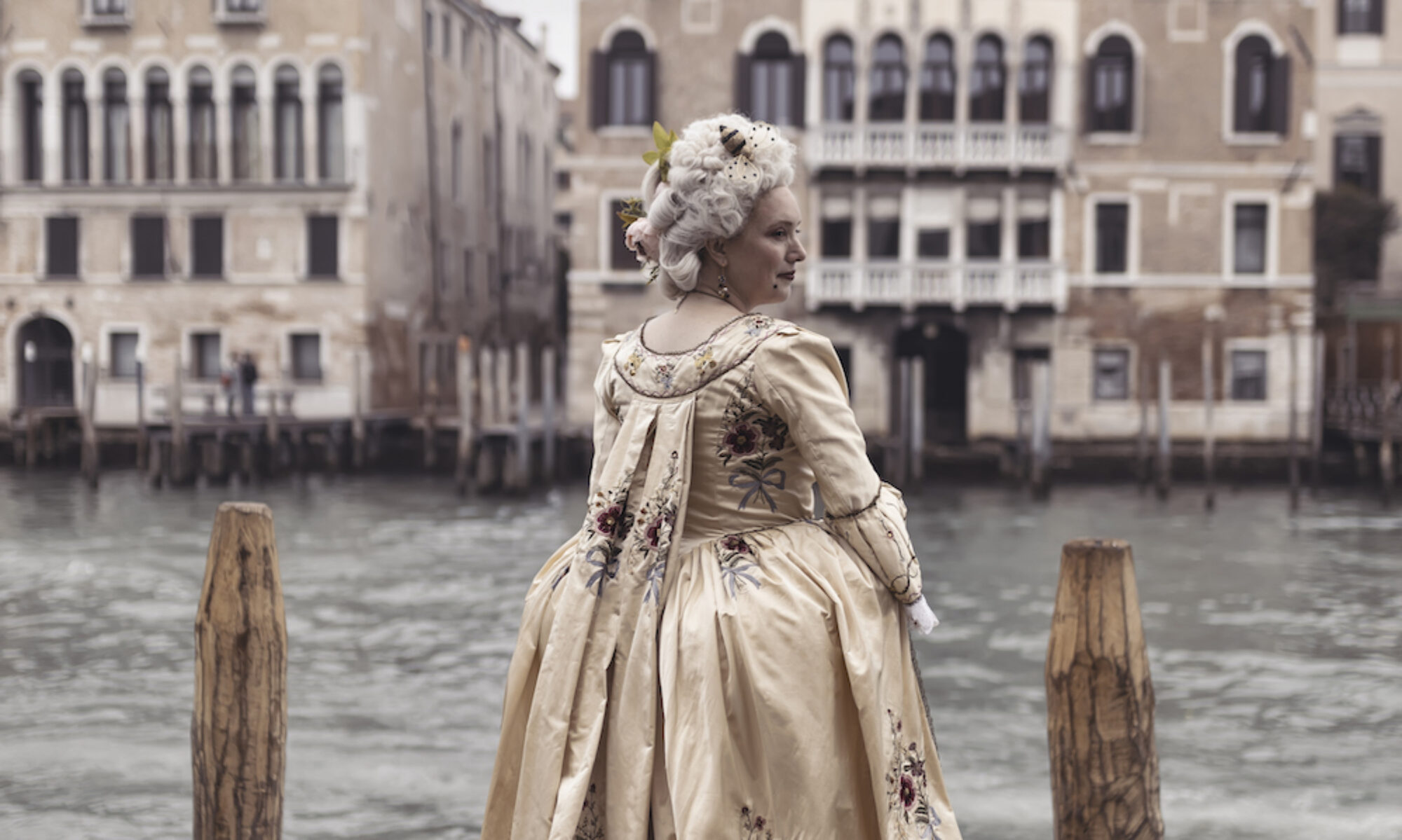
Oh, and I wore my green Venetian, but that’s very this-old-thing to me these days!

Doublet Nearing Completion…But I Need Advice!

Doublet!  I made one, and shockingly quickly too!  After procrastinating all Spring Break (ie working on something for myself), I forced myself to pick up this project.  Luckily I’d already done one mockup & fitting, so I was able to get most of this done in about two days.  I shock myself!  And I actually kind of enjoyed it, because I felt like I knew what I was doing.  The handwork took a bit longer — adding trim that I couldn’t machine sew on, putting in the lining.  But that’s stuff I can do on the couch on a weeknight.

But there’s an issue… I put this on Michael, and he said (very nicely), “It’s too tight!  It feels like a suit jacket that’s 1-2 sizes too small.”  Now, I have NO idea what it should feel like to wear a doublet, so I don’t know if I screwed something up or whether this is just an issue of a man who has never worn costume before (okay, he’s worn 1920s but that’s totally different).  Any guesses?  There are some wrinkles going from the front of his armscye to his underarm, so I was thinking I could open up the armhole more (UGH THE WORK!), but won’t that just make things tighter by having a bigger armscye?  I had him lift his arms up as high as he could go, so you can see his arm movement range… the back looks good – no real wrinkles – altho I’m guessing that’s where the “too small” comes in.  I could piece a strip in to make the doublet itself wider by piecing something next to the arm (UGH THE WORK), but is that even going to help?  And, is this a problem that needs fixing?

Ham Pants!

One random thing I do is make up dorky songs.  Mostly these get sung to the critters, but sometimes they are sewing-related.  This is relevant because I came up with a song about “ham pants,” and thus Michael’s trunkhose got their name.  (Okay, they were Ood Pants for a while, because the panes were very tentacle-y, but now they’re Ham Pants).

So, uh, yeah, I’ve worked on these.  A LOT!  Boy clothes are boring, I have decided.  Although I am having crazy thoughts of making some super over the top 18th century man’s outfit for myself and cross-dressing, just because 18th c. men’s clothing is fab and when will I ever have a chance to make it?  But now I am off topic.

So I made Michael’s shirt a loong while ago, working from the Tudor Tailor book.  All very easy, rectangular construction, except for the fact that the collar was about .5″ too small, so I cut a new one and somehow brilliantly cut it even SMALLER, so ended up making/attaching the collar 3 times.  Someday it will get ties at the neck and cuffs.  It will probably never get a hem (hey, I often leave my shifts unhemmed, so it’s standard practice!).

But the trunkhose were made using the Tudor Tailor sized patterns, which are EXPENSIVE given the exchange rate.  They really need a US supplier!

And let me tell you about this pattern.  It was drafted very nicely — all the pattern pieces matched up and went together.  Fitting the pants was relatively easy, as it was just a matter of fitting the fitted lining, then extending the length on the various pattern pieces to match (my husband is 6’5″).

BUT:

1. The pattern sheets are HA-UGE.  I mean seriously, ridiculously, crazy huge.  I took a picture to show you how it basically covered 1/2 of the square footage of my sewing room, but I seem to have lost it.  It made tracing off the various pieces a serious pain.  Luckily the doublet is on one sheet, and the trunkhose on two, so it’s not that crazy Simplicity hunt for a tiny piece on a random sheet.  But DUDE, that’s a seriously big piece of paper.

2. Even more importantly, THE INSTRUCTIONS SUCK.  The pattern instructions included with the (scaled, not the book) pattern are exactly the same ones as in the book.  I first looked at them and though, “Eh, no problem.  I’m a pretty decent seamstress, and I don’t usually bother to follow pattern instructions anymore (when I bother to use patterns).”  But this was my first time sewing this garment, and I admit I needed a bit of guidance.  Now, yes I could have gone and read every bit of Janet Arnold and scoured the web, but I don’t think I should NEED to do this in order to make up your pattern.

There are a few more photos vs. the book, but they are faded color copies and are hard to make out.  One photo completely puzzled me until Teresa figured it out, explained it to me, AND I looked at it upside down.  It still makes no sense when I look at it right side up.

Most importantly (and this goes for the book too):  they tell you to do some things out of order.  To wit, in case anyone else decides to make up this pattern from the scaled pattern or the book:  Go ahead and put the darts in the trunkhose lining bottom, but do NOT gather and/or attach the trunkhose lining top to the waistband UNTIL you have figured out the panes length.  Do what I did:  attach the panes at the bottom of the trunkhose lining, then figure out the pane lengths, then gather/attach the trunkhose lining top to the waistband, then cartridge pleat the panes.  Also, I have no idea if it’s because I was making a larger size, but I found that there really wasn’t much fabric to cartridge pleat in the panes.  I mean, I had to gather them, yes, but they basically made waves rather than tight cartridge pleats.  I doubt it’s period, but if I ever made these again, I would just do two rows of gathering stitches across all the tops of the panes, sew that to the waistband; then I would gather the trunkhose lining and hand sew it to the waistband/panes (I think it would be too thick to machine sew; you’ll have to handsew anyway if you cartridge pleat).

Some positives?  Again, all the pattern pieces went together well.  I would personally think about adding some balance marks, but hey, I didn’t need them.

One thing that could go either way:  the patterns are drafted without seam allowance.  This will be great if you work like me, where you make mockups and worry about the seamlines, perfect your pattern, and then add seam allowance — it saved me the step of removing the seam allowance before making a mockup.  But I know that freaks some people out, so I thought I’d note it.

So, they are done, minus lacing holes.  And the husband is super cute, because I put him into his shirt and Ham Pants to check that they were done, and then told him I was done, and he said, “Hey, don’t you have a blog where you post photos?”  So he gets a gold star for volunteering to have dorky photos of himself wearing Ham Pants on the interwebs.  Winston just walked right into the photo and sat very nicely for his portrait, so I had to include him too.

Yes, the Ham Pants(TM) are mostly black, so it’s hard to tell what’s going on here… but they’re done, and minus some loose cartridge pleating, I’d say they’re decently well made.  And I am now SO over boys clothes, and really just want to work on my own stuff (which, I admit, I did last weekend… but more on that in another post!).