Copyright for Costumers

Trystan has written an excellent primer on copyright for costume bloggers that’s worth checking out.  It’s a good rundown on the essentials and can help us all determine what’s legal to post and what’s not.

And while we’re on the topic… I want to boost the signal on one particular portion:  crediting others for their work.  I can’t tell you how many times I’ve seen people post about something online that they’ve made or “researched” and I just KNOW exactly whose work they’ve used — without crediting the person who originally came up with the technique/did the research.  It sucks, because it can make the original maker/researcher feel like not sharing their techniques/research if others are going to essentially appropriate it — take the credit for all that hard work.

Nobody’s perfect, and sometimes we just plain forget, but if you try out somebody else’s technique, drop a mention!  Even if you improved on it; you can say “I started with Jane Costumer’s tutorial, and found that if I did X differently it worked better for me!”  If you draw on somebody else’s research, just add a mention — “Jane Costumer’s article on Obscure Hat from Obscure Town got me thinking…”  One way I like to do this is to have a “Useful Links” section on my project pages — I can just list the sites that I found useful, and I know I’m covering my bases.

Costuming is a small world.  When you DON’T give a shout out to others for their work, we are all thinking, “Wait, hasn’t X done a lot on this?” or “Gee, it sure sounds a lot like Y’s research/method.”  And it looks tacky, even if you didn’t MEAN to take credit for their work, we are probably thinking that you did… so to avoid looking tacky, drop a quick mention and/or link and then you know you’ve covered your bases!

Costume College Teaching Thoughts

I’m trying to decide what to offer to teach at Costume College this year.  Here’s a bunch of ideas — I’d love to hear feedback on what sounds interesting!  Some ideas are fleshed out, some are still rudimentary…

Social History of Hair in England, 1770s-1820s

The changes in English hairstyles from the Georgian to the Regency will be traced, focusing on their social, cultural, and political context. From women’s gigantic “poufs” and men’s wigs of the late 18th century, through the “natural” and classical styles of the Regency, hairstyles underwent significant stylistic changes. These represented shifts in politics and society and served as a locus for debate around issues of gender, class, and politics.

18th Century Court Dress

The origins and developments of women’s formal court dress in France and England from the late 17th century through the early 19th century.

18th Century Dress Variations

What’s the differences (and similarities!) between a mantua, robe a la francaise, and a robe a l’anglaise?  How did those three main 18th century dress styles change over time?  For that matter, what’s a Brunswick, polonaise, sultane, or levite? Come geek out over 18th century dress! We’ll look at their origins in the late 17th century, trace the major styles throughout the century, and discuss as many of the weird variations that we can fit in!  This class will make far more sense to you if you have a basic idea of 18th century women’s costume, as we’ll be tracing individual styles over time, rather than going through a chronological rundown.

Hand Sewing Some Basic Garment

I keep thinking of doing some half/all day workshop where we hand sew some small basic garment (a partlet would work really well) and in the process learn the basic handsewing stitches and treatments… but I don’t know if this is too basic!

18th Century Patches (or Cosmetics?)

I want to do more research into 18th c. beauty patches, but I don’t know if there’s enough to make a full class, so maybe as part of a discussion of cosmetics?

Lucas de Heere 16th c. costume illustrations

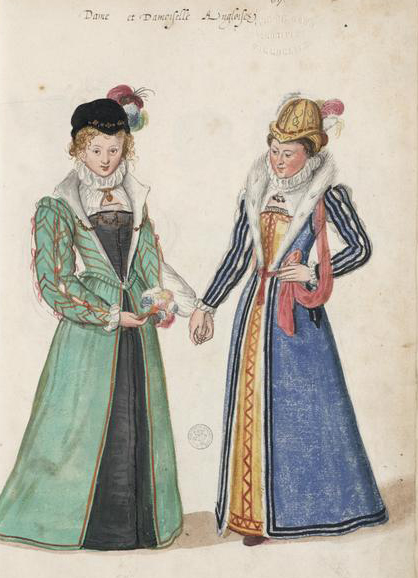
Researchers of 16th century English costume are probably familiar with Lucas de Heere’s sketch of middle and lower class London ladies (discussed here, higher resolution image here).  It’s an important source, given that de Heere is documented as having actually BEEN in England when it was drawn, and it shows the common people.  Most images depicting common people of this era are drawn/painted by people who may never have seen a commoner of whatever-country in their lives.  There are a couple other famous-within-the-costuming-community images by de Heere:  his images of Irish dress and his allegory of the Tudor succession.

About five years ago, I found some further images of Englishwomen by de Heere in a book on the Valois tapestries, but they weren’t the highest resolution and were only in black and white, which started me on a hunt to find more.  It turns out that he published a costume book with a number of images I’d never seen.  I found an online copy of a dissertation written somewhere in the Netherlands or Belgium which included all of the images, but the resolution was TINY.  So, every year or so I’d do some poking around and hope to find an online or print source with usable images.  And today I found it, digitized at the University of Ghent!

There’s a lot that’s in it that I think will be very interesting to 16th c. costume researchers.  The book is a mix of representations of historical and contemporary dress.  Some of the illustrations are probably pretty accurate, and some may be completely made up.  However, there are enough images that are likely to be correct to make it a great source for costume research, and importantly costume books like this often served as models for future painters (ie an artist needed an image of some French peasants to fill out his/her landscape, so they’d copy those peasants out of a costume book).

Here is a link to the bibliographic data on the book, and here’s the scanned PDF of the book itself…. and here are some individual images from the book that I find most interesting!

12th Night, a New Dress, Sarah’s Laurel, and possibly more!

This past weekend was 12th Night for the SCA West Kingdom, and my super good friend Sarah received the Laurel award!  The Laurel is kind of like a lifetime achievement or master-level award in the SCA for arts & sciences; she received her’s for costuming.

Sarah asked me to be an attendant in her ceremony, so both I and Trystan decided to make outfits to coordinate with Sarah’s. Originally she was planning to do 1560s English, and I was all set to make a dress worn in a portrait by Mary I, but then she changed her mind to Florentine. I went through my image files and Moda a Firenze and found myself most inspired by this portrait, which worked perfectly because Sarah’s colors are black and white:

Trystan and I both wanted to distinguish our costumes from Sarah’s, so since she was doing a black veste (overgown) and white sottana (undergown) with sleeves that would show, we contrasted with black sleeves. Don’t ask, I overthought this!

I was super happy to be able to use fabric from my stash – a black silk duchesse satin that I bought on sale about 5 or more years ago and just hadn’t found the right project for yet.  I had promised to sell some of it to Trystan for an 18th c. costume she wants to make, but we did the math and found I had enough fabric for her and me if I made the sleeves out of another fabric.

No, I didn’t blog about the costume, because terminal laziness set in!  I am a bad, bad blogger… try to forgive!

Luckily I had two weeks off around Christmas so I set to work. Here’s a writeup and pics of the final costume, which I LOVED — I felt evil and badass, and I’m excited that I can swap out the sleeves and petticoat for a new look:

(C) Wendi Koble

Sarah’s ceremony was really wonderful and we all got verklempt!  She had a fun vigil (ie party) on Friday night, and the ceremony itself was really beautiful — the choir sung a gorgeous Italian song, there was a parade of SCAdians in 16th c. costumes, and the various people who spoke were really quite touching in their praise of Sarah and her work in the SCA. Yay!

The rest of the day was spent alternately flopping and socializing. I’ve been to two 12th nights before, and I saw even MORE pretties at this one than I have in the past, so I had a lot of fun costume-watching! The evening ended with Trystan and I at the bar creating our own SCA drinking game (don’t ask) and then a PJ party in our room with some peeps. Good times!

I didn’t take TOO many photos — mostly they are from when we were waiting around for the ceremony to start — but here they are!