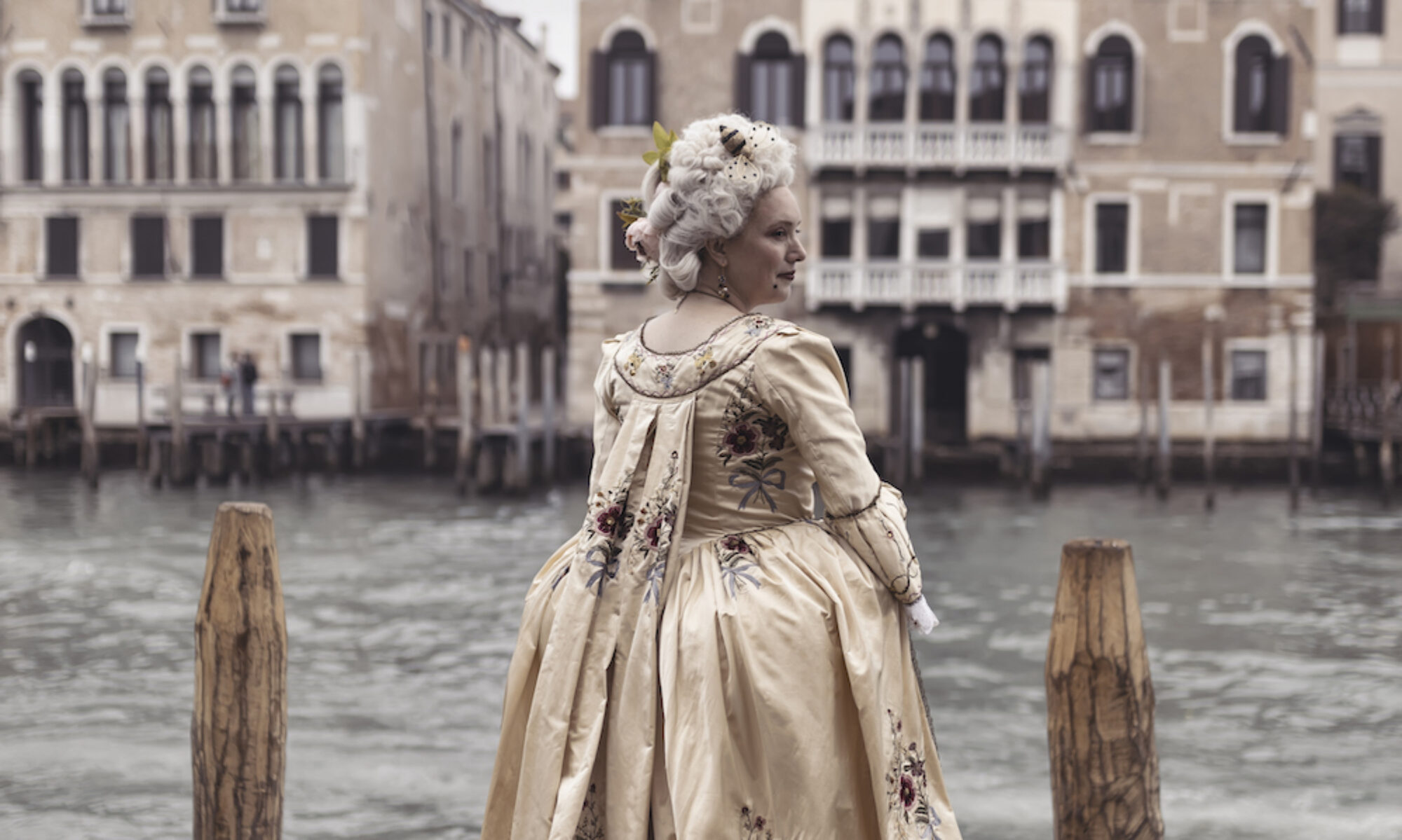
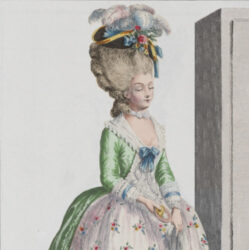
I was starting yet another simultaneous project (this 1778 robe a la turque, more details to come soon) and realized that what I was doing could provide a useful example of fitting.
When I first started doing costuming, I was working from commercial patterns, as so many of us do. Fitting, particularly bodices, was so annoying, and I usually went for “good enough,” getting the bodice to be close to my waist and bust measurements and not worrying about wrinkles and weirdnesses beyond that. As I started doing more sewing, I heard various people advise, “Just listen to what the fabric wants to do,” and I found that SO annoying. What do you mean, “listen to the fabric”? The fabric isn’t talking! How the hell am I supposed to know what it wants to DO? I’m not psychic!
When I learned to drape (a bit through a workshop, mostly self-taught), a lightbulb went off in my head — OH, the fabric DOES tell you what it wants to do! And here’s what I mean:
For this project, I’m making a separate corset (sleeveless bodice — not stays) to wear under the robe, as in the original painting there’s no center front seam (which you’d see on a false front). It could be a stomacher worn under there, but because the fit of the robe is relatively loose, I don’t want stays showing at the side, so a corset it is.
So I started with the pattern for the underlayer of my proper polonaise. Initially, I cut out a mockup and sewed it together, and then put it and my stays on my dress form. The polonaise has a center front seam, and as was frequently done in the 18th century, that CF seam is curved in order to fit the curved front of my body. Also, the fronts are cut on the bias, which helps the fabric to stretch around a curved shape.
Of course, this mockup didn’t fit when I removed the seam at the center front, because now the center front has to be on the straight. So what to do? Initially I just tried taking in the side seams, to see if that could do it. But I was left with a lot of poochy un-fittedness at the front waist.
So instead, I listened to the fabric. I ripped out the side back seam, pinned the front on the form aligning the center front, and then smoothed the fabric around the body and let it go whatever direction it needed to to lie flat. And here’s what I ended up with:
Can you see how in order to make the front fit without a CF curve and bias, the angle of the fabric wants to change drastically? I could have left things as is, tightened up those side back seams, and lived with a less-than-fitted bodice pattern. Instead, I needed to change the angle of the bodice front piece, which then necessitated moving the armhole and patching in some fabric along the side waist.
This could be useful to you, because whenever you fit a pattern to your shape, YOUR curves will be different than the curves the original pattern was intended to fit — whether it be a commercial pattern, or a scaled pattern for a surviving garment.
So how can you implement this in your sewing? Whenever you make a pattern, ALWAYS create a mockup. Leave tons (I’m talking 5+ inches) of seam allowance on that mockup, and don’t draw around the seam allowances of the pattern — draw in the actual seamlines. Try pinning the garment together and see if it will follow your curves. If there’s any weirdness or wrinkling or whatever, pin each piece to your dressform or body (it helps to have a friend here!) separately. Figure out what is your starting point (usually, the center front, back, or side) and smooth the fabric in whatever direction it will lay flat. Then, you can adjust any seamlines that have changed and patch in any areas that are missing (I have found that masking tape works beautifully to patch in a new piece of muslin) — just make sure that any patch you use follows the same grainline as your pattern piece, because whether the fabric is on the straight or bias will affect how much it stretches and therefore the fit.
I hope you find this useful, feel free to ask any questions if it’s clear as mud!