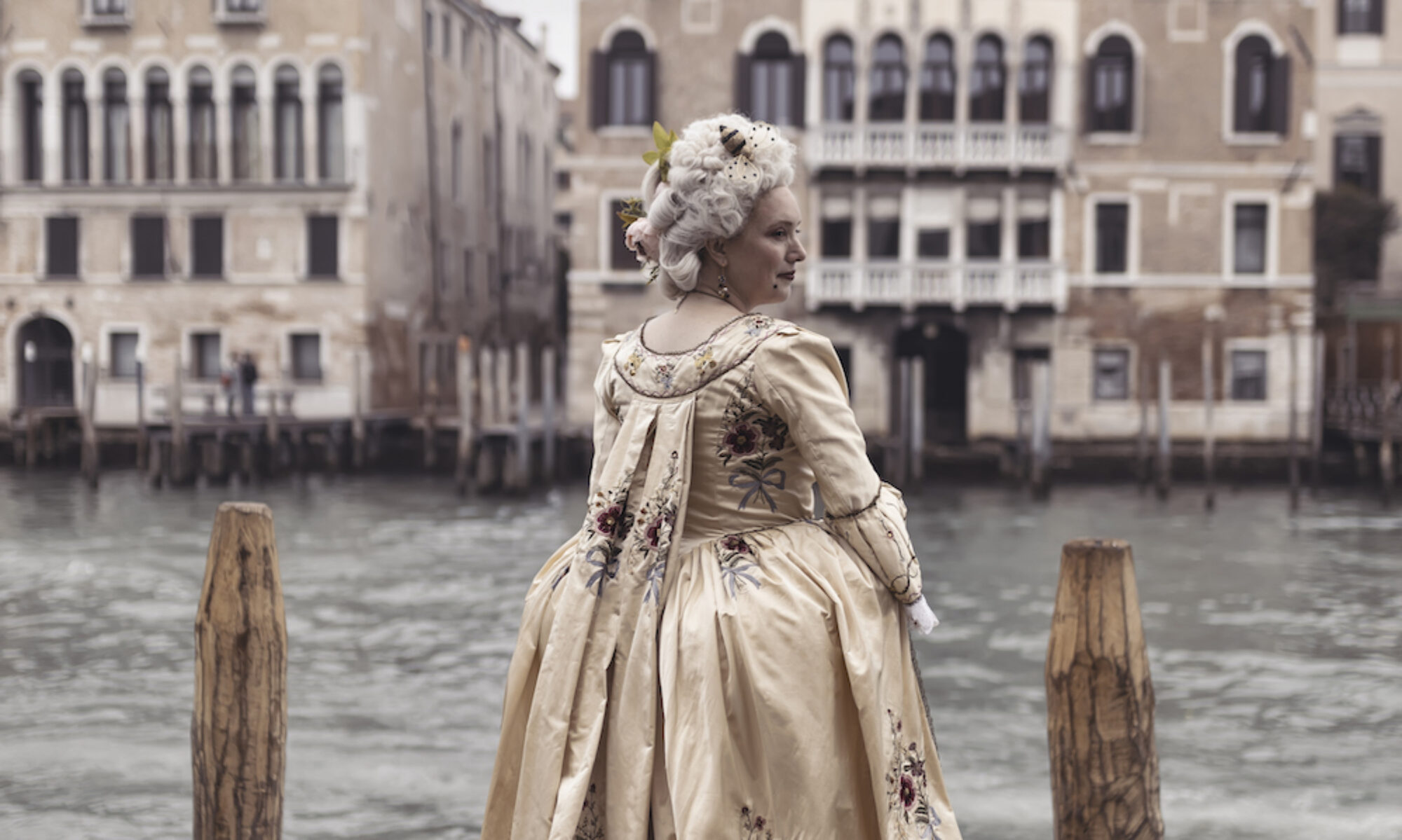
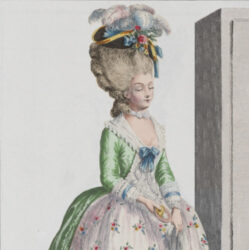
Those who know me know that I have a particular passion: STRIPES! I’m absolutely drooling over this this self-portrait by Rose Adélaïde Ducreux at the Met.
I’m back at work on my 1874-77 afternoon dress, and I’ve FINALLY gotten around to putting up pictures of my 1940’s creations!
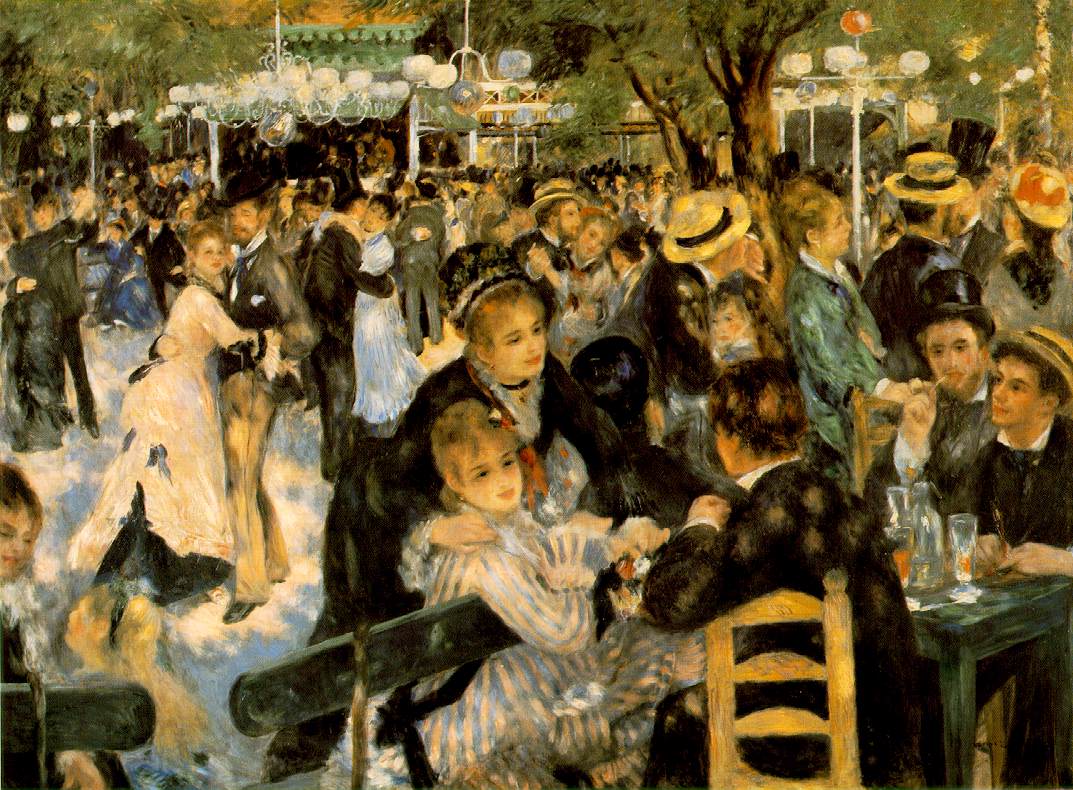
Shopping for reproduction period jewelry? The Musee d’Orsay in Paris offers a number of jewelry pieces inspired by art from their collections at quite reasonable prices! My current favorite is this pendant from Renoir’s Dancing at Moulin de la Galette, Montmartre.
Phew! Life has been far too busy lately, but I’ve finally gotten back on the sewing track. I’m working on a 1943 Simplicity pattern for a wrap dress that’s coming along nicely, so I’ll soon have an excuse to update my 1940’s page. As soon as that is done, I’ll get back to my 1874 afternoon dress — although I think it may become an evening dress instead. Or both.
Saw The Four Feathers last week — some interesting costumes (it’s set in 1898) on Kate Hudson in the eary scenes, although WHAT was going on with her Alice in Wonderland outfit at the end? Terrible!
Lately (the past year or two) I’ve been collecting museum catalogs. I find that they are great resources because they give you specific examples of how a particular dress or item of clothing was put together. You can see construction lines that you can’t see in fashion plates, and see color and texture in fabric and trim. It’s great for seeing how a particular style works in an individual example.
I’ve come across some great finds using ebay and trolling through used bookstores (both physical and online). Recent acquisitions (to use my librarian voice!) include: In Style: Celebrating Fifty Years of the Costume Institute (Metropolitan Museum of Art), Costume (Western Reserve Historical Society), the catalog from the Museum of Costume in Bath (U.K.), and Vanity Fair: Four Centuries of Fashion From the Costume Institute of the Metropolitan Museum of Art (St. Louis Art Museum). I’m on the hunt for a version of Best Dressed (Philadelphia Museum of Art), but since it came out relatively recently (which means there are still a number of copies in circulation) I’m not willing to pay much for it (plus most of it is 20th century).
One that I’m particularly excited about is Modesty to Mod: Dress and Underdress in Canada, 1780-1967 (Royal Ontario Museum), published in 1967, which includes (yay!) scaled patterns for a number of dresses in the exhibition. I think I’m going to use the pattern for an 1894 ballgown bodice for my 1897 ballgown.